
Politicians and VRT unions push back against Belgium’s Eurovision 2027 participation over Israel’s inclusion.
Belgium’s decision to participate in Eurovision Song Contest 2027 which will take place in Burgas, Bulgaria, has sparked considerable controversy. Following the announcement that the country would not join the boycott over Israel’s participation, a number of artists, politicians and public figures expressed their anger and disappointment. The criticism continued even after Flemish broadcaster VRT, which is responsible for Belgium’s participation this year, issued an official statement explaining its decision.






Despite the growing opposition, Belgium’s participation appears to be moving forward. In fact, the country already has artists interested in representing it. Young singer Maëlle Moquet, who is close to Dutch Eurovision 2024 representative Joost Klein, expressed her interest in representing Belgium back in September. Her announcement demonstrates that there are artists willing to take part, despite the ongoing controversy surrounding the country’s participation.
Politicians Criticise VRT’s Decision
Several Belgian politicians have already spoken publicly against the broadcaster’s decision. Former politician and chairwoman Gwendolyn Rutten criticized what she described as VRT’s hypocrisy, pointing out that the broadcaster had previously criticized French-speaking broadcaster RTBF over its position on participation. She also directly addressed Israel’s inclusion in the competition.
“A clear signal against Israel is needed, and when an opportunity is handed to VRT on a silver platter, unfortunately, it fails to take it,”
Rutten stated. Politician Katia Segers described the decision as a missed opportunity. While acknowledging that the final decision rests with the broadcaster, she argued that VRT could have used its position to make a political statement. Addressing Israel’s participation, Segers made her position clear:
“The central question is whether Israel should be allowed to participate, and the answer is clearly no.”
She also pointed to Israel’s strong results in recent editions of the contest, questioning how Belgium would respond if Israel were to win again this year. Flemish Member of Parliament Bram Jaques similarly criticized VRT’s decision, arguing that the broadcaster had an opportunity to establish a clear moral position.
“VRT could have drawn a red line this year. It could have shown some backbone and emphasised that human rights and speaking out against genocide are more important than competing in a song contest that has lost all credibility,”
Flemish Media Minister Defends the Broadcaster
Not everyone agrees with the criticism. Flemish Media Minister Cieltje Van Achter has defended VRT’s decision, saying she understands the broadcaster’s reasoning.
“Over the past few months, I have consistently said that the EBU must restore trust and provide clear answers to the legitimate questions raised by various public broadcasters. VRT evaluated the answers it received and decided to return to the competition,”
she explained. Van Achter also stressed that Eurovision remains an important international platform for Belgian artists.
“It is also an event that brings people together across borders. However, this is not an empty decision. VRT itself has stated that the process is not over. Anyone who wants to see change within the EBU must continue applying pressure at the negotiating table,”
Union Backlash Follows Broadcaster’s Eurovision Decision
Following VRT’s decision to participate, the national broadcaster faced pressure from internal labor organizations. Two major unions, ACR VRT and ACOD VRT, announced plans to strike during the semi-finals and the grand final. According to their statements, the unions aim to protect employees who hold moral objections to contributing to the broadcasts due to Israel’s participation. ACR VRT expressed hope that the broadcaster will reverse its decision, warning that if the broadcasts are disrupted as a result of the strikes, they will stand by their actions.
An Internal Selection for 2027
In addition to the union disputes, VRT NEWS – the official news portal of the national broadcaster – reported that the 2027 Belgian entry will be selected internally. This is not unprecedented for the country, which also opted for an internal selection in 2026 with Essyla, who finished 21st in the final with “Dancing on the ice“. The last Belgian national final took place in 2025, where the country failed to qualify for the grand final. The confirmation of an internal selection further fuels the ongoing speculation surrounding Camille’s potential casting.
Belgium at Eurovision 2026
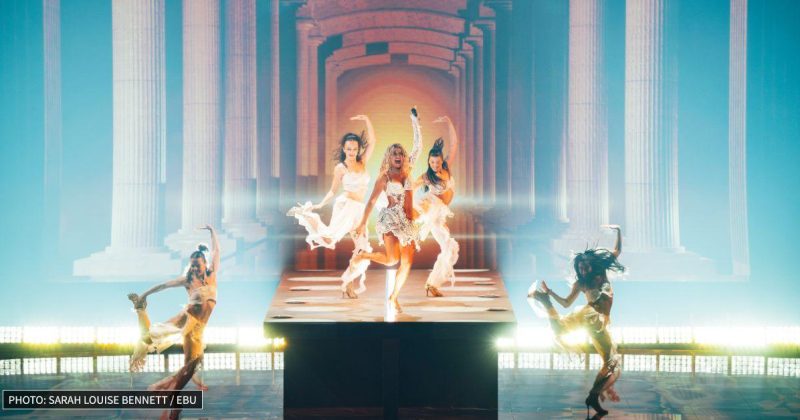
“Dancing on the Ice” is the song that was performed by Essyla, who represented Belgium at Eurovision 2026 in Vienna, Austria. Essyla finished 21st in the grand final with 36 points. The song was written by Essyla herself, alongside songwriter Barbara Petitjean. The song is performed entirely in English.
The lyrics present a distinct “anti-heroine” character – one who declares disloyalty and claims a crown that does not belong to her. The central imagery of dancing on ice where “everything is dead” serves as a powerful metaphor for survival against all odds – precisely within the cold and solitude, the speaker finds her satisfaction and sense of existence. The song creates a sharp contrast between heat and cold, and between pain and pleasure.
Eurovision 2027: This will Belgium’s 68th participation in the contest. Belgium joined Eurovision in 1956 as one of its seven founding nations. The country’s best result came in 1986, when Sandra Kim won first place with “J’aime la vie”.