The Eurovision 2026 betting season has officially launched, with Israel securing the top spot. Sweden and Ukraine follow closely. Where do Montenegro and Albania with their released songs begin their competitive journey? All the details – Right here!
International betting agencies are already opening markets for the winner of the Eurovision Song Contest 2026. To date, only two songs have been officially selected for the competition, representing Montenegro and Albania. Although the season is in its infancy and many representatives have yet to be named, Israel is currently leading the forecasts. This follows a high-profile year where Yuval Raphael secured second place with the song “New Day Will Rise“, an achievement that firmly re-established the nation as a central force in the contest.
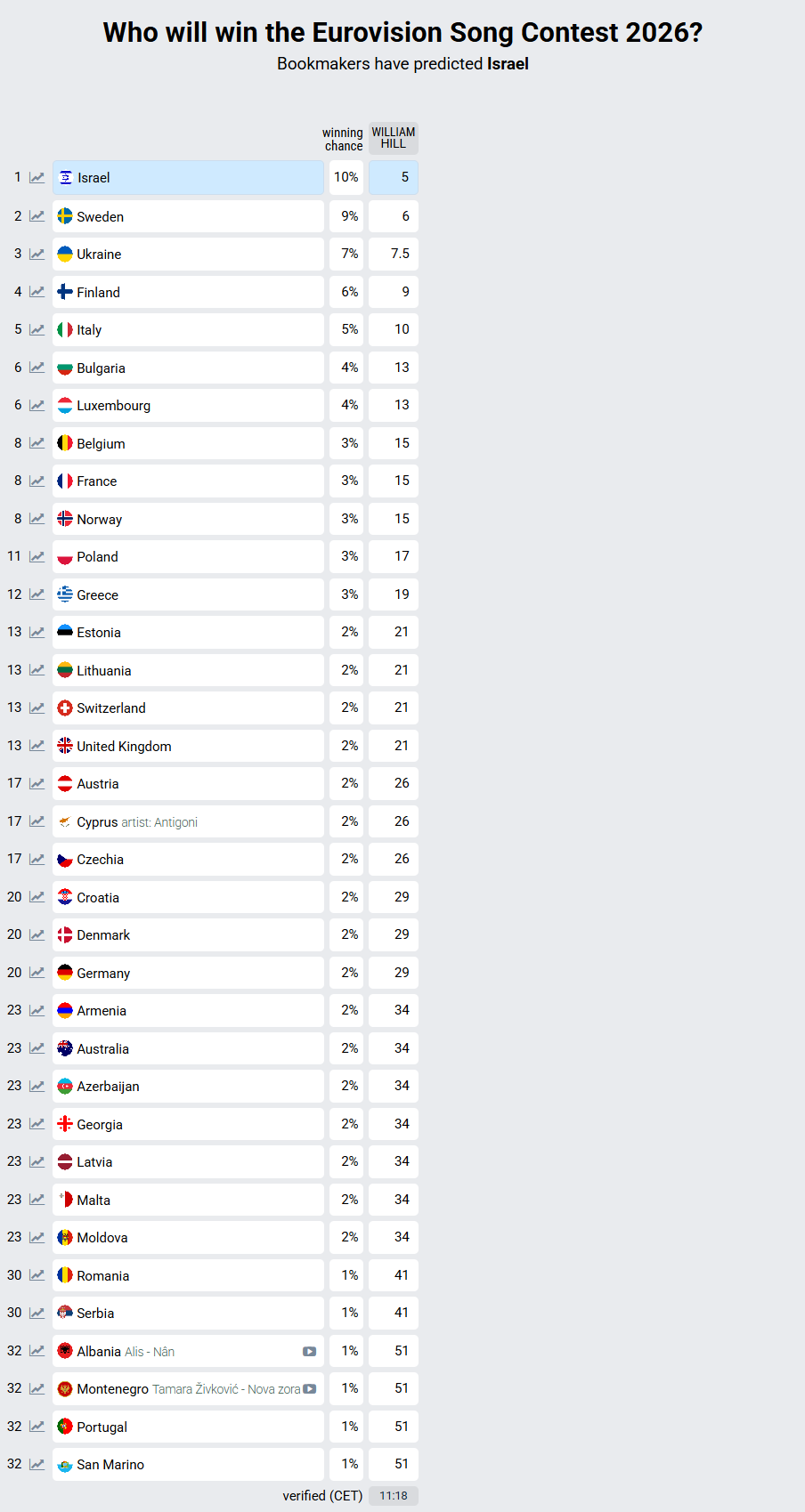
At this stage, the rankings are primarily influenced by William Hill, one of the industry’s largest and most prominent bookmakers. As the season progresses, the list will expand to include additional agencies. Currently, Israel holds the first position, with Sweden in second and Ukraine in third. We have analyzed the current betting table and its significance at this early juncture, especially considering that only two songs have been revealed.






The first entries for Eurovision 2026, set to be held in Vienna, Austria, were recently unveiled. These include the song “Nân” performed by Alis representing Albania, and “Nova Zora” by Tamara Živković for Montenegro. Both entries debuted in a tie for 32nd place. While these positions are low, they are not necessarily indicative of final results, Balkan nations often start at the bottom of betting tiers due to lower initial wagering volumes, despite frequently achieving strong results in the actual competition.
Israel, Sweden, and Ukraine historically some of the strongest Eurovision participants—occupy the top three spots. Their impressive track records of victories and consistent high rankings make them the “safest” bets early in the season.
Courtesy of: eurovisionworld.com
The Significance of Early Betting Trends
It is important to emphasize that betting tables are based on public speculation and financial stakes placed by individuals who believe a specific country will win. At this point, the table serves as a map of expectations, much of which is based on historical performance rather than the current year’s musical content. These odds are expected to fluctuate thousands of times before May.
Historically, these trends offer a mixed bag of accuracy. Two years ago, Israel climbed to the top of the odds before its song was even released, eventually finishing fifth in the Grand Final. Conversely, Switzerland took the lead in April and went on to win. In 2022, Ukraine led the odds following the outbreak of war and maintained that momentum to victory. However, in 2021, Malta led for most of the season but ultimately finished seventh, while Italy surged during rehearsals to take the trophy.
Last year, the opening odds placed Israel in fourth. Despite various shifts that saw it drop to seventh in the betting closing prices, the entry actually achieved a remarkable second place finish. Because we are in such an early stage, these tables should be viewed with perspective, though they remain an essential tool for tracking momentum heading into the spring.
Eurovision 2026: The 70th Eurovision Song Contest will be held in Austria, following the country’s third historic win with the song “Wasted Love” performed by JJ. This will be the third time the contest is hosted in Austria, after 1967 and 2015.

Email: [email protected]
Phone: +972-50-9441919
Writer and content creator at EuroMix, providing cultural insights into the world of Eurovision. Talor is a second-generation Eurovision enthusiast who grew up attending family viewing parties. The 1999 Eurovision, at just five years old, was the event that shaped his love for the contest. He holds a BA degree in Culture – Creation and Production, and his articles combine academic knowledge with a passion for pop and trash, appreciating humor and clever references in the competition’s songs. He specializes in cultural and social analysis, offering in-depth commentary.
Outside the Eurovision world, Talor works as an independent content and media manager.