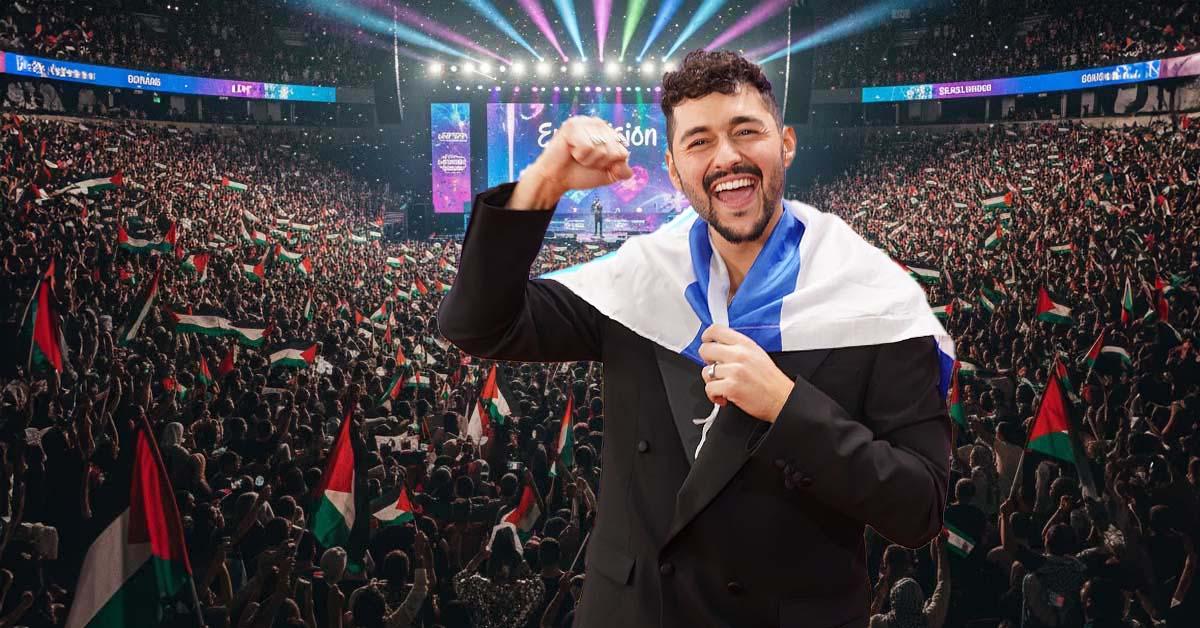
A new Norwegian survey shows that nearly half the public supports a boycott of Israel at Eurovision 2026, while the Winter Olympics faces almost no opposition.
In recent hours, a new Norstat survey commissioned for the Norwegian national broadcaster NRK has been published in Norway, showing that 47% of respondents believe Norway should boycott Eurovision 2026 because of Israel’s participation in Eurovision. At the same time, only 6% support a boycott of the Winter Olympics, where Israel also takes part. The figures place the Eurovision Song Contest at the center of a fierce public confrontation over Israel at Eurovision and sharpen the gap in Norwegian public opinion between cultural events and sporting events.
Eurovision 2026 in the Spotlight: Nearly Half Support a Boycott of Israel at Eurovision
The dramatic gap between the cultural event and the sporting event is particularly striking. While Eurovision 2026 is seen by part of the Norwegian public as a political arena, the Winter Olympics provokes almost no comparable opposition, despite Israel’s officially identical participation.
Israel is competing in the Winter Olympics with ten athletes in various disciplines, yet the public debate focuses almost exclusively on the Eurovision Song Contest.





MGP CEO Responds: “No Fundamental Difference”
The MGP CEO, Mads Tørklep, responded to NRK about the controversy.
“There is no fundamental difference between competing against Israel on a music stage and competing against it on the ski slopes”.
However, he acknowledged that there is a sense of frustration among the Norwegian public. According to him:
“Some believe that Israel has used Eurovision to improve its image and to appear more popular in the voting than it might actually have been”.
Tørklep stressed that the issue has been discussed at NRK and within the EBU, the body that runs the Eurovision contest. “The rules have been tightened”, he noted, referring to the new voting rules and promotional campaigns around Eurovision 2026.
The Figures Have Changed Since November
Despite the drama around Israel’s participation in Eurovision, the current figures are lower than in the previous survey. Last November, 6 out of 10 respondents thought NRK should vote against Israel’s participation in Eurovision during the EBU’s December meeting. Now, the figure stands at almost 5 out of 10. Tørklep said:
“The numbers reflect a snapshot in time, […] In December, there was intense media exposure around the boycott issue. Now public attention has decreased”.
The decline in support for a boycott may encourage actors in Israel. However, the figure remains significant: almost half of the Norwegian public still supports a boycott of Eurovision, a high rate compared with other international events examined in the survey.
Reasons for the Gap Between Eurovision And the Winter Olympics
One assumption is that Eurovision is perceived by the Norwegian public as a cultural and entertainment event in which politics and personal sentiments can influence the vote. For this reason, a boycott of Israel at Eurovision is seen as a symbolic step that does not directly harm athletes or professional competitions, making it easier for much of the public to adopt such a position.
In addition, the Winter Olympics is perceived as a professional sporting event, where athletes’ individual achievements are at the center. Many Norwegians view sporting values as paramount and find it difficult to imagine a boycott that would prevent Israel from participating without harming the athletes themselves. This gap explains why support for a Eurovision boycott is several times higher than support for a Winter Olympics boycott.
Limited Impact of the Boycott
Professor Frode Steen from the Norwegian School of Economics (NHH) in Bergen, a public economics expert who has previously spoken on consumer and political boycotts, said that it is important to distinguish between a moral stance and actual impact. and said:
“There is a difference between the feeling that you are taking a stand and the real impact of a boycott, […] I believe a boycott has little, if any, effect, because Israel will not withdraw from international events just because of a Norwegian boycott”.
Are Norwegians Also Against the USA?
The survey also shows that a considerable proportion believes Norway should boycott the football World Cup that will be held in the United States. Twenty‑two percent of respondents support a boycott. Professor Steen believes that the extensive media coverage of American politics and of Donald Trump explains these figures:
“Naturally, many people are very preoccupied with this. But whether it will actually affect Norway’s participation — that is a completely different question”.
Women and Oslo Lead Support for a Boycott of the Eurovision Song Contest
A breakdown of the data reveals clear gaps:
- 49.5% of women support a boycott of Eurovision 2026, compared with 44% of men.
- Among those aged 70–79, support for a boycott stands at 54.9%.
- In Oslo, Norway’s capital, the highest rate was recorded — 55.2% support a boycott.
The figures place Eurovision 2026 and the issue of Israel at Eurovision at the heart of a sharp public dispute in Norway, at the height of the preparations season for the Eurovision Song Contest, in which Israel is also expected to participate with Noam Bettan as its representative.
Norway at Eurovision 2025
“Lighter” was the song performed by Kyle Alessandro, who represented Norway in the Eurovision 2025 grand final. Norway finished in 18th place overall with 89 points – 67 points from the audience and 22 points from the juries. In the televote, Norway ranked 12th, while in the jury vote, it reached 23rd place.
Eurovision 2026: This will be Norway’s 64th participation in Eurovision. Norway joined the competition in 1960 and has won three times over the years. Their last win was in Eurovision 2009 with the song “Fairytale” performed by Alexander Rybak.

Email: [email protected]
Phone: +972-50-9441919
Ilay Gaist is a leading Israeli content creator and writer specializing in the Eurovision Song Contest. He is a well-known commentator with extensive expertise in the contest’s history, rules, and dynamics. His passion for Eurovision drives him to deliver rich, professional, and innovative content to his audience.
Ilay holds a bachelor’s degree in Arabic and has a multilingual background. He also engages in cultural research, with a particular focus on global culinary traditions and the evolution of local cuisines around the world.