The EBU General Assembly will vote on crucial statute amendments, potentially allowing Kosovo, Canada, and Kazakhstan to join Eurovision 2027.
The map of countries participating in the Eurovision Song Contest is facing one of the largest and most shaking structural changes of the last decade. Zana Spahiu, the Director General of the Kosovan national broadcaster RTK, revealed that dramatic changes to the union’s statutes will be brought up for discussion and voting at the upcoming General Assembly of the EBU. According to the plan, new categories of membership with limited rights will be created, which will pave the way for the participation of new countries in Eurovision events, including Kosovo and Canada.
The Political Obstacle That Blocked Kosovo
Until today, the rules of the contest were particularly strict: in order for a national broadcaster to send an entry to Eurovision, it had to hold full membership in the EBU, or alternatively receive a special and exceptional invitation, as was done in the case of Australia. According to the current statutes of the EBU, a national broadcaster can become a full member of the union if and only if its country is a member of either the International Telecommunication Union (ITU) or the Council of Europe. Kosovo, as is well known, does not meet either of these conditions due to its limited international recognition, and especially due to the stubborn opposition of Serbia, its neighbor.
However, these political and technical obstacles are expected to come up for discussion at the upcoming EBU General Assembly, which will be held in Prague between June 25th and June 26th. The union is considering introducing amendments to the statutes that will allow national broadcasters outside the traditional European Broadcasting Area, or those that are not members of the parallel international organizations, to receive a status of “limited membership”. This step will significantly ease the path for national broadcasters from Canada, Kazakhstan, and Kosovo, which are currently defined as associate members only, to fulfill the dream and join the official competition.
Eurovision 2027: The Dream Overseas and in the Asian Steppes
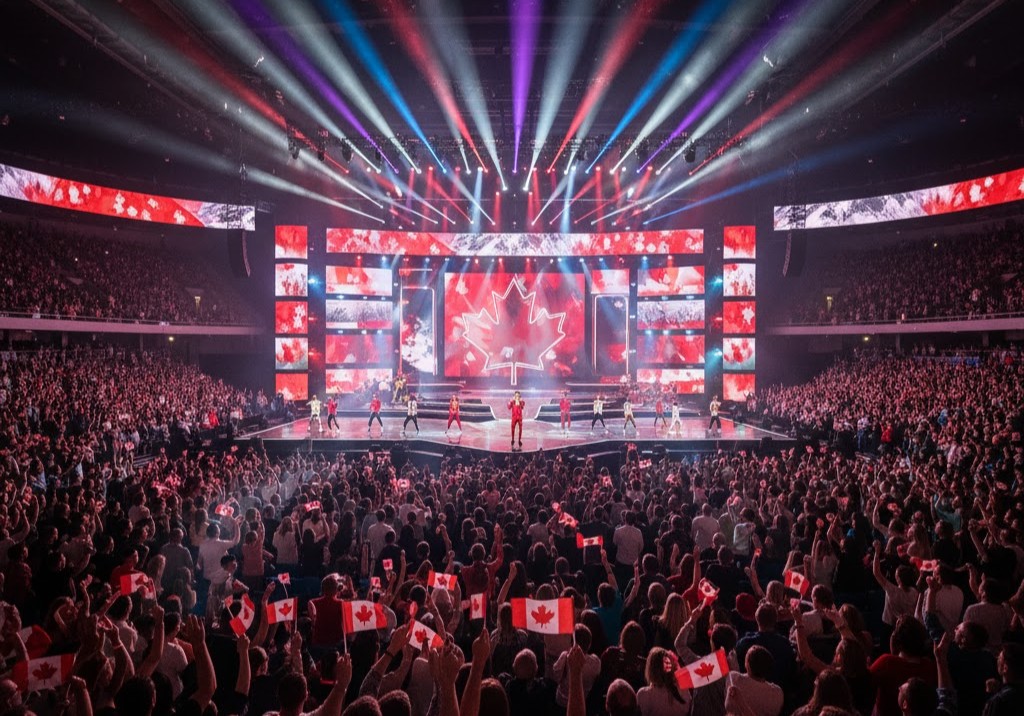
This development is dramatic not only for Kosovo, but also for Canada and Kazakhstan. Both countries have expressed immense interest in joining Eurovision but have been blocked repeatedly due to the lack of permanent and full membership in the EBU. Both currently hold the status of associate members only, which has so far denied them the right of passage to the center stage. In Kazakhstan, the local national broadcaster broadcasts the contest religiously and has even participated several times in the Junior Eurovision Song Contest, but has been rejected repeatedly in its requests to move up to the adult competition.
On the other hand, the story of Canada gained tremendous momentum only recently, when an official delegation on behalf of the Canadian national broadcaster CBC arrived at Eurovision 2026 in Vienna to closely monitor the production of the contest and to hold working meetings with the heads of the EBU. The physical presence of the Canadians behind the scenes in Vienna may signal that the EBU is determined to find the legal formula that will bypass geographical limitations and allow Canada to join Eurovision without the need for full membership.
The Target: Junior Eurovision 2026 in Malta and Eurovision 2027 in Bulgaria
In the circles of the Kosovan national broadcaster RTK, great optimism is being expressed ahead of the vote in Prague. The Director General, Spahiu, hopes that these changes will be approved as soon as possible, which will allow Kosovo to register a first and historic foothold as early as the Junior Eurovision Song Contest 2026, which will be held on October 24th, in Malta.
But the truly big goal lies one year ahead: RTK is aiming for a first official participation on the stage of Eurovision 2027, which is expected to take place next May in Bulgaria. Will the EBU approve the change to the rules of the game and open the door to new members, or will political pressures behind the scenes tip the scales? The answers will be received at the end of June in Prague, and EuroMix will closely monitor and continue to update on every development.
What is Kosovo Waiting For?
The opposition to Kosovo’s entry does not happen only because of technical matters. The international status of Kosovo, which declared its independence from Serbia in 2008, remains controversial. Many of the world’s countries do not recognize Kosovo as an independent state, and Russia vetoes its admission to the UN. Serbia refuses to recognize Kosovo’s independence, and so does Spain. Despite this, 104 countries recognize its independence.
Eurovision Song Contest 2026 was held in Vienna, Austria, following the country’s victory at Eurovision 2025 with the song “Wasted Love” performed by JJ. The competition took place at the Wiener Stadthalle, the largest indoor arena in Austria, with the semi-finals held on May 12th and 14th, and the Grand Final on May 16th. This marked the third time that Vienna hosted the contest, having previously hosted the event in 1967 and 2015.