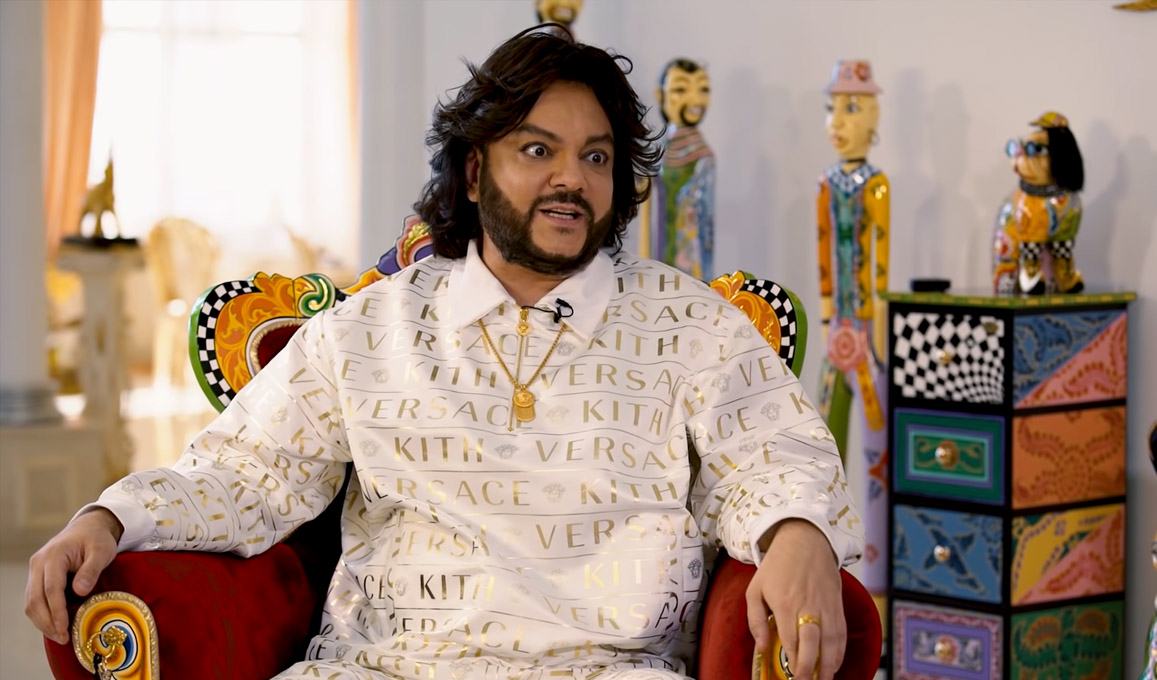
Russian pop icon Philipp Kirkorov claims credit for Bulgaria’s Eurovision victory with “Bangaranga”, sparking fierce denials from the winning creative team.
The historic victory of Bulgaria at the recent Eurovision Song Contest in Vienna continues to make headlines across the continent, but it seems the real drama is unfolding far from the stage. Immediately after the song “Bangaranga“, performed by the singer DARA, captured first place, a media storm erupted in Russia surrounding the true identity of the creators behind the hit. At the center of the storm are persistent claims that the person pulling the strings is none other than a massive star well-known to fans of the contest.





The man at the center of the rumors is Philipp Kirkorov, a Russian singer of Bulgarian descent who has earned the nickname “The King of Russian Pop”. Kirkorov is a particularly colorful and prominent figure in the history of the competition. He represented Russia at Eurovision 1995 with the song “Kolybelnaya dlya vulkana” (in English: “Lullaby for a Volcano”) and reached only 17th place, which is still considered Russia’s lowest achievement in any of the finals in which it participated. However, over the years, Kirkorov returned to the contest numerous times as a songwriter and/or musical producer for Belarus (2007), Ukraine (2008), Russia (2014, 2016, 2019), and Moldova (2018, 2020, 2021). These songs achieved great success and became hits, such as “Work Your Magic” for Belarus and “Sugar” for Moldova.
Beyond his success in Europe, Kirkorov has a warm and special connection to Israel. Although he identifies as an Orthodox Christian, his mother is Jewish, and he frequently visits the country to perform for his many fans there. He was a close friend of the late maestro Swika Pick, and one of the biggest commercial successes of his career is the Russian version he recorded of the song “Diva” by Dana International.
Now, all of Russia is talking about how Kirkorov is actually the “shadow brain” who wrote the winning song for DARA. On several talk shows in Russia and across social media, Philipp tried to take credit for the success and boast about his alleged involvement in the Bulgarian project. These rumors gained momentum mainly due to the fact that one of the official writers of the song is the Greek composer Dimitris Kontopoulos, a close friend and long-time creative partner of Kirkorov for many years. The Russian public was quick to connect the dots and conclude that Kirkorov worked together with his friend on the winning song.
Despite the celebratory claims in Russia, the official team of the song rushed to publish sweeping denials and refute the rumors. As previously revealed, the song began its journey at a writing camp in Bulgaria by DARA, the Norwegian songwriter Anne Judith, and the Romanian producer Monoir. Only at a later stage did Kontopoulos join to polish the creation together with the Bulgarian producer Sanya Armoutlieva. Kontopoulos himself was interviewed and completely ruled out any involvement by Kirkorov, and the other producers also confirmed that the Russian singer was not present in the studio at all or took part in the process.
So why do the rumors refuse to die down? This is where a fascinating hypothesis comes into play. One of the key people on the official team, who was also one of the directors of the winning Bulgarian performance, is Nicholas Chov, who boasts, among other things, Ukrainian origin and citizenship. According to some estimates and rumors in Russia, it is possible that Kirkorov did indeed advise and contribute to the song behind the scenes through Kontopoulos, but the original team is trying to hide it at all costs. The reason for this is simple: a collaboration of a Ukrainian creator or director with the Russian Kirkorov could be perceived as an absolute betrayal of his homeland and lead to the elimination of his career in Ukraine.
The volatility of Kirkorov for any Ukrainian entity is no coincidence. The singer expressed open and declared support for the Russian invasion of Ukraine, a step that made him “persona non grata” in many countries and even caused him to be denied entry to Moldova. Furthermore, Kirkorov himself recently stated in an interview that he has been boycotting Eurovision and has not watched it since Russia’s expulsion from the competition in 2022. According to him, he realized the competition was political and cynical back in 2016, when he was part of the Russian delegation with the song “You Are The Only One” performed by Sergey Lazarev, and claims he lost the victory to Ukraine’s Jamala only because of the jury voting. In the same interview, he even recommended that Russians watch the show “The Voice” instead of the European contest.
Despite the discussed boycott, it seems that the magic of Eurovision is still stronger than him. The same Kirkorov who declared his abandonment of the competition admitted that he “accidentally” happened to watch the French entry and the performance of the Israeli entry, Eden Golan, at Eurovision 2024, and even praised them both. Whether he truly contributed ideas to the Bulgarian hit and the team is silencing it to prevent a serious diplomatic incident, or whether he is simply trying to ride the wave of his friends’ success – it seems the King of Russian Pop is simply unable to release his grip on the Eurovision institution.