Eurovision Asia reveals its first-ever trophy ahead of its Bangkok debut, featuring a colourful design and metallic elements.
The new Eurovision Asia trophy has been unveiled ahead of the inaugural competition in Bangkok, featuring a colourful design and metallic elements that set it apart from the European trophy. Who will be the first to lift it?
The first-ever Eurovision Asia contest is approaching, bringing with it a historic moment: the presentation of the competition’s inaugural trophy. Ahead of the event, scheduled to take place in Bangkok, Thailand, on November 14th, images showcasing the new trophy were shared on social media. The winner will receive the first-ever title in Eurovision Asia history.







View this post on Instagram
The new trophy, which will accompany the announcement of the competition’s first winner, was revealed in photographs published on Instagram. It is an impressive piece that gives the competition an identity of its own and adds to the excitement surrounding its debut. After years in which the iconic microphone trophy has become one of the most recognizable symbols of the European Eurovision Song Contest, the Asian competition will now have a trophy of its own.
Unlike the familiar transparent glass microphone trophy of the European Eurovision Song Contest, Eurovision Asia’s new award features a colourful design incorporating metallic elements. Its distinctive appearance sets it apart from its European counterpart and establishes a visual identity of its own. However, beyond its design, one detail in the photographs caught attention: the organizers appear to have reinforced the trophy’s structure, possibly to prevent it from breaking during the winner’s celebrations. Is this merely a coincidence, or have the lessons of Eurovision’s past finally reached Asia?
The Trophy Curse: When Victory Ends in Broken Glass
Over the years, Eurovision’s famous glass microphone trophy has become more than just a symbol of victory. It has also been the source of several particularly awkward moments. The delicate glass structure has sometimes struggled to withstand the excitement of the winners, with several trophies breaking shortly after being lifted into the air.
In 2009, Alexander Rybak, who won for Norway with “Fairytale”, broke his trophy during a post-victory photo call and press activities. In 2013, Emmelie de Forest of Denmark also had to deal with a broken trophy following her victory with “Only Teardrops”. Five years later, Netta Barzilai, who brought Israel victory with “Toy”, discovered that her trophy had split into two pieces during the celebrations.
Duncan Laurence, who won for the Netherlands in 2019 with “Arcade”, experienced a similar mishap shortly after his victory. In 2024, Nemo from Switzerland broke the trophy on stage immediately after performing the winning song “The Code”, even injuring their thumb in the process. A replacement trophy was handed to them shortly afterwards. JJ, Austria’s Eurovision 2025 winner with “Wasted Love”, also joined the list after his trophy broke during the victory celebrations.
Now, as the Asian competition prepares for its debut, the organisers appear keen to learn from Eurovision’s past and ensure that the historic moment for the first winner does not end with broken pieces of glass scattered across the floor.
Eurovision Asia 2026: When and Where to Watch the Competition?
The inaugural Eurovision Asia Grand Final will take place on Saturday, November 14th, 2026, at the One Bangkok Forum in Bangkok, Thailand.
The competition will be broadcast live on the official Eurovision YouTube channel between 14:30 and 17:00 CET. Viewers will also be able to participate in the voting through the competition’s official website.
To watch the live broadcast on YouTube from 14:30 CET, click on the screen below!
All You Need to Know About Eurovision Asia
The Eurovision brand continues its global expansion with Eurovision Song Contest Asia, launched in collaboration with the European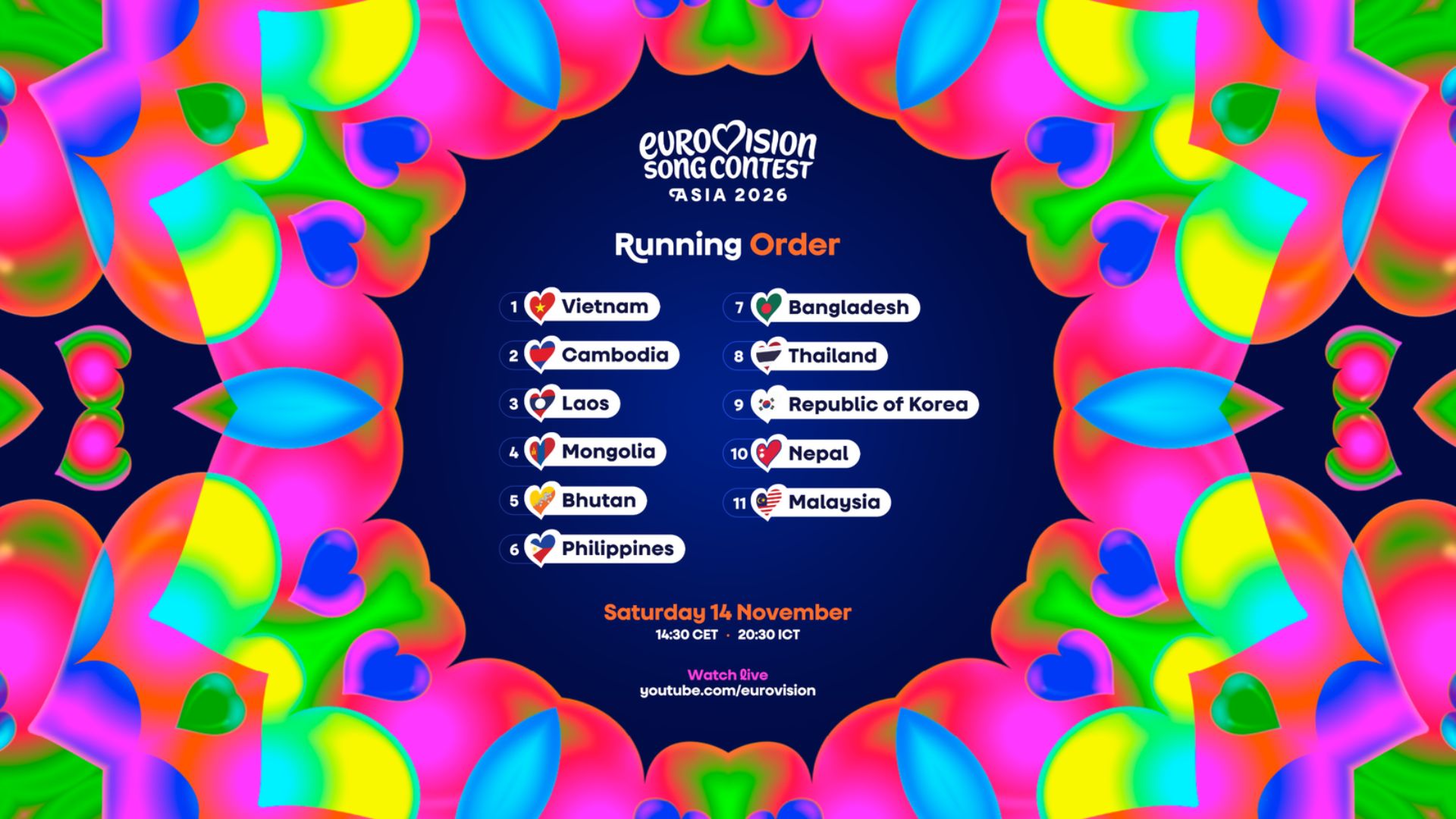 Broadcasting Union (EBU) to mark the 70th anniversary of the original contest. Following the American Song Contest in 2022, which was not renewed for a second season, this new chapter aims to bring the beloved Eurovision format to a new continent and reach a massive potential audience of over 600 million viewers. Unlike the American adaptation that focused on a single nation, this is a large-scale, multi-national competition. The inaugural Grand Final will take place on November 14, 2026, at the One Bangkok Forum arena in Thailand, preceded by a Preview Show on November 13. Hosted by media figures Woody Milintachinda and Cindy Bishop, this historic edition will feature 11 countries: Thailand, South Korea, Vietnam, Philippines, Bangladesh, Mongolia, Nepal, Laos, Bhutan, Malaysia, and Cambodia.
Unlike the European format, the contest in Asia operates under a centralized production model. It is produced by the international production company Voxovation in partnership with the leading Asian production company S2O. This structure subsidizes the selection process in various countries, allowing nations with limited budgets to participate. Additionally, the winning country will not automatically host the contest the following year but will instead be invited to perform as a guest artist at the traditional Eurovision. The voting system has also been adapted for the continent, based entirely on a unified, free digital platform that combines televoting with professional juries, giving unprecedented decisive power to the international audience through the “Rest of the World” voting. Furthermore, ZOOP will serve as the exclusive social partner of the event, enabling fans to take an active role in the digital experience.
Email: [email protected]
Phone: +972-53-9514754
A writer and content creator with a strong specialization in the Eurovision scene, particularly across Eastern Europe and post-Soviet countries. His work highlights the artistry, storytelling, and cultural variety that define the contest, offering readers a deeper look into both established performers and emerging voices.
As a skilled translator and polyglot, he brings a unique linguistic and cultural understanding to his analysis and coverage..