Ahead of the Grand Final, Eurovision Asia’s voting system is revealed! Discover the platforms and differences from traditional Eurovision.
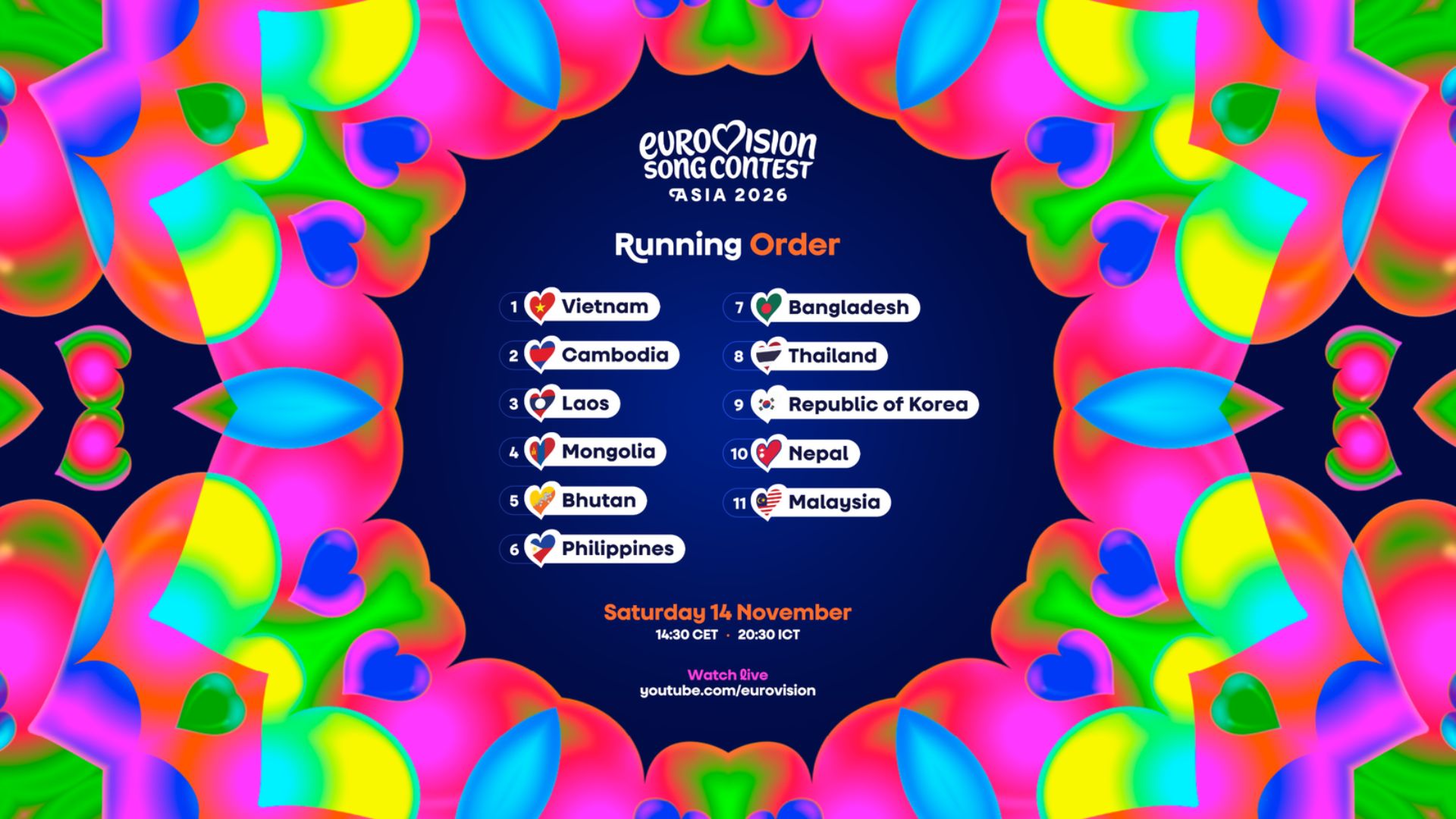
Eurovision Song Contest Asia 2026 is making history with its inaugural edition, bringing together 11 countries from across the continent on one stage in Bangkok, Thailand. Ahead of the historic competition, the first rehearsals are already offering a glimpse of the performances set to take the stage, as representatives from Laos, Bhutan, Bangladesh and Cambodia unveil their staging concepts, costumes and visual elements. From Bhutan’s cultural inspiration to the modern productions of the other delegations, here is your first look at the four countries rehearsals for Eurovision Asia 2026.







The excitement ahead of the Grand Final of Eurovision Asia 2026 in Bangkok is reaching its peak, and with it, the rumor mill on social media. For a long time, fans of the contest across the continent (and the world) have been wondering and debating exactly how the voting system will work in this new competition. Will we see an exact replica of the European Eurovision, or might the production draw inspiration from Junior Eurovision? Now, after much uncertainty and speculation filling various forums, the fog is finally lifting. Newly revealed details, based on the official voting rules of the competition, clear up the confusion and tell us exactly who will tip the scales, where we can vote, and whether the audience at home has the power to change the outcome.
50% Jury – 50% Public Vote: Keeping the Familiar Tradition
According to information revealed during the official media conference for the Philippine delegation ahead of representative Carmelle’s departure for the contest, as well as the competition’s official voting guidelines, the Eurovision Asia production has decided to stick to the classic format we know so well from Europe: The final results will be determined by a 50% Jury – 50% Public Vote split. The juries are also bound by the same rules as the public—they cannot vote for their own country. Points will be awarded in the traditional system: 12 points (“douze points”) to the first place, 10 to the second, 8 to the third, and 7 down to 1 point for places 4 through 10.
Where and How to Vote?
Unlike the European Eurovision, where you can vote via SMS or a dedicated app, voting for Eurovision Asia will be conducted exclusively online. The public will be able to vote directly through the official website, eurovisionasia.com/vote (and not esc.vote like in Europe). To cast your vote, you will need to log in to the site using a Google, Apple, or Privy account.
What about voting from non-participating countries? Good news! Viewers from countries that are not taking part in the contest will still be able to vote for any song they choose. All votes from these countries will be aggregated into a single voting category called “Rest of the World” (ROW), just as it currently exists in the European Eurovision. The “Rest of the World” votes will carry the same weight as one participating country and will be converted into points (1 to 12) that will be added to the overall public televote score.
Free Votes, But There’s a Catch
Here comes the main and most intriguing difference from the European Eurovision: According to the rules, everyone gets 8 votes for free on the voting website! However, unlike the regular contest where you can give all your votes to a single song, in Eurovision Asia, the public will be required to spread their 8 free votes across at least 3 different entries.
The system is designed to encourage support for a variety of songs, rather than just one favorite. Viewers who wish to have more influence will have the option to purchase an additional bundle of 10 votes (and no more) to continue voting. Additionally, it is important to emphasize that there is a strict ban on the use of bots, scripts, VPN services, or organized mass voting.
Many fans on social media hoped that Eurovision Asia would adopt the Junior Eurovision (JESC) route, which allows viewers to vote for their own country online. It turns out the answer is a definitive no.
Just like in the traditional Eurovision, a geolock will be applied. A viewer voting from the Philippines, for example, will not be able to vote for the Philippine entry—regardless of their nationality.
Looking Ahead to Burgas: The EBU’s Testing Ground
It is now clear—Eurovision Asia is serving as a live “testing ground” for the European Broadcasting Union (EBU), which is already exploring behind the scenes whether to implement the “vote spread requirement” in the mother contest in Europe. While at the last Eurovision in Vienna 2026, every viewer (including in the “Rest of the World” category) could give all 10 of their votes to a single song, the Asian format forces voters to spread their 8 free votes across at least three different entries.
This bold move is intended to curb bloc voting, political mobilization, or aggressive campaigns by fan standoms for one specific song. If the Asian model in Bangkok proves successful and delivers a more thrilling, balanced, and fair scoreboard, it is highly likely that the EBU will adopt the new voting restriction in time for the upcoming edition in Burgas. Our eyes may currently be looking East, but don’t be surprised if the waves created in Thailand soon wash up on the shores of the Black Sea in Bulgaria.
Eurovision Asia 2026: When and Where to Watch the Competition?
The inaugural Eurovision Asia Grand Final will take place on Saturday, November 14th, 2026, at the One Bangkok Forum in Bangkok, Thailand.
The competition will be broadcast live on the official Eurovision YouTube channel between 14:30 and 17:00 CET. Viewers will also be able to participate in the voting through the competition’s official website.
To watch the live broadcast on YouTube from 14:30 CET, click on the screen below!
All You Need to Know About Eurovision Asia
The Eurovision brand continues its global expansion with Eurovision Song Contest Asia, launched in collaboration with the European Broadcasting Union (EBU) to mark the 70th anniversary of the original contest. Following the American Song Contest in 2022, which was not renewed for a second season, this new chapter aims to bring the beloved Eurovision format to a new continent and reach a massive potential audience of over 600 million viewers. Unlike the American adaptation that focused on a single nation, this is a large-scale, multi-national competition. The inaugural Grand Final will take place on November 14, 2026, at the One Bangkok Forum arena in Thailand, preceded by a Preview Show on November 13. Hosted by media figures Woody Milintachinda and Cindy Bishop, this historic edition will feature 11 countries: Thailand, South Korea, Vietnam, Philippines, Bangladesh, Mongolia, Nepal, Laos, Bhutan, Malaysia, and Cambodia.
Unlike the European format, the contest in Asia operates under a centralized production model. It is produced by the international production company Voxovation in partnership with the leading Asian production company S2O. This structure subsidizes the selection process in various countries, allowing nations with limited budgets to participate. Additionally, the winning country will not automatically host the contest the following year but will instead be invited to perform as a guest artist at the traditional Eurovision. The voting system has also been adapted for the continent, based entirely on a unified, free digital platform that combines televoting with professional juries, giving unprecedented decisive power to the international audience through the “Rest of the World” voting. Furthermore, ZOOP will serve as the exclusive social partner of the event, enabling fans to take an active role in the digital experience.

Email: [email protected]
Phone: +972-50-9441919
Writer and content creator at EuroMix, providing cultural insights into the world of Eurovision. Talor is a second-generation Eurovision enthusiast who grew up attending family viewing parties. The 1999 Eurovision, at just five years old, was the event that shaped his love for the contest. He holds a BA degree in Culture – Creation and Production, and his articles combine academic knowledge with a passion for pop and trash, appreciating humor and clever references in the competition’s songs. He specializes in cultural and social analysis, offering in-depth commentary.
Outside the Eurovision world, Talor works as an independent content and media manager.