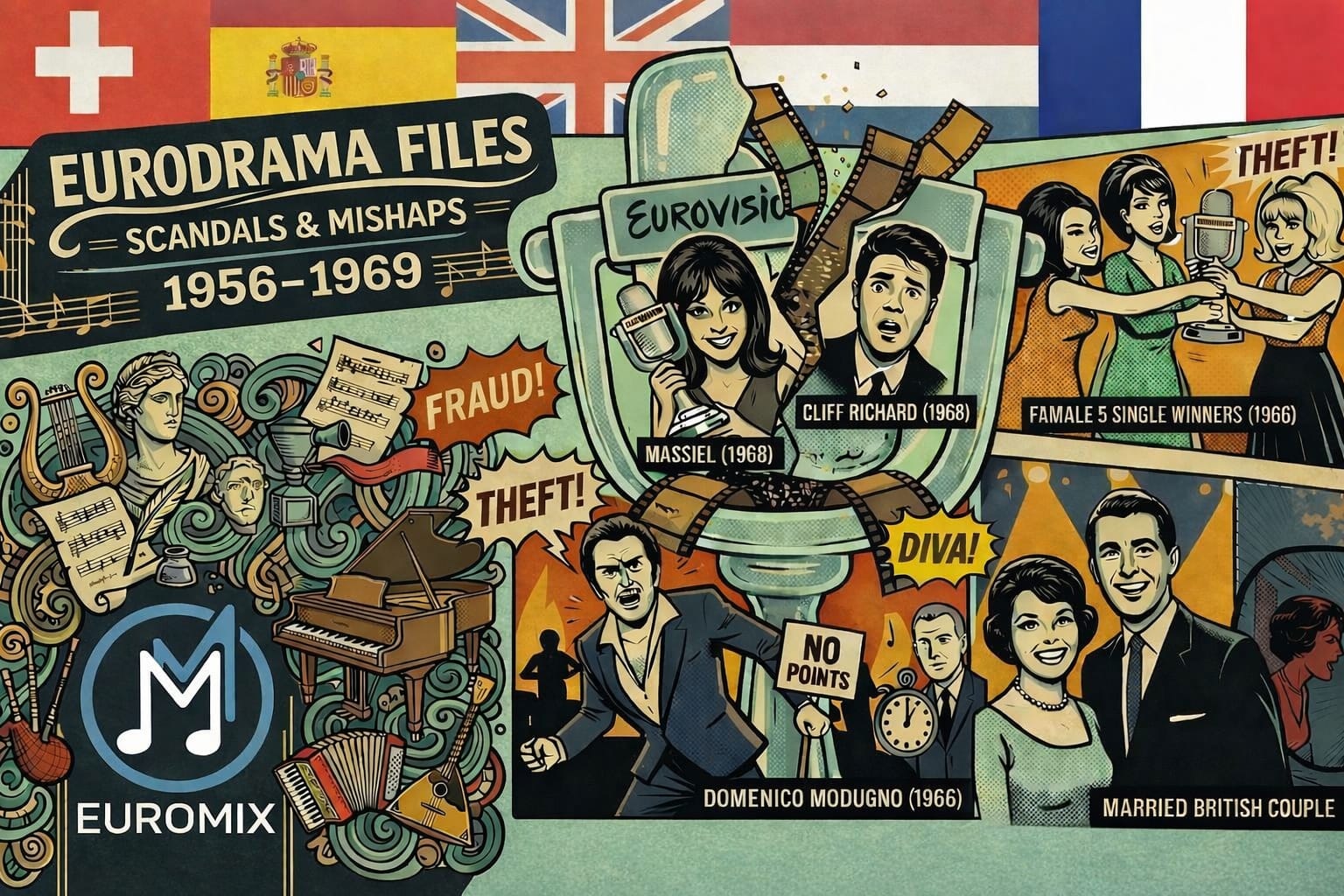
A journey behind the scenes of Eurovision: from the Swiss “arrangement” of 1956 to the dictator who bribed judges. The first chapter of the “Eurodrama Files” series exposing the contest’s dirtiest secrets.
70 years ago, in a small casino hall in Lugano, Switzerland, only seven countries gathered for a modest song competition that was broadcast almost entirely on radio. No Finnish monsters, no smoke machines, and no glass trophies shattering live on air. Seven decades later, the Eurovision Song Contest is far more than just a music competition it has become one of the world’s largest pop-culture phenomena.
To mark the contest’s 70th anniversary, EuroMix editorial team members Roie Ben Hoor, Talya Raviv, and Oscar Diefenthal embarked on a journey through the archives to bring you the most fascinating stories from Eurovision’s past.
In every episode of this series, we will open a different “file” and revisit the biggest, strangest, and most unforgettable moments that shaped the history of the world’s largest music competition. This time, we dive into the contest’s earliest years to explore the messy dramas of the 1950s and 1960s and trust us, you may be surprised to discover that some of these incidents are not so different from today.






Corruption from the First Note: The Secret Behind the 1956 Home Victory
Think controversies around jury and public voting began only in the modern era? Think again. It turns out the “arrangements” started from the very beginning.
The year was 1956. Europe was still recovering from World War II when several members of the European Broadcasting Union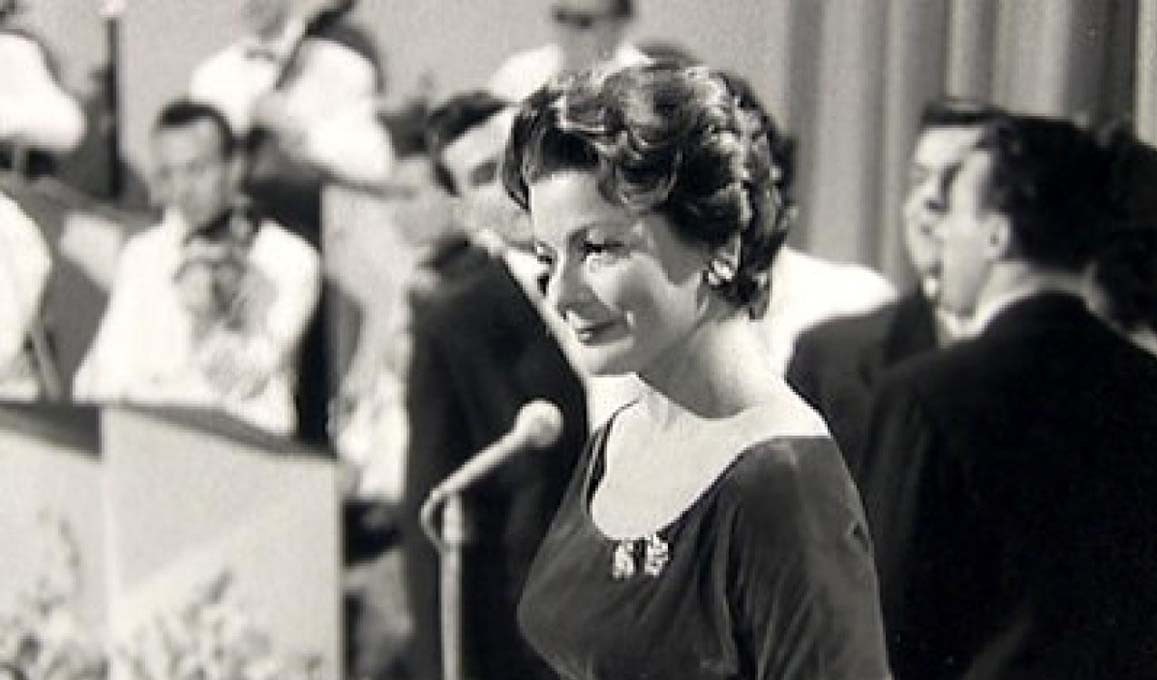 (EBU) proposed an innovative idea: a song competition between European countries aimed at building a cultural bridge across the continent. That same year, on May 24, 1956, the competition was held for the first time with just seven participating countries.
The first contest took place in the Swiss city of Lugano, and “coincidentally” the winning country was Switzerland with its representative Lys Assia. Sounds like pure coincidence, right? Not quite.
In the competition’s first year, the winner was determined by juries from the participating countries, with each country allowed to send two judges. Unfortunately, Luxembourg, which took part that year, could not afford to send its jurors. As a result, the EBU allowed the host country Switzerland to appoint two additional judges “on behalf of Luxembourg.”
Many observers were far from indifferent to this arrangement, raising questions about whether the competition had been fair at all. The voting that year was secret and the results were never officially published. However, rumors suggested that the victory was heavily influenced by Swiss jurors who voted for their own entry while ensuring that rival songs received especially low scores.
Smiles for the Camera, Screaming Backstage: The Duo Who Refused to Speak
It turns out that in the contest’s early decades, the British took Eurovision perhaps a little too seriously. In 1959, backstage drama reached its peak.
That year the United Kingdom sent the duo Pearl Carr and Teddy Johnson, who were expected to charm Europe with their cheerful song “Sing, Little Birdie.”
On paper, it was the perfect casting: a harmonious couple singing together in flawless coordination. In reality, however, the two “lovebirds” nearly tore each other apart. During rehearsals for the competition, Carr and Johnson argued so fiercely that they refused to speak to each other at all the silence between them was absolute.
Yet when the moment of truth arrived during the live broadcast, British professionalism or perhaps fear of the BBC national broadcaster prevailed. The moment the cameras switched on, the pair smiled widely, launched into their duet, held hands, and displayed dazzling on-stage chemistry as if they were the most devoted couple in the world.
And what happened after the applause? Seconds after the cameras turned off and the duo stepped off the stage, the show ended. They walked to separate dressing rooms, slammed the doors, and did not speak to each other for two full weeks. They may have finished in second place that night but for the most convincing performance on stage, they undoubtedly deserved first prize.
The Italian Diva Who Collapsed: Zero Points for Ego
Fast forward to 1966. Italy chose to send superstar Domenico Modugno to Eurovision for the third time. At the time he was considered the most famous singer in Europe, holding two Grammy Awards for the 1958 Eurovision hit “Nel blu dipinto di blu” (In English: “Painted Blue in Blue”), better known worldwide as “Volare.”
Modugno arrived at the 1966 contest in Luxembourg with the song “Dio, come ti amo” (In English: “God, How I Love You”), hoping to finally secure victory. But the third time did not prove lucky and the only love in the room appeared to be the singer’s love for himself.
During rehearsals for the performance, Modugno was dissatisfied with the orchestra’s arrangement. Instead of addressing the issue calmly, he abruptly stopped the music and burst into loud shouts, declaring that the orchestra was “terrible” and unable to play his music properly.
The drama did not stop there. Modugno was so furious that he threatened to leave the competition entirely and return to Italy unless he was allowed to bring his own musicians or change the rules. The contest producers panicked at the thought that the event’s biggest star might abandon the live broadcast.
In an unprecedented exception, the producers decided to bend the competition rules and allow him to perform with his own group of musicians something that was strictly forbidden at the time. Eventually the singer did take the stage, but he appeared tense and distant.
Other delegations were outraged by what they saw as favoritism toward Modugno simply because of his fame. Despite his legendary status, karma seemed determined to catch up with him. When the final scoreboard appeared, Italy finished in last place with zero points. For an artist of Modugno’s stature, it became one of the greatest humiliations in the history of the Italian delegation and a powerful lesson about letting ego take control.
A Miracle Victory: How Spain’s Dictatorship Orchestrated a Eurovision Victory
You might think the drama ended there but it did not. Two years later, in 1968, the United Kingdom sent its pop legend Cliff Richard with the massive hit “Congratulations.” It seemed destined to win effortlessly, and much of Europe expected exactly that.
But in the final moment, the United Kingdom lost to Spain by a frustrating margin of just one point. At first glance it looked like simple bad luck. In reality, the story appears to be far more complicated.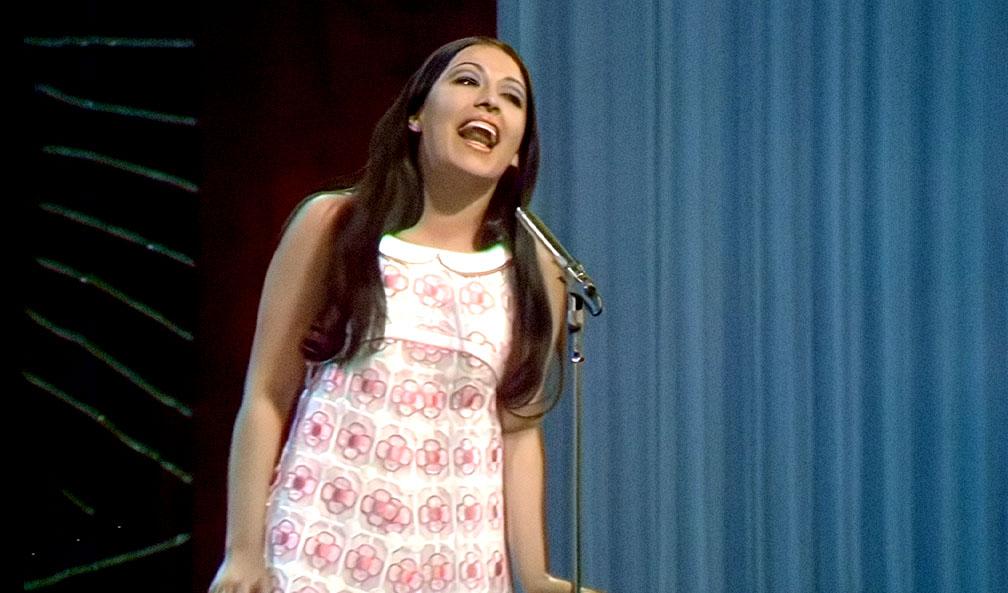
Decades later, investigations in Spain revealed a darker secret. Dictator Francisco Franco had no intention of leaving the result to chance. In a desperate effort to improve Spain’s international image and present the country as modern and European, representatives of the regime were reportedly sent across Europe.
Their mission? To “persuade” a polite term often interpreted as “bribe” the juries of various countries to vote for the Spanish entry “La, la, la,” performed by Massiel.
The plan, it seems, worked. Spain took the trophy. And what about Cliff Richard? Years later, when the investigations became public, he did not hide his frustration. In an interview he said: “I have lived my whole life with the feeling that Spain stole the trophy from me.” And people say voting controversies are only a modern phenomenon.
Four Winners, One Trophy, and Total Chaos: The Night Eurovision Nearly Collapsed
Just one year later, on the eve of the 1970s, Eurovision nearly fell apart live on air. If you think today’s voting system is confusing, wait until you hear about the fiasco of 1969.
At the end of the tense vote announcement in Madrid, the scoreboard showed an unprecedented result: no fewer than four countries: Spain, United Kingdom, France, and the Netherlands finished in first place with exactly the same score of 18 points each.
The real problem? The EBU simply had no rule for a tie. The result was total panic in the control room with no backup plan, the production declared all four countries joint winners.
But the chaos did not stop there. The organizers had prepared only a single set of prizes medals for the singer, composer, and lyricist of just one song. The ceremony ended in complete confusion as the host, Laurita Valenzuela, stood helplessly in front of the cameras.
The improvised solution was to distribute the creators’ medals among the winning singers including the United Kingdom’s Lulu and France’s Frida Boccara so that each could hold something for the press photographs. The remaining prizes and medals missing from the delegations were sent to them by mail several weeks later.
The incident did not pass quietly. Scandinavian countries Norway, Sweden, and Finland joined Portugal in announcing an official boycott of the 1970 contest in protest over the amateurish handling of the situation. As a result of the backlash, the EBU was forced to rewrite the rules and the tie-breaker rule used today was born.
So the next time a country loses because it received fewer “12 Points,” you’ll know exactly whom to blame.
The next time you shout at the screen during the voting, remember: diva egos, backstage scandals, bribery allegations, and live broadcast mishaps have been part of Eurovision’s DNA since its very first years.
See you in the next episode of “Eurodrama Files,” where we will open the case of the “cursed trophies” that haunted the contest over the years. Stay tuned!
Eurovision 2026: the 70th edition of the contest will take place in Vienna, Austria, on May 12th, 14th, and 16th, 2026. The Wiener Stadthalle arena, which will host the event, is expected to accommodate around 16,000 spectators per show. The contest returns to Austria following the nation’s third historic win with the song “Wasted Love”, performed by JJ. It will be Austria’s third time hosting Eurovision, after previous editions held in the country in 1967 and 2015.