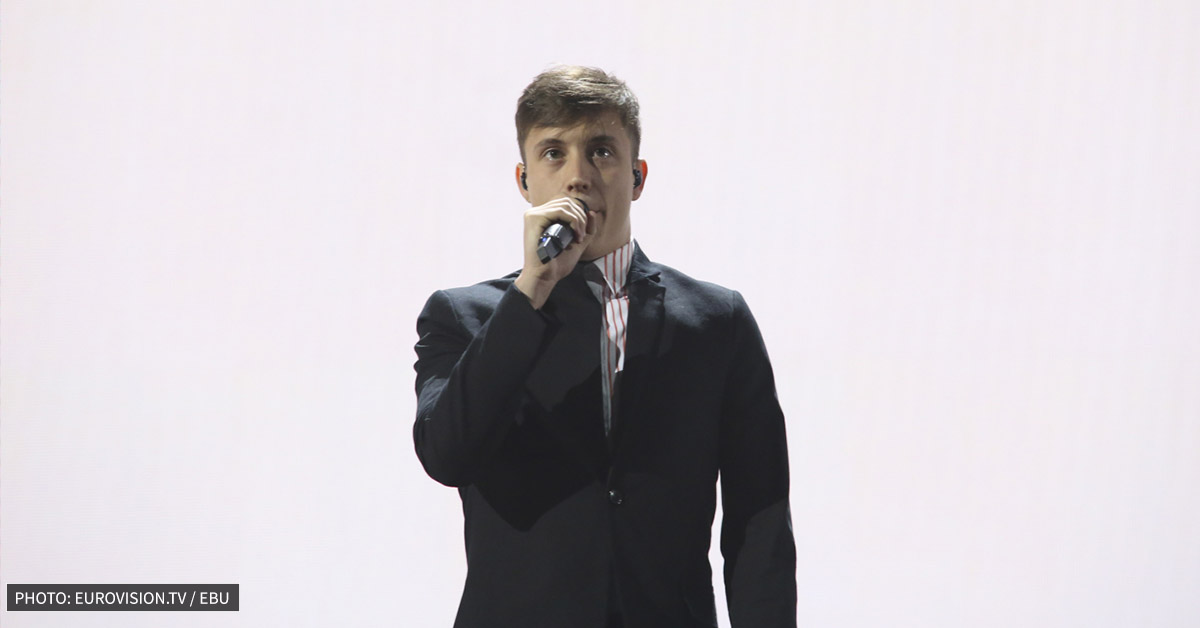
Belgian singer Loïc Nottet reportedly refused to represent Belgium at Eurovision 2026 due to Israel’s participation, sparking political debate and local protests.
A dramatic report shaking the Eurovision community was published moments ago. According to Belgian newspaper DHnet, Belgian Eurovision star Loïc Nottet has decided not to represent Belgium in Eurovision 2026, citing Israel’s participation as the reason. The unusual move has caused a major stir among Eurovision fans and reignited political controversy around the beloved contest.





Alongside the report, it was revealed that last Saturday around 50 people protested in the Belgian city of Namur. Demonstrators called on the national broadcaster RTBF to boycott and withdraw from Eurovision 2026 due to Israel’s inclusion.
Loïc Nottet Reportedly Withdrew Over Israel
As early as last August, Belgian media reported that Loïc Nottet had been selected once again to represent Belgium at Eurovision 2026. Nottet is no stranger to the competition – he represented Belgium at Eurovision 2015 in Vienna, Austria, with his song “Rhythm Inside”, finishing fourth in the grand final.
Just days after the report claiming he would return to the Eurovision stage, RTBF was quick to deny the rumors, stating that “no decision has yet been made regarding Belgium’s representative for Eurovision 2026”.
Now, new reports in the Belgian press reveal that RTBF did indeed choose Nottet as the country’s representative. However, the singer allegedly decided to decline participation because of Israel’s controversial inclusion in the contest.
It is important to note that this is not an official announcement by RTBF or by Nottet himself. Whether he was truly selected and later withdrew due to Israel’s participation – or whether the claims are entirely false – remains unclear for now.
Who Is Loïc Nottet?
Loïc Nottet, 29, rose to fame after participating in the third season of “The Voice Belgique”, where he was on the team of singer BJ Scott and finished second. He was later internally selected to represent Belgium at Eurovision 2015 in Vienna with “Rhythm Inside”, placing fourth.
After the contest, Nottet took part in the sixth season of Belgium’s “Danse avec les stars” (“Dancing with the Stars”) and won first place. Today, Nottet is considered one of Belgium’s leading artists. His discography currently includes three studio releases: the single album “Million Eyes” (2016), his debut album “Selfocracy” (2017), and “Sillygomania” (2020). His debut album achieved platinum status in both Belgium and France. In 2020, he returned to “The Voice Belgique” for its ninth season, this time as a mentor.
Protests Calling for Belgium’s Withdrawal
The protest was organized by local citizens, associations, NGOs, and even artists. At the same time, similar demonstrations took place outside other RTBF centers in the cities of Charleroi and Liège.

During the protest, participants called on the national broadcaster to withdraw from Eurovision in response to Israel’s participation. Despite attempts to present the protest as a large-scale demonstration, only about 50 people attended. No serious incidents were reported, and the event concluded without police intervention.
The EBU’s Decision and International Withdrawals
As previously reported, the European Broadcasting Union (EBU) decided at its General Assembly last December that Israel may compete in Eurovision 2026 under updated contest rules.
Following the decision, several countries – Including Iceland, Ireland, the Netherlands, Spain, and Slovenia – announced their withdrawal from the contest in protest of Israel’s participation.
Belgium at Eurovision 2026
“Dancing on the Ice” is the title of the song to be performed by singer Essyla, who will represent Belgium at Eurovision 2026, set to take place in Vienna, Austria. Belgium will compete at the 2nd half of the First Semi-Final on May 12th. The song was written by Essyla herself, alongside songwriter Barbara Petitjean. Belgium is currently ranked 28th on the beeting charts towards Eurovision 2026.
Eurovision 2026: This will be Belgium’s 67th participation in the contest. Belgium joined Eurovision in 1956 as one of its seven founding nations. The country’s best result came in 1986, when Sandra Kim won first place with “J’aime la vie”.