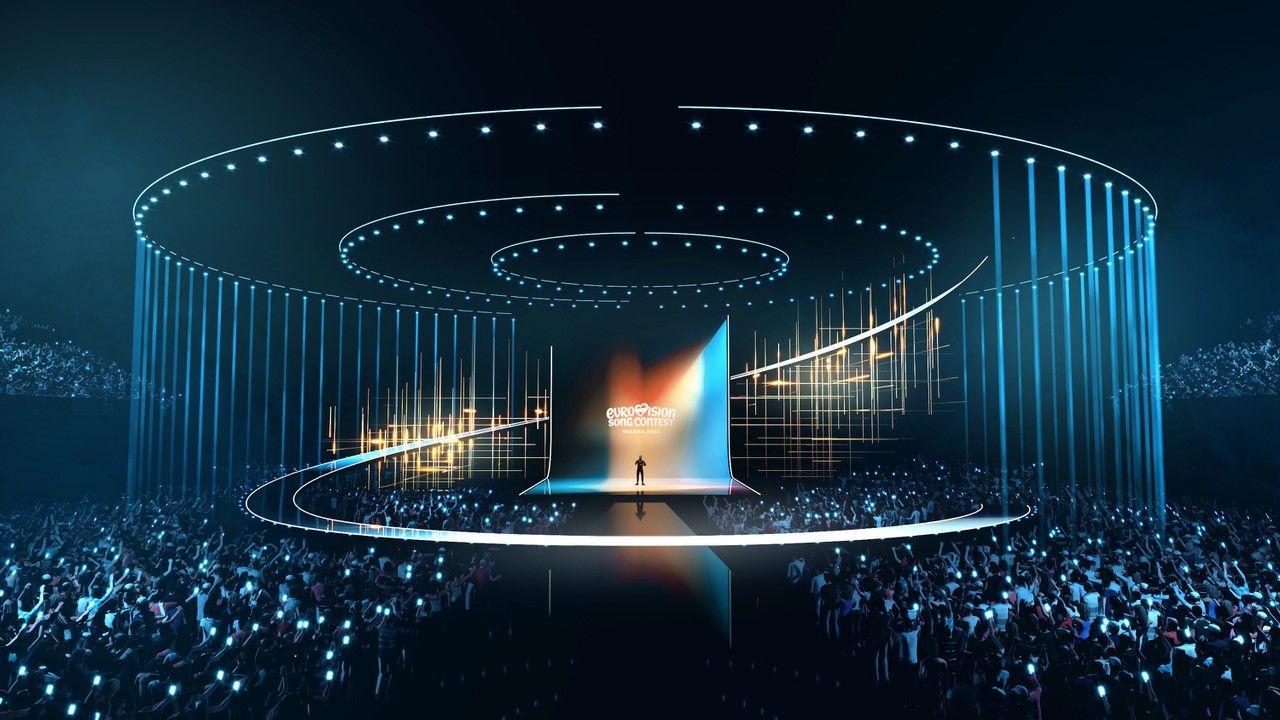
Preparations for Eurovision 2026 intensify as stage construction begins at Vienna’s Wiener Stadhalle, with first images revealing early progress of one of the contest’s most ambitious productions.
Preparations for Eurovision 2026 are entering a high gear, as construction of the stage in Vienna has officially begun and production teams are starting to shape the Wiener Stadhalle arena, which will host the competition. The stage, designed by international designer Florian Wieder, draws inspiration from the Vienna Secession art movement, emphasizing the breaking of conventions and creative innovation.


First Look: Giant Lighting Ring and Aerial Structures
Images released from inside the venue reveal that production teams are already working on installing ceiling structures, a central element that will support the lighting systems and visual effects. At the same time, a large circular lighting ring has already been installed above the main stage area, offering a first glimpse into the visual design that will define this year’s contest. This stage of the production is considered one of the most critical, as every technical detail must be executed with precision ahead of the rehearsals set to begin soon.
🚨🇦🇹First photos from the #Eurovision 2026 stage construction! pic.twitter.com/Rz4y8BDC3g
— Eurovision News (@EurovisionNewZ) April 9, 2026
Lighting Concept Revealed – Drama on Stage
Alongside the physical construction, the official lighting concept for Eurovision 2026 has also been unveiled – and it promises significant visual drama. According to the artistic vision, lighting will play a central role in shaping each performance, with the use of bold geometric forms and dynamic transitions designed to enhance the television experience. The implication is clear: each country will be able to highlight its performance in a unique way, fully utilizing advanced technology.
The Race Against Time Has Begun
Work at the venue is expected to continue at an intensive pace over the coming weeks, in order to meet the tight schedule of the competition. The goal is clear – everything must be ready for the first technical rehearsals, which will mark the beginning of the final stretch toward the major event in May. For the delegations, this is a highly significant moment: the stage is beginning to take shape, and Eurovision 2026 is becoming a reality.
Eurovision 2026 – Dates and times
Eurovision 2026 will take place in May, continuing the long‑standing tradition.
Here are the exact dates:
- First semi‑final: Tuesday, May 12th, 2026
- Second semi‑final: Thursday, May 14th, 2026
- Grand final: Saturday, May 16th, 2026
For those asking “What time does Eurovision 2026 start?”, each live show is scheduled to begin at 21:00 CET, making it accessible to viewers right across the continent.
Side events and Eurovision parties
In the run‑up to Eurovision 2026, several side events and Eurovision parties are planned across Europe. At these pre‑parties, competing artists perform their entries live, promoting their songs, meeting fans and giving interviews to media outlets from all over the continent. These events include:
Melfest WKND in Stockholm, March 6th-7th
Eurovision Party SKG in Thessaloniki, March 12th
Nordic Music Celebration, March 21st
Eurovision in Concert 2026 in Amsterdam, April 11th
Eurovision Pre-Party Bucharest 2026, April 18th
London Eurovision Party, April 19th
Eurovision 2026: the 70th edition of the contest will take place in Vienna, Austria, on May 12th, 14th, and 16th, 2026. The Wiener Stadthalle arena, which will host the event, is expected to accommodate around 16,000 spectators per show. The contest returns to Austria following the nation’s third historic win with the song “Wasted Love”, performed by JJ. It will be Austria’s third time hosting Eurovision, after previous editions held in the country in 1967 and 2015.

Email: [email protected]
Phone: +972-50-9441919
Neta Geffen is a respected journalist at Euromix, Israel’s leading news site for Eurovision coverage. Since 2010, Neta has been closely following the Eurovision Song Contest, bringing with him extensive experience, profound knowledge, and a broad understanding of the history, politics, and cultural influences that shape the event every year.
Neta publishes articles, analyses, and up-to-date reviews on all Eurovision developments, including musical trends, format changes, political influences, and audience reactions across Europe and Israel. Thanks to a deep connection to the contest’s history, Neta provides readers with wide-ranging context—from the impact of political events on results, to in-depth analyses of songs and languages within the competition. Neta specializes particularly in the Eurovision rock genre, Balkan ballads, and native language entries, with a special focus on Italian and Greek songs.