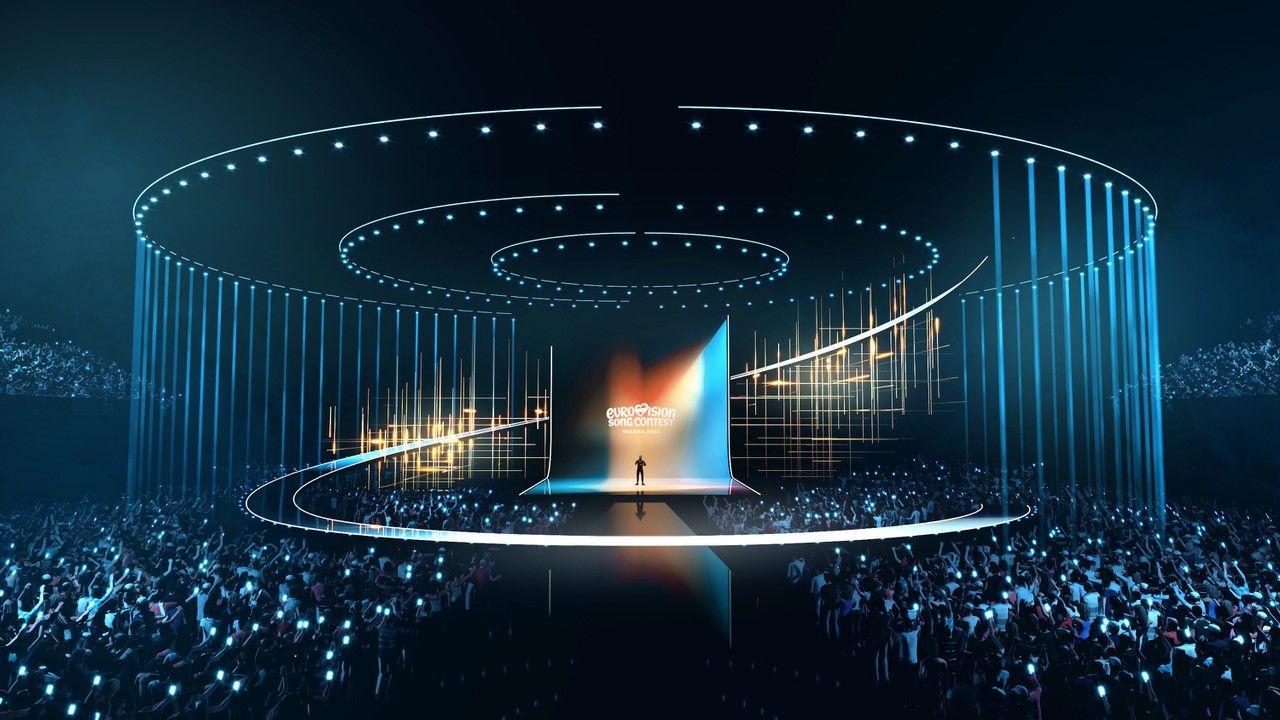
Featuring a leaf motif, curved lines, and elegant gold accents, national broadcaster ORF has unveiled the stage design for Eurovision 2026 in Vienna. This sophisticated layout aims to blend tradition with modern versatility
Following the spectacular stage of Eurovision 2025 in Basel, the spotlight has turned to Vienna as the 2026 rendering was revealed yesterday. To celebrate the 70th anniversary of the contest, the national broadcaster ORF is utilizing a concept by German-Jewish designer Florian Wieder, who has designed no fewer than nine Eurovision stages. At the heart of the design lies a curved leaf-shaped LED surface, serving as the production’s central element. A wide arch and a complex structural framework complete this striking visual display.


As noted in yesterday’s coverage of the reveal, Wieder is a seasoned stage designer with extensive experience in televised musical events. Having designed the stage for Eurovision 2025 in Basel, Switzerland, he set an exceptionally high bar for himself. The primary challenge in designing a stage that must look stunning for both the live audience and viewers at home is ensuring visual impact in both close-ups and wide shots. Since home audiences primarily see specific sections of the stage, every detail, graphic, and angle must be camera-ready. In this context, the fine details are as vital as the overall structure.
Another challenge is that, unlike concerts focused on a single artist or band, Eurovision features a vast array of performances that must each look distinct. Each participating nation sends its own representative with a specific style, supported by designers, directors, and choreographers working to create a unique “number” that stands out. The ability to provide versatility is the key to success. Failure in this regard leads to repetitive performances, hindering the national delegations and boring the audience. Does Wieder have the potential to succeed again this year?
The Success of Basel and the Shift to Viennese Elegance
As mentioned, Wieder designed the stage for Eurovision 2025 held in Basel, Switzerland. In my view, that stage was a triumph. What initially appeared to be a puzzling design – focusing on mountain motifs flanking the stage, dual platforms, and an unusual frame – proved to be a successful formula for generating interest. Most performances felt distinct, as the stage allowed creative freedom for each country’s directors. Integrated “Lego-style” lights created unique shapes, and delegations utilized the mountains, moved between stages, and made use of the expansive LED screens to bring their creative visions to life. Basel’s great success was creating individual worlds for each artist, giving the viewer a sense of watching something entirely new every three minutes. Can Wieder surpass himself this year?
Last year, we saw the Swiss Alps lead the design to highlight the host nation’s characteristics. This year, the Austrians have decided to emphasize their local culture more directly. While Switzerland focused on iconic Swiss branding, it appears that Austria – perhaps because the EBU has recently rebranded the contest anyway – is taking a different direction to showcase Viennese culture. We are currently seeing a global trend returning toward ethnicity and local heritage rather than universal designs. When Austria hosted in 2015, they followed the “Building Bridges” theme with a universal design that could have existed anywhere. This year, the trend toward cultural uniqueness has changed the landscape.
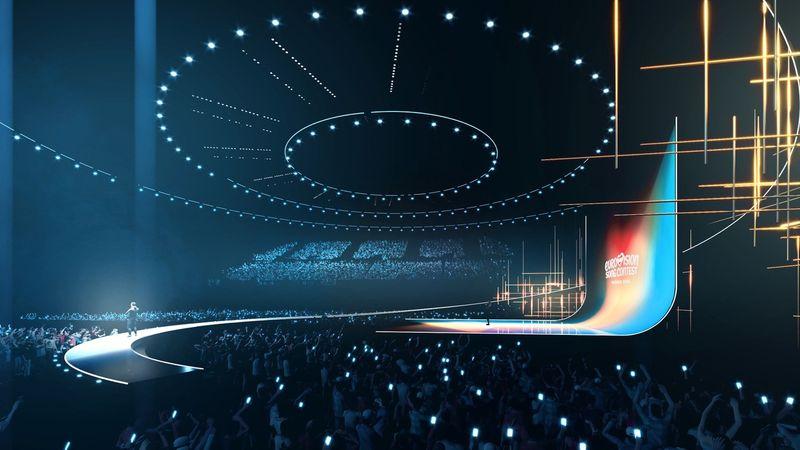
Austria is renowned for artistic movements older than Swiss modernism, boasting magnificent architecture and a history of nobility. The classical music of Austrian composers such as Wolfgang Amadeus Mozart, Franz Schubert, Joseph Haydn, and Johann Strauss represents a legendary canon that the national broadcaster ORF will likely showcase. The current stage resembles a concert hall, with lighting arranged in a circular fashion and clear separation between audience zones. A short runway connects the main stage to a secondary path encircling the audience, creating an atmosphere where the inner crowd feels like an orchestra – part of the performance – while the outer crowd acts as the traditional audience.
The Vienna Secession: Artistry Meets Functionality
The central concept the Austrians drew inspiration from is the “Vienna Secession” – a movement of artists, architects, and musicians who resigned from the Association of Austrian Artists in 1897 to protest traditional styles. This movement included figures such as Gustav Klimt, Josef Hoffmann, and Koloman Moser. The movement advocated for “total art,” integrating disciplines like painting, sculpture, and music. This style is the Austrian version of Art Nouveau, emphasizing natural motifs, organic lines, and gold ornamentation. Unlike traditional Art Nouveau, the Austrians emphasize gold in every corner. ORF aims to break conventions, stating they are embracing radical creativity and new design choices. While the Secession style is more elegant than “radical” today, it perfectly represents the local tradition.
The natural motifs are visible in the elegant curve of the walkway surrounding the stage. There is an extensive use of rounded shapes, and gold is a recurring theme in the released simulation. The gold is used tastefully, avoiding the excessive gradients seen in recent years. This is a serious cultural display with classical music motifs and a timeless Viennese atmosphere.
Three Central Design Motifs:
- The Leaf: A symbol of roots and potential, representing new beginnings. The stage itself is the leaf, made entirely of LED screens. Its curved edges create a sense of flow, with the only sharp angle at the top to add dynamism.
- The Curved Line: An expression of musical resonance and movement. This “second stage” or walkway separates the audience and rises elegantly toward the ceiling lights, creating a soft connection between “heaven and earth.”
- The Structure: A golden framework connecting art and functionality. These golden pillars create depth, ensuring the stage does not appear flat. This use of gold distinguishes the Vienna Secession from European Art Nouveau and provides a royal, unique feel.
The “Green Room” will be connected directly to the stage via a walkway, allowing for the “winner’s walk” through the crowd. This design maintains the Eurovision DNA while breaking new creative ground.
The Emerging Branding
At the end of the simulation video, the branding ORF intends to use is visible. They have adapted the new Eurovision heart logo into their chosen style. The result is a magnificent use of the heart element, featuring flowing shapes in gold and cream that echo the works of Secessionist artists. Beneath it, a wavy, musical line moves with the rhythm of the music – appearing classic and beautiful without being cliché.
Will Wieder Succeed?
Wieder set a high bar last year. This year’s design is nothing short of spectacular and, for a change, truly elegant. It is a perfect celebration of local culture. However, the question remains: is the stage suited for the Eurovision challenge? Unless there are surprises, it does not appear particularly versatile. Each performance will likely rely heavily on video art to stand out. Wealthier nations might bring large props (like a giant blender or a dollhouse), while others will rely on graphics and costumes. This could lead to a sense of monotony.
Furthermore, there is the matter of camera angles. This stage is most beautiful as a wide shot; in close-ups, we may simply see a singer against a screen. This forces delegations to find graphic solutions to maintain interest, or perhaps fall back on traditional pyrotechnics and smoke. I believe Wieder has created a masterpiece, and the branding by the national broadcaster ORF is unique. Whether it will be practical for the chaotic variety of Eurovision remains to be seen, but the aesthetic success is undeniable.
Eurovision 2026: The 70th Eurovision Song Contest will be held in Austria, following the country’s third historic win with the song “Wasted Love” performed by JJ. This will be the third time the contest is hosted in Austria, after 1967 and 2015.

Email: [email protected]
Phone: +972-50-9441919
Maor Heumann has been writing about the Eurovision Song Contest and following it for over three decades. He has attended five contests and has found something to appreciate in almost every possible musical genre — from the sugary pop entries that finish last in the semi-finals to the quirky avant-garde pieces that even the competition’s juries struggled to connect with. He usually prefers original languages and songs with depth over Swedish-produced English clones — though he doesn’t promise to stick to that rule.
He grew up on the kibbutz of Sara’le Sharon, who instilled in him a love for music and created his first connection to the contest back in 1993 — before most of the current editorial team was even born.