
Keren Peles addresses questions about her collaboration with Greece in “Ethnikos Telikos”, emphasizing her Israeli pride and responding to the criticism and protests over their partnership.
Last Sunday, Euromix reported exclusively that singer-songwriter Keren Peles,Keren Peles wrote a song for “Ethnikos Telikos”. Peles is also known internationally in the Eurovision community for writing the songs “Hurricane” and “New Day Will Rise” — both of which represented Israel at Eurovision and became national sources of inspiration. If Peles’ song wins the Greek national final, she could find herself at Eurovision 2026 in Vienna, under the blue and white flag of the Mediterranean neighbor.
It was also revealed that the Greek singer set to collaborate with Peles is Xannova Xan, who is no stranger to the Eurovision scene. Xannova Xan participated in last year’s Greek national final with her song “Play It!“, finishing fifth, and in Junior Eurovision 2005 with “Tora einai i seira mas“, which placed sixth. Now, Keren Peles responds for the first time to this collaboration and addresses her followers’ questions.






Keren Peles Responds Publicly via Instagram Story
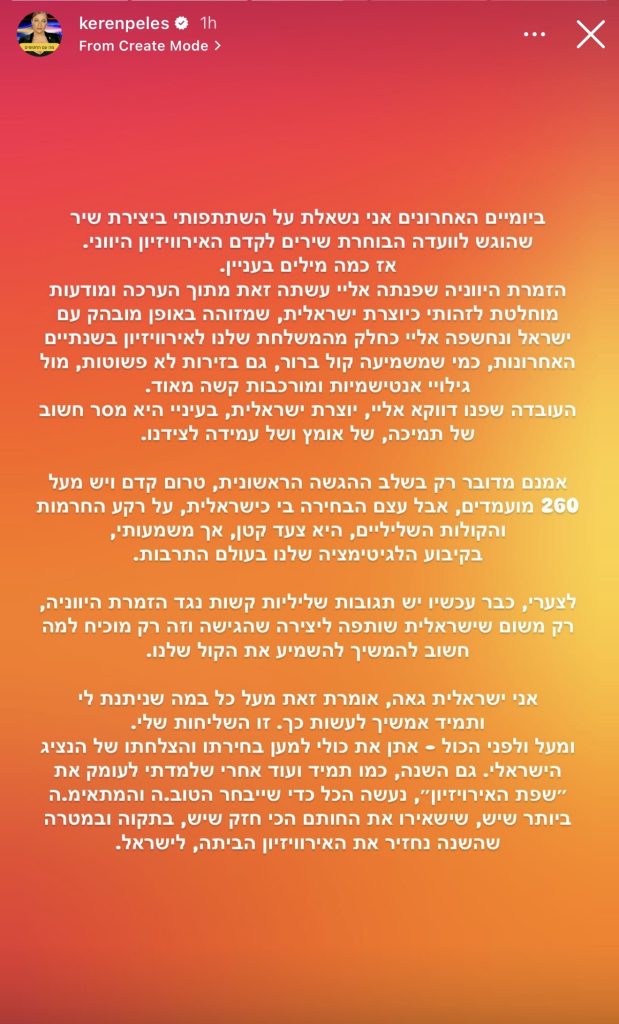
Today (Tuesday), Keren Peles shared an Instagram story where she openly reflected on and gave her voice to the upcoming collaboration with Greece ahead of “Ethnikos Telikos”.
“The Greek singer approached me out of respect and full awareness of my identity as an Israeli creator, someone who is distinctly associated with Israel and became known to her over the last two years as part of our struggle at Eurovision – someone who makes her voice heard, even in challenging arenas, against manifestations of antisemitism and complex circumstances. The fact that they chose me, an Israeli creator, is, in my eyes, an important message of support, courage, and standing by us”. “I am a proud Israeli… I will give my all for the choice and success of the Israeli representative”.
As a reminder, Peles is returning this year as a judge on “HaKokhav HaBa LeEurovision 2026”, the show that will select Israel’s participant for the upcoming contest in Vienna. She notes that she is frequently asked about her involvement in the song chosen for the Greek pre-selection, presenting herself not only as a creator but also as a voice-bearer for Israel.
Criticism, Pride, and Meaning Beyond Music
From her story, it is clear that Keren Peles feels the need to address intense negative reactions:
“Unfortunately, there are already harsh negative responses against the Greek singer, just because an Israeli participated in creating the song submitted”.
This exposes an open secret in the Eurovision world – not just a musical decision, but the ongoing social, political, and media pressures behind the scenes. She emphasizes that the dialogue is not only artistic:
“The very choice of me as an Israeli, against the backdrop of boycotts and negative voices, is a small but significant step toward solidifying our legitimacy in the cultural world”.
There is a clear sense of formidable Israeli and artistic strength, marking Israeli creativity as a resistance to the erasure of Israeli presence specifically in the realm of culture and art, especially at Eurovision.
The story shared by Keren Peles goes beyond PR: it reveals strength, pride, and identity – while also acknowledging the pain of facing criticism. She stands at the forefront of an international project that challenges traditions, sending a clear message: the more our voice is carried, the stronger it becomes.
Keren Peles’ Song – How Does It Sound?
The song, a result of collaboration between Euromix.co.il and the Greek site eurovisionfun, has already been submitted to the Greek national broadcaster ERT and is performed by the compelling Greek artist Xannova Xan. The song is a touching and powerful ballad, unmistakably bearing Keren Peles’s signature, but sounds even more “Eurovision” than her previous works showcased at the contest.
The lyrics will be in English and Greek, with the Greek part not written by Peles but by a Greek songwriter well-known among Eurovision fans. If selected, this will mark the first time an Israeli songwriter would represent Greece at Eurovision.
Watch Xannova Xan’s performance from “Ethnikos Telikos 2025”:
Keren Peles’ Road to Eurovision 2026
Following last year’s successful revival of the open national selection — the first of its kind since 2003 — Greece’s broadcaster has decided to maintain the same format for 2026. This decision allows participation from artists not signed to Greek record labels, opening the door for creators like Keren Peles.
The 2026 selection will consist of three live shows: two semifinals and a grand final. A total of 28 songs will compete — 14 in each semifinal — with viewers alone deciding which seven songs from each semifinal advance to the final. The grand final will include 14 songs, with voting split evenly: 50% from the jury (divided between local and international panels) and 50% from the public televote, mirroring last year’s system.
The strong result achieved by Klavdia last year is expected to raise the bar for this year’s composers and performers. With Greece’s renewed motivation and a competitive lineup, Keren Peles will likely face tough competition on her path to potentially representing Greece at Eurovision 2026.
Greece at Eurovision 2025
“Asteromáta” (in English: “Eyes of Stars”) is the song performed by Klavdia, who represented Greece in the grand final of Eurovision 2025. Greece qualified for the grand final after placing fourth in the second semi-final with 112 points. In the grand final, Greece finished in sixth place with 231 points, with both the juries and the public awarding her eighth place.
This sixth-place finish is considered Greece’s best result since 2013, when the country also ranked sixth.
Eurovision 2026: This will be Greece’s 46th participation in Eurovision. Greece joined the competition in 1974 and achieved its best result in Eurovision 2005 when singer Helena Paparizou won first place with the song “My Number One”.

Email: [email protected]
Phone: +972-50-9441919
Ilay Gaist is a leading Israeli content creator and writer specializing in the Eurovision Song Contest. He is a well-known commentator with extensive expertise in the contest’s history, rules, and dynamics. His passion for Eurovision drives him to deliver rich, professional, and innovative content to his audience.
Ilay holds a bachelor’s degree in Arabic and has a multilingual background. He also engages in cultural research, with a particular focus on global culinary traditions and the evolution of local cuisines around the world.