Christian Panou, Daniel Diges, SuRie, Jamala, Hatari, Madonna, Tommy Cash – The Biggest Eurovision Stage Invasions Ever
Seventy years ago, in a small casino hall in Lugano, Switzerland, only seven countries gathered for a modest song contest. There were no Finnish monsters, no wind machines, and no glass trophies shattering live on air. Seven decades later, the Eurovision Song Contest is no longer just a song competition – it is one of the biggest pop‑culture phenomena in the world. To mark the contest’s 70th anniversary, the “Eurodrama Files” series by EuroMix editors Roie Ben Hoor, Talya Raviv and Oscar Diefenthal continues its journey deep into the archives.
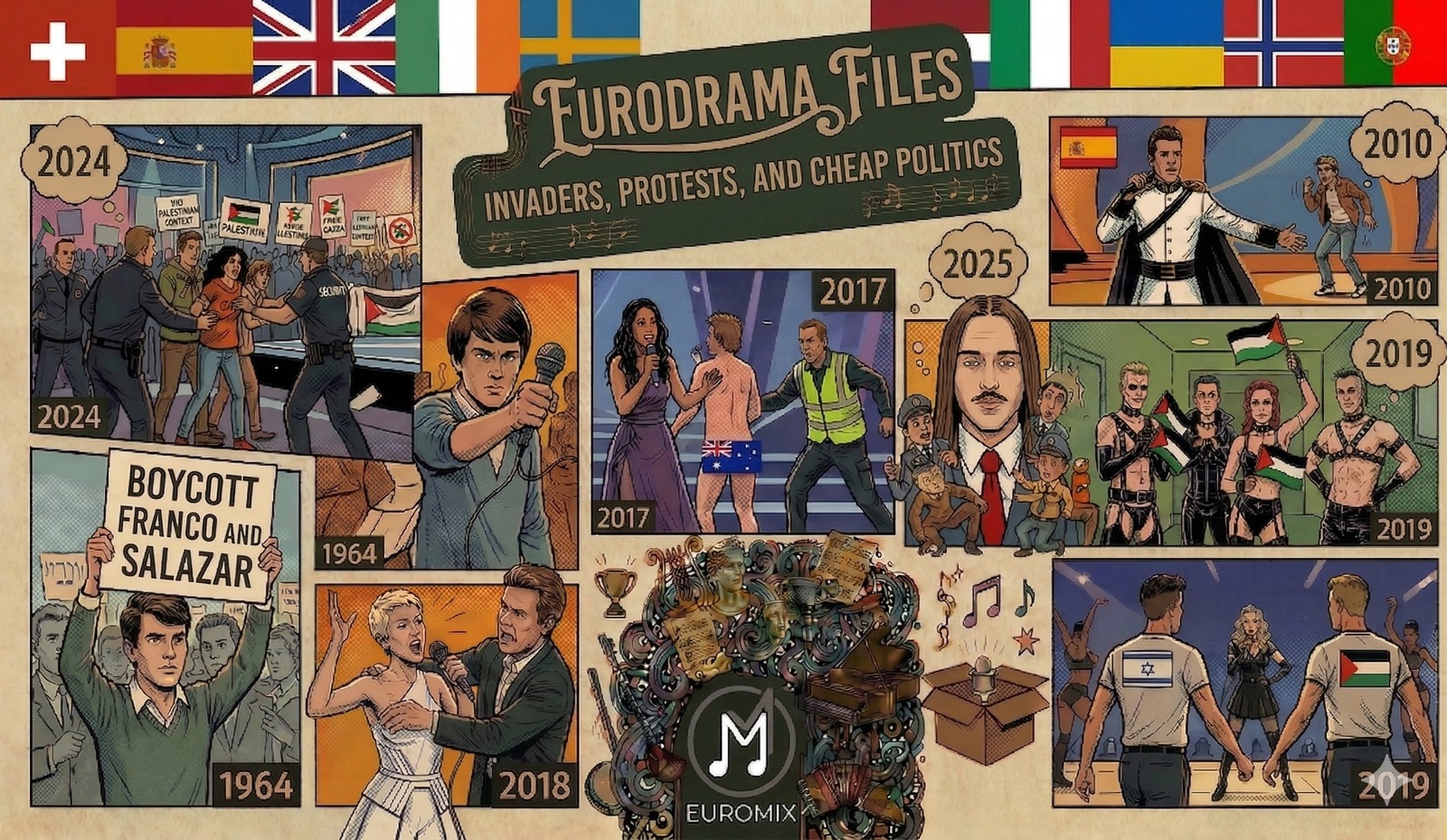
In each episode, we open a different file and return to the biggest, strangest, and most unforgettable moments that shaped the history of the world’s largest music competition. After opening the “Trophies File” in the previous chapter and discovering what happens when the prestigious prize meets the floor or even toilet paper this time we turn to the greatest nightmare of every director, producer, and security officer: losing control during a live broadcast, when the most secured stage in the world is breached before hundreds of millions of viewers. We opened the “Intruders and Protests File” to uncover what really happens when Eurovision meets hijacked microphones, political statements, Palestinian flags, and even staged provocations. From a young Danish protester in the 1960s to modern-day European political tensions, security teams, get ready.



When Spain Was the Target of a Boycott
Listening today to statements from parts of the Spanish delegation or political voices calling for boycotts over international conflicts, it may seem as if Spain has always positioned itself as Europe’s moral compass. History, however, is rich in irony. The very first person ever to storm the Eurovision stage live on air did so in protest against… Spain.
This happened at the Eurovision Song Contest 1964 in Copenhagen. A young man named Christian Panou managed to slip past security, which was far less experienced in those days. He climbed onto the stage holding a sign reading: “Boycott Franco and Salazar.” The protest targeted the participation of Spain and Portugal, which at the time were ruled by the military dictatorships of Francisco Franco and António de Oliveira Salazar.
The Danish director immediately cut the cameras to the scoreboard, Panou was removed from the stage, but the message had already echoed across Europe.
The Uninvited Sixth Dancer: The Incident in 2010
Karma, it seems, also works at Eurovision. During the Eurovision Song Contest 2010 in Oslo, Spain found itself on the receiving end of one of the strangest and most amusing invasions in contest history.
Spanish singer Daniel Diges was performing his theatrical song “Algo pequeñito” when, mid-performance, a man in a black shirt and red hat jumped onto the stage. This was Jaume Marquet i Cot, better known as Jimmy Jump, a serial pitch invader at major sporting events.
Instead of shouting through a megaphone or waving a political sign, Jimmy simply positioned himself at the center of the stage, spread his arms, and began blending into the choreography together with the dancers, as if he had rehearsed with them for months. Daniel Diges displayed remarkable professionalism, maintaining a frozen smile and continuing to sing without missing a single note. After several long and awkward seconds, Norwegian security realized what was happening and rushed onto the stage to drag him away.
Because the intrusion completely disrupted the original staging and camera direction, the organizers allowed Spain to perform the song again from the beginning at the end of the Grand Final running order. However, despite the repeated performance, it was the moment when the Spanish intruder naturally blended into the choreography that remained forever etched in the memory of Eurovision fans.
The Violent Interruption That Led to Withdrawal from the Spotlight
Eight years after the Spanish incident, a similar event occurred again but this time it was the United Kingdom that was hit, and the case was far more severe. During the Grand Final of the Eurovision Song Contest 2018 in Lisbon, British singer SuRie stepped onto the stage, visibly emotional and excited to perform her powerful song “Storm”. No one, however, could have prepared her for what was about to happen.
In the middle of her performance, a man suddenly rushed the stage as stormy as the name of the song itself and grabbed the microphone directly from her hand during the live broadcast. In the few seconds before security managed to overpower him and remove him from the stage, he used the opportunity to shout an extreme statement: “For the Nazis of the British media, we demand freedom.”
Millions of viewers watching the performance were left in shock, and the British audience reacted with outrage. Rather than panic or scream, the disappointed singer was forced to continue performing. SuRie began clapping her hands and dancing slightly, while her backing vocalists continued singing as usual in the background. Similar to Daniel Diges in 2010, she was later offered by the organizers the opportunity to perform the song again from the beginning. Unlike Spain, however, she declined the offer, explaining that she was satisfied with her performance despite the intrusion.
Although she managed to carry on professionally, the incident left her traumatized. She later admitted struggling with the fear that such a situation could happen again, and for a period she withdrew from the spotlight and from her musical career.
If you try today to find the original live intrusion in the official Eurovision YouTube upload, you will struggle to see it. The organizers chose to remove the live Grand Final performance and replace it with footage from the jury rehearsal, which takes place at the exact same time the day before the live show. Despite this attempt to erase the moment, the incident remains remembered by viewers as one of the most bizarre and unsettling moments in the contest’s history.
The Intruder, the Flag, and the Viral Moment
A year earlier, the Grand Final delivered a no less bizarre incident one that left the production, the security teams, and viewers at home in absolute shock, and it happened דווקא during the interval performance of the previous year’s winner, Jamala.
During the interval act at the Eurovision Song Contest 2017 in Kyiv, Jamala performed her new song “I Believe in You” on the grand stage. Suddenly, a man from the audience rushed onto the stage wrapped in an Australian flag. He quickly climbed up, pulled down his trousers, and exposed his backside to the cameras in front of millions of viewers watching live.
For several long seconds which felt like an eternity the cameras continued broadcasting the surreal scene before the director managed to cut to a different angle. Security personnel reacted with noticeable delay and dragged him off the stage, while Jamala did not pause for a single moment and continued singing with impressive professionalism as if nothing had happened.
It was later revealed that the intruder was a well-known Ukrainian provocateur named Vitalii Sediuk, who had previously made headlines for similar stunts on red carpets and major global events. He was arrested on the spot by local police and later received a suspended sentence along with a fine of only 280 euros.
The incident immediately became one of the most embarrassing and viral moments in the contest’s history and led the organizers and production teams in subsequent years to further tighten security procedures around both the stage and the green room.
The Double Provocation in 2019
The Eurovision Song Contest 2019 was not expected to pass quietly without anyone attempting to turn the event into a public relations moment around the Middle East conflict. Despite reinforced security around the stage and increased distance between the audience and performers following incidents in previous years, the Grand Final delivered two carefully orchestrated political provocations involving Palestinian flags this time initiated by the artists themselves, catching the organizers completely off guard during the live broadcast.
The first came from members of the Icelandic techno-BDSM band Hatari. From the moment they won their national selection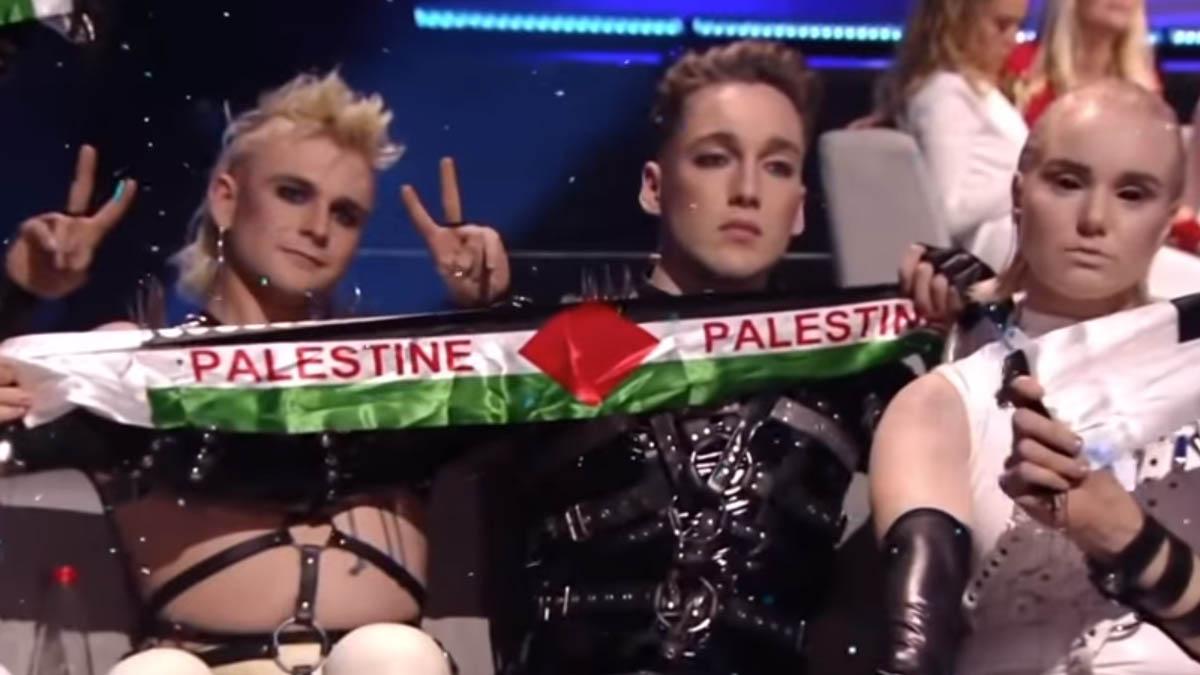 until their appearance in Tel Aviv, they had been relatively restrained regarding their opposition to Israel and support for Palestine. They saved their “grand finale” for the peak moment of the show. During the public voting results, when the camera cut to them in the green room to capture their reaction, the band members suddenly pulled out scarves printed with the Palestinian flag and displayed them to the cameras. Tens of thousands in the arena responded with loud boos, and the directors cut away within seconds. For this deliberate breach of contest rules, the organizers later fined the Icelandic national broadcaster.
Hatari were not the only ones that evening to decide the rules did not apply to them. During the highly anticipated interval act, global pop icon Madonna performed with Quavo their song “Future.” Near the end of the performance, two dancers walked up the stairs arm in arm, one with an Israeli flag on his back and the other with a Palestinian flag. Once again, the organizers and the production team clarified that this act had been completely hidden from them and had not appeared in any rehearsal. While Madonna may have intended to convey a message of unity, the result was another moment where the Eurovision stage was used to generate international controversy and media noise rather than music.
The Estonian Trick: When the Intruder Was Part of the Show
Taking the concept one step further, Tommy Cash turned a stage invasion into part of his act at the Eurovision Song Contest 2025 in Basel. During his performance of “Espresso Macchiato,” a fan appeared to rush the stage holding a sign asking to dance with him.
Security dancers tried to stop her before Cash invited her into the choreography. Moments later, it became clear this was a perfectly staged and rehearsed segment of the performance.
Whether it is a sharp political protest, a desire for fifteen minutes of fame, or part of a brilliant Estonian staging decision, the “Intruders and Protests File” proves that during a live broadcast, anything can happen. Eurovision may attempt to present itself as a sterile and apolitical event, but its stage remains an irresistible magnet for people who want to make a statement — or show a body part. Ultimately, these unplanned or seemingly unplanned moments are what make the contest so human, chaotic, and unpredictable.
In the next chapter of “Eurodrama Files,” we will open the “Voting File”: from moments when presenters confused country names, through technical malfunctions that stopped Europe’s breath, to scoreboard dramas that changed the fate of the contest in the very last second.
Eurovision 2026: the 70th edition of the contest will take place in Vienna, Austria, on May 12th, 14th, and 16th, 2026. The Wiener Stadthalle arena, which will host the event, is expected to accommodate around 16,000 spectators per show. The contest returns to Austria following the nation’s third historic win with the song “Wasted Love”, performed by JJ. It will be Austria’s third time hosting Eurovision, after previous editions held in the country in 1967 and 2015.