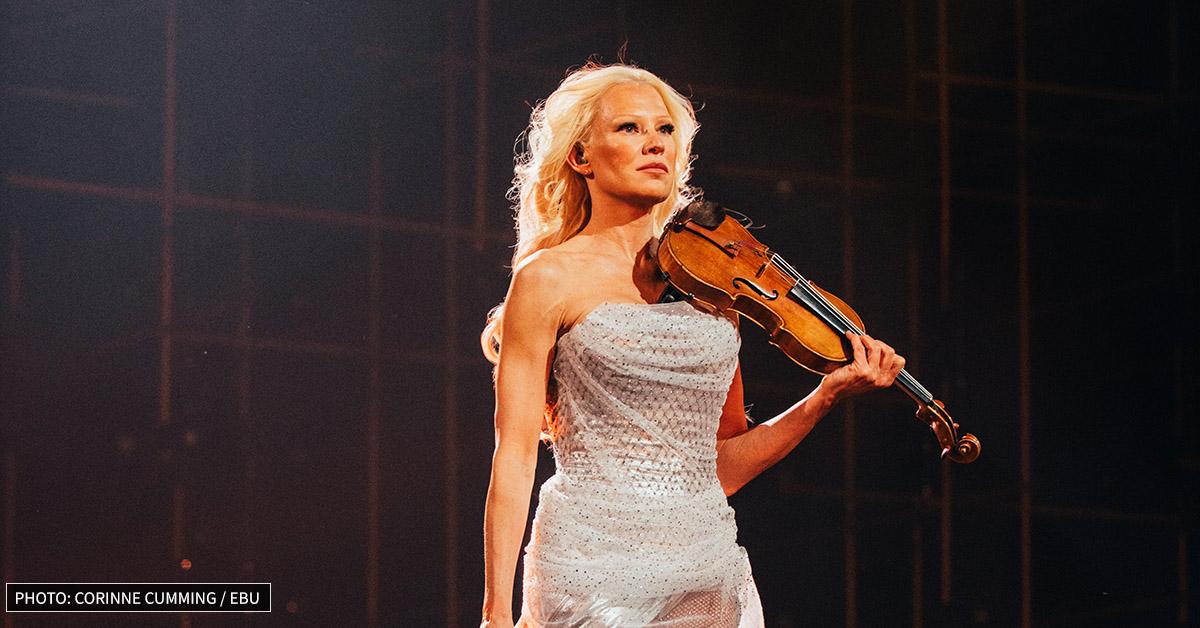
EBU grants Finland a historic exception for Eurovision 2026, allowing Linda Lampenius to perform live violin parts on the Vienna stage.
This is undoubtedly one of the most dramatic behind-the-scenes moments of Eurovision 2026 to date. Finland, currently the leading favorite to win in the betting odds, achieved an unprecedented milestone today as the EBU decided to bend one of the oldest and strictest rules of the competition: the absolute ban on live instrumentation on stage.
Since 1999, the Eurovision rules have stated unequivocally that all musical instruments appearing on stage are considered stage props only, and the backing track is what is heard in the arena and on the television broadcast. The rule was designed to prevent sound technicalities during the live broadcast and to ensure equality among the participating nations.







A Historic Exception in Vienna
However, it appears that when it involves a legend like the violinist Linda Lampenius, who performs the Finnish entry alongside Pete Parkkonen, the EBU is willing to make concessions. Following months of rehearsals and negotiations, Finland received official and exceptional approval for parts of the violin roles by Lampenius to be performed entirely live on the stage in Vienna.
The sensational news, revealed here following a EuroMix report on March 22nd regarding the submission of this unusual request to the EBU, was officially confirmed today.
“Part of History”
In an emotional post on the official Instagram account of Lampenius and Parkkonen, they wrote:
“We are very honoured and grateful to be a part of history. After countless rehearsals, trials and discussions we are proud to announce that Linda Lampenius is allowed to and will play violin-led parts live on the Eurovision stage. It brings us immerse joy that her voice will be heard through her violin on the biggest night in music.”
In a sneak peek of the second rehearsal, viewers can get a small impression of the performance expected on stage. Is the live violin already audible here? Judge for yourselves:
Can the rules change?

Since 1999, one of Eurovision’s rules has been the ban on live instrument playing on the Eurovision stage. The reason for this rule is the speed required to prepare the stage between each country’s performance – an instrument usually needs its own microphone and tuning, which can extend the setup time. In addition, the EBU also has technical concerns about sound issues arising from the use of live instruments.
Over the years, a considerable number of artists have tried to ask the EBU for permission to play live on stage. Among the memorable cases are Netta Barzilai’s looper in 2018 and Tinkara Kovač, the flutist who represented Slovenia at Eurovision 2014 and also tried to make the same request to the European Broadcasting Union while in Copenhagen.
All contestants who asked to play live on stage in the past were refused, with one exception last year. Lucio Corsi, the Italian representative, performed a harmonica solo on stage and took advantage of the fact that this instrument did not require a prior sound check or an additional microphone. The question this year is therefore whether the European Broadcasting Union will be more flexible in light of that case and in light of the fact that the Finnish song is currently ranked first in the betting tables.
Perfect hair flicks and precise camera angles: a glimpse into Finland’s plan for Vienna
Linda and Pete revealed in the Finnish newspaper “Iltalehti” that their performance on the Eurovision stage in Vienna will differ from their show at the Finnish national selection UMK. This decision stems from the major differences between the stage designs of the national final and the Eurovision arena itself. While the stage at the Nokia Arena, where UMK took place, is squared and somewhat reminiscent of the Eurovision 2025 stage in Basel, the upcoming Eurovision stage in Vienna is designed as a rounded space, with curved, classical elements inspired by the Viennese Secession movement.
To prepare for this, the Finnish national selection organisers did not hesitate and immediately set the production in motion. In a letter of around 30 pages, sent to the Eurovision production team, they provided a detailed brief for the stage direction and camera work for the duo’s performance in Vienna this May. The document includes precise descriptions of how violinist Linda’s hair should flow, after three stagehands dressed in black like “ninjas” used leaf blowers during the UMK performance so that her dress and hair would billow dramatically.
In addition, the duo’s performance at UMK featured a window prop that burst into flames mid‑performance. Because of the significant difference between the walking paths and layout of the stages, a smaller version of this prop may be required for Vienna. The drastic change in staging could also affect singer Pete Parkkonen’s live vocals to some extent, as he adapts his movement and breath control to a new stage environment that must still deliver the same dramatic impact to an international audience.
Live vocals only: behind the scenes of Finland’s national selection
Vocal coach Aija Puurtinen, who works with the UMK contestants, told the same newspaper how Pete Parkkonen, the song’s lead vocalist, is preparing for his pivotal moment in Vienna.
She shares that the singer approaches the task like a seasoned professional and barely needs guidance: “I told him – you are doing everything in an ideal and wonderful way, and if there is anything you need to ask, I will help and respond. But Pete does not need to be taught, not at all”, she said of their first training session for the national final.
Puurtinen also noted that the Finnish selection “UMK” follows Eurovision’s rules, meaning that no vocal effects can be heard during the live performance on stage. She highlighted the clear difference between the studio version and the live rendition of the song:
“At the end of the performance of ‘Liekinheitin’, Parkkonen’s voice rose so much that the audience noticed. At that point, the song did not sound the same as in the recorded version. When the final scream came, it was the highest note Pete could deliver at that moment. It was never meant to sound like the studio recording; in fact, we tried to avoid that, so it would feel like a truly live performance”.
What can we expect from Finland’s Eurovision 2026 entry?
Despite the extensive brief and detailed planning, a few minor adjustments still need to be made before the big night in first semi-final, but the performance is expected to retain the key elements from the national final. The UMK staging, which featured flying chairs and a kind of isolation room whose walls caught fire during the song, left the audience stunned and eager for more.
The tension built through Linda’s spellbinding violin lines and Pete’s gritty vocals created a hypnotic musical dialogue, and it is clear that audiences have embraced the song: it currently tops several betting tables and is enjoying strong streaming momentum in multiple markets. It will be fascinating to see how the difference in stage architecture between Tampere and Vienna will influence this already striking performance, but Finland seems to be aiming very high this year and appears ready to give everything in pursuit of a long‑awaited second Eurovision victory. If the show in Vienna matches the intensity of the national final, viewers can expect three breathtaking minutes that will leave them speechless.
In the lead-up to the national final, the two artists joined forces for the first time in an attempt to represent Finland at Eurovision 2026 in Vienna with “Liekinheitin”. The song quickly broke records for its viral spread on social media. From the moment it was released, it was marked as the clear favourite, holding a 76% probability of winning in national betting charts and even pushing Finland to first place in the international betting tables, and pushing Finland to first place in several early Eurovision prediction tables, with the country currently trending sharply upward and now standing at around a 31% chance of winning the contest itself.
The updated table can be found on the betting page on the website!
Linda Lampenius and Pete Parkkonen – Who are you?
Pete Parkkonen is a popular Finnish pop singer born in 1990 into a musical family. He first gained widespread recognition in 2008 when he took part in the fourth season of the Finnish version of Idols, where he finished in third place. After the show, he launched a successful solo career; his debut record, “The First Album”, reached number one on the Finnish albums chart. Over the years he has released music in both English and Finnish, appeared in various reality TV programmes, and established himself as one of Finland’s best-known contemporary artists.
Alongside him stands Linda Lampenius, a virtuoso violinist and cultural icon since the 1990s. Lampenius is known as one of Finland’s most versatile musicians, with expertise spanning pop, jazz, classical music, techno and a wide range of other styles. Her violin accompaniment gives the song its distinctive identity and aligns seamlessly with the contemporary and trend-conscious production of today’s pop landscape.
Finland at Eurovision 2026:
“Liekinheitin” is the title of the song to be performed by Linda Lampenius x Pete Parkkonen, who will represent Finland at Eurovision 2026 in Vienna during the first semi-final on May 12th. The entry was written and composed by the duo together with Vilma Alina, who wrote the song “Sun Sumero” that competed in the 2022 Finnish national selection, Antti Riihimäki, and Lauri Halavaara, who already collaborated with them last year on the song “Alina”, which finished third in the 2025 Finnish national selection, and who also wrote “Takatukka”, another entry in this year’s Finnish selection. The song is performed in Finnish.
The song portrays a destructive and addictive relationship, defined by a constant struggle between rational thought and an uncontrollable impulse. In the lyrics, the singer presents the dilemma that the right and sensible choice would be to walk away, yet he finds himself trapped under the spell of the other person, whom he likens to a flamethrower: a powerful figure who burns him emotionally and physically at the same time. The song highlights the painful contrast between intimate nights and emotional distance in public, where his lover behaves as if she does not know him at all, creating a sense of humiliation mixed with intense attraction.
Currently, Finland is ranked 1st on the betting odds ahead of Eurovision 2026, with 27% winning chance!
Eurovision 2026: This will be Finland’s 59th participation in the Eurovision Song Contest. Finland joined the competition in 1961 and achieved its best result in Eurovision 2006, winning the contest with Lordi and their song “Hard Rock Hallelujah”.