Strict Bag Policies and Prohibited Items
As part of the security preparations for the Eurovision events, strict procedures have been defined regarding the entry of bags, which represent a primary security concern for the smuggling of dangerous equipment. Bags must not exceed the size of an A4 sheet of paper, and there is an absolute ban on bringing backpacks or other large containers.
However, during particularly sensitive times, the rules will be significantly tightened. During the festive Opening Ceremony held at the City Hall square on May 10th, and during the Grand Final on May 16th at the Wiener Stadthalle, a total ban on bags will be in effect. For these specific events, visitors will only be permitted to bring items that can fit into their pockets, with one exception allowing the use of tiny transparent bags up to A6 size. These measures are designed to streamline entry procedures and ensure maximum public safety.
In addition to the bag regulations, several items are strictly prohibited from the venues. The following list of items is banned:
Alcoholic beverages are completely forbidden; only non-alcoholic drinks in open, shatterproof containers with a maximum capacity of 0.5 liters will be permitted. While strollers are generally allowed and flags are permitted, the latter are subject to complex regulations. Each individual may bring only one flag, no larger than A2 size. Furthermore, flags must be made of flame-retardant material, and flagpoles are prohibited. The city administration and police warn that racist, offensive, or discriminatory content is strictly forbidden.
Transport Adjustments and “Tour Guide” Officers
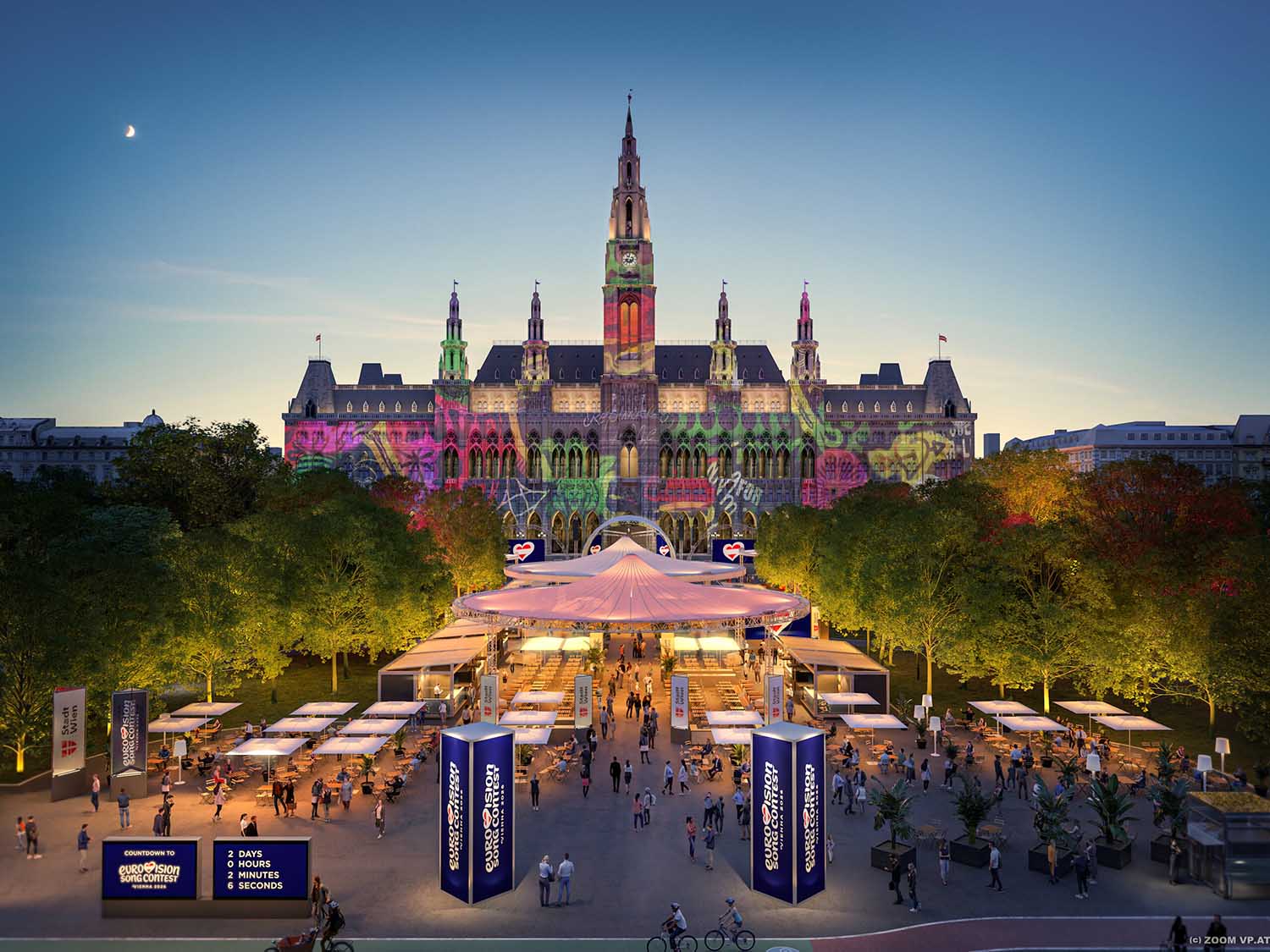
Due to the expectation of heavy crowds during the live broadcasts, the City of Vienna and the local police have announced an expansion of the “Eurovillage” at the City Hall. On the dates of the Semi-finals (May 12th and 14th) and the day of the Grand Final (May 16th), the central “Ring” road in the University area will be closed to traffic starting from 12:00 CET. This road closure will allow the venue’s capacity to double from 15,000 on a regular day to 30,000 simultaneous visitors. Following these closures, changes will apply to tram lines D, 1, and 71. Dieter Csefan, the Deputy Chief of Police, emphasized that these steps were taken to ensure the event is safe and enjoyable for tens of thousands of fans.
Starting May 11th, the Tourist Information Center at Albertinaplatz will become the intelligence hub for guests. Alongside maps and explanations of cultural sites, local police officers will be stationed daily at a dedicated information desk. This move, aimed at bridging the gap between enforcement forces and the international audience, will allow fans to receive direct answers regarding personal safety, pickpocketing prevention, and navigation through the busy public spaces of the First District. This approach prioritizes prevention and information over rigid enforcement, based on the understanding that security begins with the visitor’s sense of comfort.
Logistics and Security Challenges: Nakba Day and Protests
To manage the surge of visitors arriving from more than 80 countries, the tourism board has established a network of six “Welcome Desks” at strategic points throughout the city. Beyond the standard reception points at the airport and the main railway station, a special desk has been set up at the “Eurofan House” in the Vienna Museum, as well as two dedicated stations at the competition venue, the Wiener Stadthalle, which will serve delegations and the 2,600 journalists arriving for the major event. Approximately 30 staff members and volunteers will operate at these hubs, equipped with information about the “Vienna Offstage” program – the parallel schedule of events occurring outside the arena, including performances, parties, and cultural events across the city.
The true security challenge keeping the local police awake is the wave of protests expected to reach a boiling point. The timing of the competition coincides with “Nakba Day” (observed on May 15th), and the combination of the date with the international event intensifies the street presence. Reports indicate that a major demonstration has been registered for May 16th, the day of the Final, under the slogan “No stage for the legitimization of genocide – Freedom for Palestine.” Protest organizers expect approximately 3,000 participants to march directly toward the park adjacent to the Wiener Stadthalle.
This demonstration follows a “Song Protest” event scheduled for the day before the Final, involving approximately 1,000 people. Among the participants will be the Portuguese musician Dinis Mota, who competed in this year’s Portuguese national selection, “Festival da Canção”, but declared he would not take part in the contest. Additional protests have already been registered in front of the studios of the Austrian national broadcaster, ORF.
True security is also found in the small, invisible details. Coordination meetings began in March with the city’s luxury hotels to prepare them for 21st-century scenarios. Under the “Hotel Awareness” guide, hotel staff were instructed on how to handle cyber threats, protect VIP guests, and manage protests that may arise around the event. Even the closure of the Ringstrasse was carefully planned to allow traffic flow alongside maximum protection for participants. Vienna appears more ready than ever to prove it is not only a global cultural capital but also a host that knows how to protect its guests.