Ireland’s national broadcaster says a return to the contest will be difficult unless the situation in the Middle East changes or Israel stays out.
RTÉ has announced Ireland’s continued boycott of Eurovision in 2027, raising a question among many fans worldwide: when and how could the country return to the contest?


The CEO of Ireland’s national broadcaster RTÉ, Kevin Bakhurst, answered that question in a recently published interview. According to Bakhurst, it will not be easy for Ireland to return to the contest as long as the situation in the Middle East does not change, or as long as Israel takes part in Eurovision.
Bakhurst said he had spoken with colleagues in the industry, and that several other countries that decided not to take part last year may make the same decision again next year. As the head of RTÉ, he said he feels the decision was easy for the national broadcaster to make, given that it knows where Irish public opinion stands, unlike other countries where the question of participating in the contest is far more divisive. Bakhurst added that, given the current situation in the Middle East and Irish public opinion, it would be very difficult for Ireland to take part next year, which is why RTÉ chose to announce the continued boycott in advance.
It should be recalled that after RTÉ announced Ireland’s continued boycott of Eurovision in 2027, it emerged that Iceland will also not take part in Eurovision 2027. The Dutch national broadcaster AVROTROS announced the same, but a different national broadcaster, NPO, then tried to take its place. That attempt failed and led to an announcement of the Netherlands’ withdrawal last week, following pressure on NPO. Two more countries that have stayed away from the contest have an unclear return: Slovenia and Spain. Spain’s RTVE continues to lead a firm line against Israel, while Slovenia’s RTV SLO has already said that its decision on returning to the contest does not depend on Israel. The two remaining countries are expected to announce their decisions on participation by December.
RTÉ’s Statement and the Football Fixture
Ireland was the first country to announce a boycott of Eurovision 2027 – it will not only refrain from competing, but will also not broadcast the contest. In its statement, RTÉ explained the decision by saying: “participation cannot be justified while the killing and terrible humanitarian crisis in Gaza continues, which continues to put many human lives at risk.” The national broadcaster added that it “expresses concern about the inability of international journalists to independently enter the territory [Gaza]”
About a month ago, Ireland’s national football team played Israel. In a letter sent to a workers’ organization that had threatened to boycott Israel, RTÉ said: Not broadcasting these games would constitute a breach of contract, jeopardise RTÉ’s existing broadcast rights, and negatively affect RTÉ’s ability to acquire sports broadcasting rights in the future.” It continued: “Unlike the recent situation with the Eurovision Song Contest – where, as a participating member, RTÉ had complete freedom of action in deciding whether not to participate or not to broadcast – broadcasting these games is mandatory under RTÉ’s rights contract.”
Ireland vs. Israel at Eurovision

Ireland is known for particularly tense relations with Israel at Eurovision. The most prominent expression of this is the singer Bambie Thug, who represented Ireland at Eurovision 2024 with “Doomsday Blue” and finished 6th with 278 points, one place behind Israel in 5th.
Bambie repeatedly spoke out against Israel’s participation, both during the contest period and afterwards. During the contest, they showed clear support for the Palestinians, including by wearing writing in ancient Irish on their face calling for a ceasefire, wearing a Palestinian keffiyeh, and displaying watermelon-shaped cushions in the green room during the voting. These actions intensified the controversy surrounding Israel’s participation in the contest.
Since Ireland’s withdrawal from the contest, many voices from the country have declared their support for the decision and have criticized Israel. Johnny Logan, the legendary Eurovision winner and one of the most prominent figures in the contest’s history, revealed that he refused no fewer than four times to take part as a guest in this year’s contest because of his stance against Israel’s participation. 1994 Eurovision winner Charlie McGettigan declared his agreement with Logan, sharply criticizing the European Broadcasting Union (EBU) and even deciding to return his winner’s trophy in protest at Israel’s participation.
In contrast, Dana Rosemary Scallon, Ireland’s first Eurovision winner, who won in 1970 with “All Kinds of Everything“, shared that she thinks Eurovision should remain free of politics and that “she hopes music can be a space where people can unite.”
Ireland in Eurovision 2025
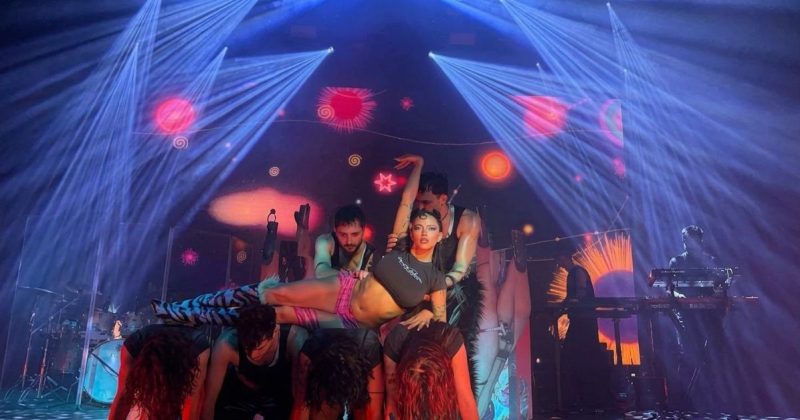
“Laika Party” is the name of the song performed by singer EMMY, who represented Ireland in the second semi-final of Eurovision 2025 held in Basel, Switzerland. Ireland failed to qualify for the Grand Final, finishing 13th out of 16 with just 28 points.
Over the past five years, Ireland has reached the Grand Final only once.
Eurovision 2025: This was Ireland’s 58th participation in the contest. The country joined Eurovision in 1965 and is tied with Sweden for the most wins, with seven victories. Ireland’s most recent win came in 1996 with the song “The Voice”, performed by singer Eimear Quinn.