Protests and boycott calls against Israel’s Eurovision participation only strengthen its position. Why do European audiences vote for Israel? How did unprecedented support for Israel emerge? An opinion piece.
The Eurovision Song Contest is meant to be a musical celebration, but in the past two years, it has turned into a stage for political conflicts, especially regarding Israel’s participation. Since the announcement of the participant list, waves of protests have swept across Europe. These include public opposition from politicians, political commentary from national broadcasters, and even withdrawal of spokespersons who announce the votes. The message was clear from all sides: “There is no place for Israel in Eurovision.”
However, the reality proved more complex. The louder the calls to exclude Israel became, the stronger public support for the Israeli delegation grew. In fact, antagonism, boycotts, boos, and extreme rhetoric became the catalysts that united viewers behind Israel’s representative.
Broad Opposition Front: Artists, Governments, and National Broadcasters Against Israel
The list of examples is extensive:

- More than 70 former artists, including Eurovision winners, signed a public letter calling for Israel’s disqualification on the grounds that it “violates human rights.”
- National broadcasters from Spain (RTVE), Slovenia (RTVSLO), and Ireland (RTÉ) issued strong statements opposing Israel’s participation and urged the European Broadcasting Union to reconsider its decision.
- The Spanish Prime Minister, Pedro Sánchez, added fuel to the fire by openly expressing reservations about Israel’s participation—an unprecedented move in the Eurovision political landscape.
Even within the contest venue, the storm continued:
- Boos were loudly heard in the arena every time Yuval Rafael, Israel’s representative, took the main stage—both during the general rehearsal and the live broadcast.
- Activists waved Palestinian flags in the stands, with some holding political signs.
- Attempts were made to burst onto the stage during the Israeli performance with the aim of disrupting Yuval Rafael.
- At the opening ceremony, a spectator in the stands directed the “slaughter” gesture at the Israeli delegate—a move that shocked the public and drew widespread condemnation on social media.
- Last year, death threats were directed at Israel’s representative Eden Golan, who faced waves of booing during every performance.
European Audiences Stand with Israel: Diverse Sectors, Varied Reasons
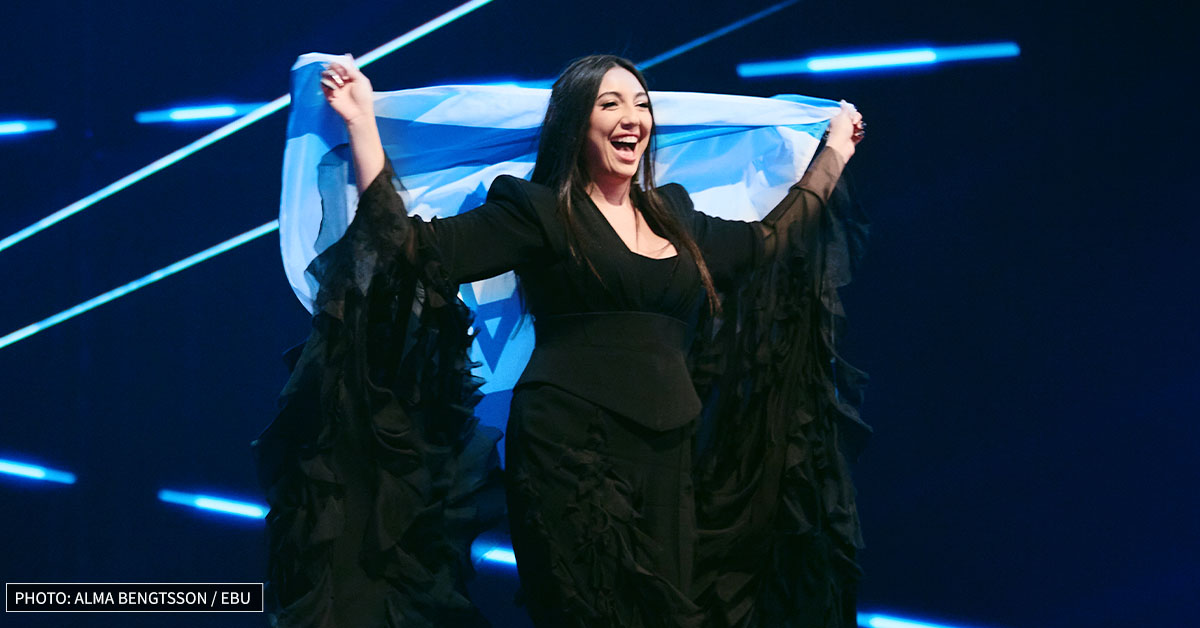 Then came a counteraction. European audiences, not beholden to any particular government or national broadcaster’s editorial line, are composed of diverse individuals: Jews who understand Israel’s policies; right-wing voters opposing Muslim migration into Europe; other minorities targeted by terrorism; and members of the LGBTQ+ community who recognize Israel as the only country in the Middle East with significant rights acknowledgment for this community. All unite around Israel, regardless of the song’s quality or performance.
Eurovision Voting System Creates an Advantage: No Votes Against
Those opposing Israel and calling for a boycott split their votes among 36 other countries. Eurovision’s voting method does not allow voting against a country, only for one. Therefore, when there is a coordinated boycott campaign against Israel amid loud dissenters in the streets, one-sided media favoring Palestinians, and politics dominating the contest, Israel’s supporters unite. The more efforts to exclude Israel, the more viewers call for Israel’s inclusion!
Jury vs. Public Voting Gap: Fear of Boycott
The gap between the public’s reaction and the judges’ decisions becomes especially apparent in such cases. The contest’s judges—many mainstream artists, singers, and creators—fear publicly identifying with Israel due to risk of boycott or reputational damage. They exercise caution, forming a unified and distant stance from Israel, while the free public acts differently. The public supports Israel not only for political reasons but also to oppose boycotts, persecution, and the politicization of a cultural platform.
The Boomerang Effect: The More Israel Is Attacked, the More Support It Gathers
Every criticism or attempt to delegitimize Israel feeds the “boomerang” effect, which paradoxically becomes the largest driver of support. Accusations such as “vote rigging” or “vote coordination” reflect a fundamental misunderstanding. When votes accumulate for a campaign, it is not manipulation but a natural side effect of antagonism. The more Israel is pushed away, excluded, and criticized, the more the broad public mobilizes for civic, moral, and cultural reasons (and, of course, simple love of music) to vote for Israel.
The story has turned upside down: those who believed boycott calls would weaken Israel ended up uniting many supporters around it. The stronger the opposition on and off stage, the more votes Israel received from the audience motivated by solidarity and protection. At the end of the evening, when the voting results were announced, the message was clear: You may want to push her out—but we invite her in.
Protests Create the Opposite Effect: A Boomerang of Strength. Against boycott. Against mixing politics in the contest.
Israel at Eurovision 2025
“New Day Will Rise” is the song performed by Yuval Raphael, who was chosen to represent Israel after winning the 11th season of “The Next Star.” Israel advanced to the final after winning the second semi-final with 203 points and finished second overall with 436 points in the grand final. Israel ranked first in the public vote but only 14th with the jury. This marks the third consecutive year that Israel has reached the top five – an unprecedented achievement.
Eurovision 2025: This was Israel’s 47th participation in Eurovision. Israel joined the contest in 1973 and has won four times. Its most recent victory was at Eurovision 2018 with the song “Toy,” performed by singer Netta Barzilai.

Email: [email protected]
Phone: +972-50-9441919
Avi Zaikaner is an editor-in-chief, content creator, commentator, and international expert on all things related to the Eurovision Song Contest. Avi has followed the contest for nearly 30 years, and for the past seven years has served as the founder and editor-in-chief of EuroMix, one of the top Eurovision websites in the world, with over 1.5 million users annually.
Since 2021, Avi has provided on-the-ground coverage of the Eurovision Song Contest from the press center in the host city, bringing readers exclusive firsthand experiences, professional analysis, and direct reactions from audiences, artists, and experts. His extensive experience and deep familiarity with the Eurovision world are reflected in every article, ensuring reliable, professional, and up-to-date information.
Avi is recognized as a leading Eurovision opinion maker in Israel, frequently interviewed by major media outlets, collaborating with international experts, and publishing professional content on additional platforms. Every article is written with a commitment to accuracy, transparency, and understanding the audience, with a strong emphasis on fact-checking and presenting a diverse range of opinions.