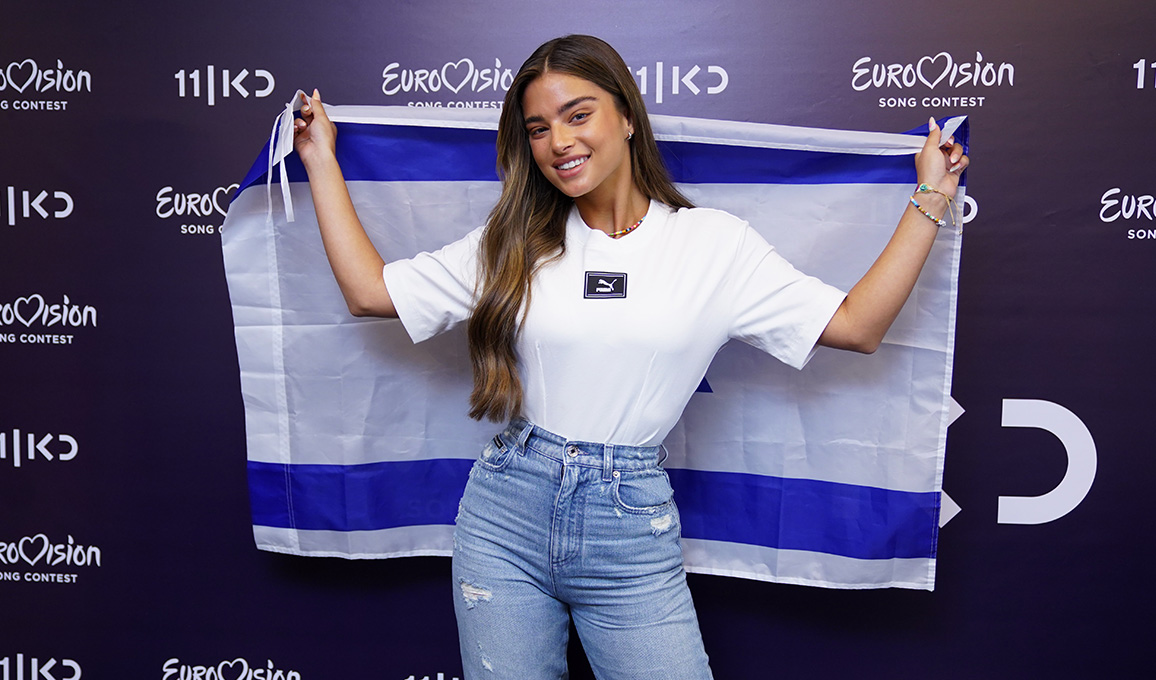
Eurovision star Noa Kirel faces backlash from Spanish media after her new World Cup music video sparked political controversy.
Photo Credit: Avi Zaikaner
Eurovision 2023 entrant Noa Kirel is once again at the center of an international media storm. Just days after launching her new World Cup song, “חושב שאתה מסי” (in English: ״Thought You Were Messi״), created in collaboration with sportswear giant Adidas, a wave of furious reactions has emerged from Spain. The official music video, featuring Kirel stepping into the role of a goalkeeper and saving penalties from a player wearing the Spanish national team jersey, was interpreted in the European country as a deliberate political attack amidst ongoing diplomatic tensions between the nations and the pro-Palestinian stance of the Spanish government.






Spanish Media and Socials React
Fierce criticism on X (formerly Twitter) and across Spanish media followed rapidly, targeting not only Kirel but also her partner, goalkeeper Daniel Peretz. Spanish-Moroccan sports journalist Leyla Hamed posted on her X account: “Israeli singer Noa Kirel has released a video where she confronts Spain’s NT and saves all their penalties. Worth remembering her boyfriend is Daniel Peretz: Bayern’s worst keeper this century, Hamburg benchwarmer, now Championship keeper. Embarrassing. Israel’s obsession with Spain since the country stood with Palestine is nothing new.” Hamed also called on the Royal Spanish Football Federation (RFEF) to intervene, expressing bewilderment that a brand like Adidas would sponsor the project.
Israeli singer Noa Kirel has released a video where she confronts Spain’s NT and saves all their penalties.
Worth remembering her boyfriend is Daniel Peretz: Bayern’s worst keeper this century, Hamburg benchwarmer, now Championship keeper. Embarrassing, pic.twitter.com/0kI2oInubu
— Leyla Hamed (@leylahamed) July 8, 2026
The backlash against the singer escalated further with a particularly harsh article published on the left-leaning Spanish news website Público, titled “Zionism and Ridiculous Events Go Hand in Hand”. The piece claimed that the music video serves as “propaganda for a failed state” aimed at “whitewashing barbarism.” The authors went even further in their artistic interpretation of the dance, arguing that Kirel’s movements and choreography are “a metaphor for the murder of minors in Gaza and illegal occupation.” The publication concluded by advising its readers to “be decent people, unlike Noa Kirel and the country she represents.”
Noa Kirel Responds with Message of Peace
Apparently responding to the growing controversy, the singer uploaded a story to her Instagram account stating: “España, tranquilos” (in English: “Spain, calm down”).

Simultaneously, Kirel shared a post on her official Instagram account promoting a message of peace and unity between the countries. In the photo, she sits on the pitch holding the flags of Israel and Spain in both hands. A massive flag of Argentina hangs in the background – a direct reference to the song’s title – while a white football decorated with a dove carrying an olive branch, a clear symbol of peace, rests beside her. Kirel captioned the post in Spanish: “Viva España, viva Argentina y viva Israel!” (in English: “Long live Spain, long live Argentina, and long live Israel!”).
הצגת פוסט זה באינסטגרם
Context: Eurovision Strains and Spain’s History
For Eurovision fans, the current Spanish outrage towards an Israeli artist comes as no surprise, as it aligns with the public mood that led to Spain’s dramatic withdrawal from the Eurovision Song Contest. Spain has a rich and glorious history at Eurovision, having made its debut in 1961. The nation secured two consecutive victories in the 1960s: the first in 1968 with singer Massiel performing “La, la, la“, and the second in 1969 with Salomé and her entry “Vivo cantando” (in English: “I Live Singing”) during the historic contest in Madrid that ended in a four-way tie. Spain remains one of the few nations (alongside Ireland, Israel, and Luxembourg) to win the contest twice in a row. Over the years, Spain was designated as one of the “Big 5” major financial contributors, securing an automatic place in the Grand Final each year.
However, political and public pressure within Spain against Israel’s participation in the contest mounted significantly in recent years. This pressure culminated when the Spanish national broadcaster, RTVE, backed by the local government, announced its official withdrawal from Eurovision starting from the most recent contest – a move that sent shockwaves through the European Broadcasting Union (EBU) due to the loss of a major financial contributor. The ongoing controversy surrounding Kirel’s World Cup music video demonstrates that tensions between the nations remain high, with both music and sports continuing to serve as an intense political battleground.