
Luxembourg Song Contest finalist Irem faces a PR storm after a fake social media account engages in controversial political and personal online disputes
The Luxembourgish national broadcaster, RTL, unveiled the songs for the “Luxembourg Song Contest 2026” yesterday (Thursday), where the representative for Luxembourg at Eurovision 2026 in Vienna, Austria, will be chosen. One of the contestants is Irem with the song “Bad Decisions (Hush Hush)”. While Eurovision fans are still processing the eight revealed songs, the real drama seems to be unfolding on Twitter and Instagram.





Social Media Drama Surrounding Irem
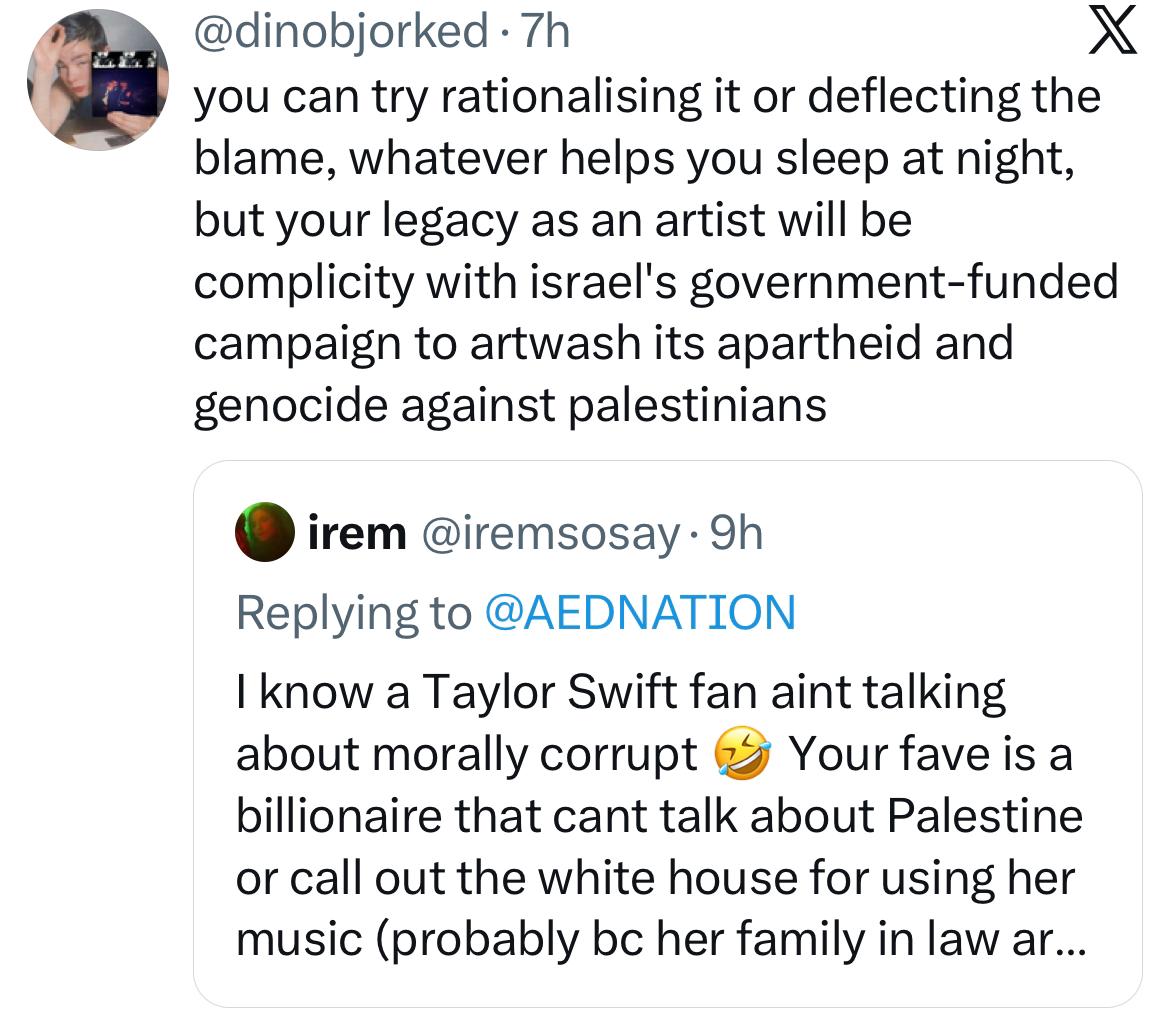
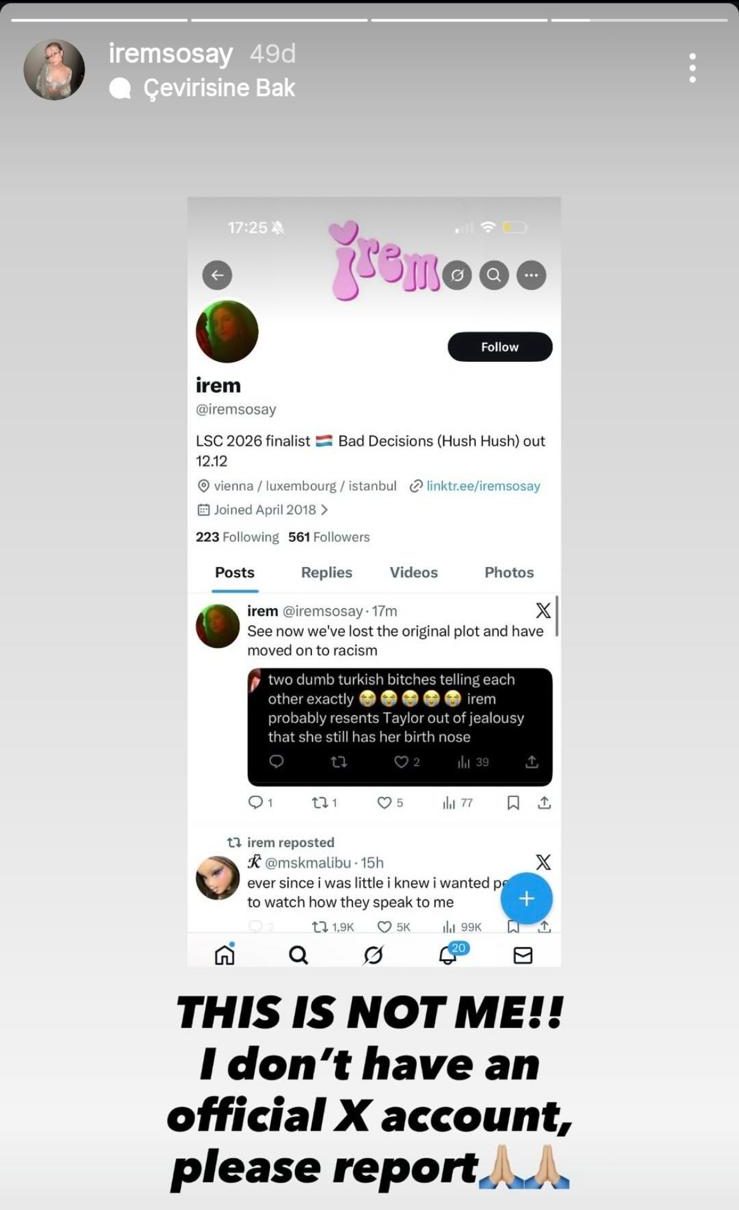
Irem, one of the prominent contestants in the national final, is at the center of the current storm. In recent hours, screenshots have been circulated showing sharp comments written from an account using her name, including harsh statements about Taylor Swift and people who criticized her. Irem discovered that an anonymous person had opened a fake account in her name on the social network X (formerly Twitter). The counterfeit account, which used the handle @iremsosay, looked quite authentic: it included her official photo, and the bio line stated: “LSC 2026 Finalist, song out 12.12”.
According to the screenshots circulating among the fan community on the social network X, the impersonator did not stop at simply using her identity but began engaging in public arguments with other users. In one viral screenshot, the fake account is seen responding to heated discussions about the singer’s Turkish origins and racist remarks, using language inappropriate for an official representative in a state competition. The tweets caused great confusion among Eurovision fans, some of whom believed it was the singer herself.
Controversy and Political Incitement
In another post, the impersonator did not merely “troll” but seemingly attempted to drag Irem into political discourse, potentially to sabotage her chances or make her a target of activist groups and protestors. In one piece of documentation, the impersonator is seen responding to a user named @AEDNATION (identified as a fan of pop star Taylor Swift), who had apparently leveled accusations of “moral corruption” against the star. The impersonator did not hold back and responded with a tweet designed to ignite the network: “I know a Taylor Swift fan is not talking to me right now about moral corruption”, the impersonator wrote in Irem‘s name. “Your favorite is a billionaire who can’t speak about Palestine or criticize the White House”.
The singer, who was horrified by the misuse of her name, quickly published an unambiguous clarification on her official Instagram account. In a story she uploaded, she included a screenshot of the fake profile and wrote in large letters: “THIS IS NOT ME!! I DON’T HAVE AN OFFICIAL X ACCOUNT, PLEASE REPORT 🙏🙏”.
It is hard to ignore the irony hidden in the name of her song for the competition – “Bad Decisions”. While Irem herself has not made any mistake, it seems the impersonator who decided to get into trouble with the ‘Swifties’ certainly made a particularly bad decision.
Luxembourg in Eurovision 2025
“La poupée monte le son” (in English: “The Doll Turns Up the Sound”) is the title of the song performed by Laura Thorn, who represented Luxembourg at Eurovision 2025 in Basel, Switzerland. Luxembourg qualified for the final from seventh place in the semi-final with 62 points and finished 22nd in the final with 47 points – 23 from the jury and 24 from the public.
Eurovision 2026: This will be Luxembourg’s 40th participation in Eurovision. Luxembourg joined the competition in 1956, was one of the seven founding countries, and has won it five times over the years. Luxembourg’s last victory was at Eurovision 1983 with the song “Si la vie est cadeau” performed by singer Corinne Hermès. In 2024, Luxembourg returned to the competition after a 31-year absence.

Email: [email protected]
Phone: +972-50-9441919
Maor Heumann has been writing about the Eurovision Song Contest and following it for over three decades. He has attended five contests and has found something to appreciate in almost every possible musical genre — from the sugary pop entries that finish last in the semi-finals to the quirky avant-garde pieces that even the competition’s juries struggled to connect with. He usually prefers original languages and songs with depth over Swedish-produced English clones — though he doesn’t promise to stick to that rule.
He grew up on the kibbutz of Sara’le Sharon, who instilled in him a love for music and created his first connection to the contest back in 1993 — before most of the current editorial team was even born.