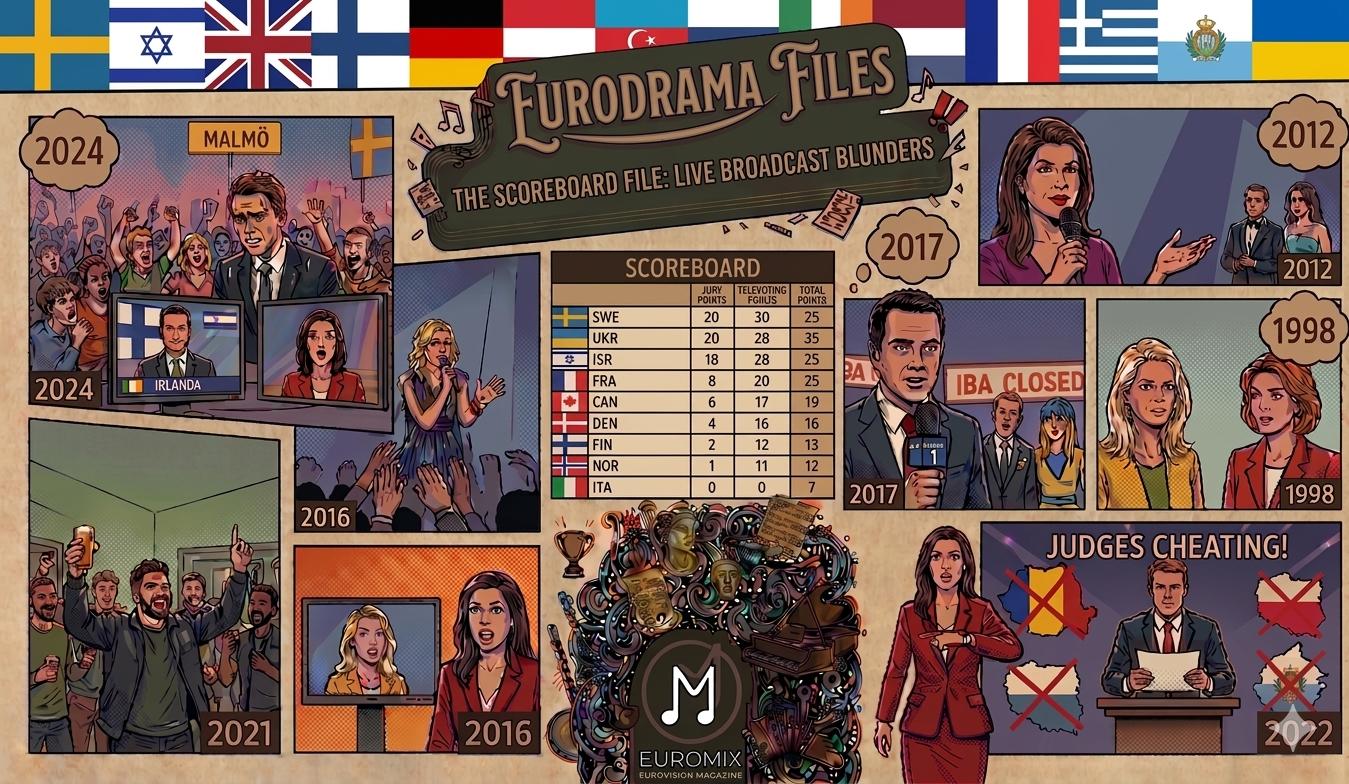
Unforgettable Eurovision voting disasters, political protests, jury scandals, and iconic zero-point humiliations that production teams wished viewers would forget.
Seventy years ago, in a small casino hall in Lugano, Switzerland, only seven countries gathered for a modest song contest. There were no Finnish monsters, no wind machines, and no glass trophies shattering live on air. Seven decades later, the Eurovision Song Contest is no longer just a song competition – it is one of the biggest pop‑culture phenomena in the world. To mark the contest’s 70th anniversary, the “Eurodrama Files” series by EuroMix editors Roie Ben Hoor, Talya Raviv and Oscar Diefenthal continues its journey deep into the archives.
In each episode, we revisit moments that shaped Eurovision history. After the “Intruders and Protests” case, we now turn to a different nightmare: the voting sequence. What should be the most suspenseful part often becomes live TV chaos with language issues, technical failures, attention-seeking spokespersons, and even political tension.
Welcome to the “Voting File.” Get your scoreboard ready.



When Politics Steals the Spotlight
The European Broadcasting Union loves repeating like a mantra that “Eurovision is not a political event,” but anyone watching the voting sequence knows this is the evening’s best joke. The moment the map of Europe lights up on the screen, the music steps aside and gives way to historical conflicts, regional alliances, and real-time protests. Over the years, voting spokespersons and audiences in the arena have used their precious seconds on air to deliver sharp diplomatic messages or simply provoke neighboring countries. Here are several moments when politics exploded in the production’s face.
Sweden 2024: The Booing Chorus Against the Supervisor – It is impossible to discuss voting drama without recalling Malmö. Remember the dramatic disqualification of Dutch representative Joost Klein just before the Grand Final of Eurovision Song Contest 2024? And the tension surrounding Israel’s participation amid war? As a result, the arena audience and viewers at home turned contest supervisor Martin Österdahl into public enemy number one. Every time he opened his mouth to confirm the votes, he was met with deafening boos unlike anything heard before at Eurovision. The humiliated Österdahl continued professionally, but a year later he was no longer in the role and stepped away from the spotlight. Coincidence, or did the embarrassment take its toll?
The Jury Rehearsal Drama (2024): The Spokesperson Who Refused to Say “Israel” – The chaos in Malmö did not end with the live broadcast. During the jury rehearsal, where fake votes are read to rehearse cameras and graphics, Finland’s voting spokesperson was drawn to award the imaginary 12 points to Israel. Everything went as planned until, in a display of stunning unprofessionalism, she simply refused to say the word “Israel,” and instead awarded the points to Ireland. Host Petra Mede was visibly embarrassed and asked the Finnish spokesperson to “read the results again,” but she again said Ireland. Ultimately, it was Martin Österdahl who announced Finland’s imaginary points himself.
The “Anti-Booing Technology” – During the Grand Final voting of Eurovision Song Contest 2015, every time Russian representative Polina Gagarina received 12 points, the Vienna audience responded with piercing boos following Russia’s annexation of Crimea the previous year, despite the singer declaring herself apolitical. The situation escalated so much that the frightened production activated a special real-time sound system known as “anti-booing technology,” overlaying fake applause over the arena audio to prevent a diplomatic incident on air.
The Hosting School of Petra Mede
Hosting the voting sequence requires nerves of steel. There are always broadcast delays, spokespersons who do not understand English, and endless technical issues. While most hosts maintain a polite plastic smile regardless of circumstances, legendary Swedish host Petra Mede who hosted Eurovision in 2013, 2016, and 2024, brought a completely different approach to the screen: pure Swedish cynicism and zero tolerance for nonsense. Mede turned interactions with voting spokespersons into an art form and proved that she was the undisputed boss of the stage.
The Greeting Eliminator: If there is one thing Mede hates, it is time-wasting greetings. When spokespersons across Europe began reading long, flattering scrolls of unnecessary compliments (“Thank you for the amazing hosting, your set is stunning, the evening was magical…”), she would cut them off with a now iconic line: “Yes, yes, we know it’s been a wonderful show, just give us the points!”
Lena Loses It: In 2013, singer Lena, Germany’s Eurovision 2010 winner and the country’s representative the following year, delivered the German votes and completely lost track. She first announced that 10 points were going to Norway which had already received points from Germany and was already on the scoreboard.
When Lena realized the mistake, she panicked, muttered a quiet curse, and mumbled to the camera, “Oh God, there’s been a mistake here!” And Petra? Instead of trying to calm her down or help her out of the awkward moment, she simply stood there with a frozen Swedish smile, laughed lightly at her expense, and waited for Lena to pull herself together alone in front of all of Europe.
There is no doubt that Mede’s ability to combine cynicism with professionalism made her one of the most memorable figures for viewers at home, explaining why Sweden repeatedly chose her to host.
Israeli Cringe and Jury Scandals
Some blunders end in laughter, while others cause the EBU leadership to sweat in their suits. The voting sequence has repeatedly exposed the contest’s uglier, more corrupt side, with jury manipulations revealed live and forcing production into awkward improvisations.
Ukraine 2017: Israel “Says Goodbye” to Eurovision – A particularly embarrassing moment lost entirely in translation. Because Israel’s broadcaster at the time was shutting down that week, Israeli spokesperson Ofer Nachshon used the platform for a dramatic farewell speech: “This is the Israel Broadcasting Authority calling from Jerusalem: Israel has participated in Eurovision for 44 years, winning three times, but tonight is our last night. The Israeli Broadcasting Authority will close forever.” Hosts in Kyiv and viewers across Europe misunderstood the context and believed Israel had just announced live that it was withdrawing permanently from Eurovision.
When Spokespersons Went Viral
A voting spokesperson has exactly thirty seconds of fame. But sometimes, those seconds turn into viral eternity.
United Kingdom 1998: The Glorious Insult – British host Ulrika Jonsson turned to the Dutch voting spokesperson, singer Conny Vandenbos, who had represented her country three decades earlier. Conny excitedly shared: “My heart goes out to the participants tonight, because I know what they feel.” Ulrika, who was merely trying to keep the small talk going while struggling with deafening noise in the arena, responded naturally into the open microphone: “That was a long time ago, wasn’t it?” The surprised Conny politely answered, “Yes, in 1965,” but the audience in Birmingham had already burst into roaring laughter, assuming the host had just unintentionally called the elderly spokesperson old live on air. This blunder was immediately etched into the contest’s history books.
Sweden 2016: The Painful Off-Key Tribute – When French spokesperson Élodie Gossuin went live at peak energy, she decided to pay tribute to that year’s French entry “J’ai Cherché” (English: “I Searched”), performed by French-Israeli singer Amir Haddad. In the middle of announcing the votes, she suddenly began loudly screaming the “You-hou-hou-hou-hou” from the chorus in such an exaggerated and off-key manner that host Petra Mede was left stunned and completely speechless while trying not to burst into laughter. Mede’s forced smile became an eternal GIF, and Gossuin’s painful singing was forever engraved in viewers’ memories.
Ireland 1981: When the Points Disappeared – Host Doreann Ní Bhriain turned to the Yugoslav jury team to receive the country’s points and simply received no response. After a particularly long, echoing, and painfully awkward silence, the Yugoslav spokesperson finally replied in despair to the host requesting the votes: “I don’t have it.” The audience in Dublin exploded with laughter, and the phrase became a running joke among Eurovision fans to this day.
The Cruelty of “Zero Points”
In 2016, the European Broadcasting Union decided to stretch viewers’ nerves to the limit and changed the voting system. Instead of combining jury and public votes together, the hosts began announcing the public votes at the end of the evening in ascending order. This created phenomenal television moments, but also some of the most heartbreaking scenes ever broadcast on screen the moment when the hosts pause, take a long breath, and say: “I’m sorry… zero points” to a delegation sitting shattered in front of the cameras. The event quickly became an official trauma for several countries, with one particular country standing out.
Germany’s Serial Collapse: It almost seems as if the new system was invented specifically to torment Germany. In 2019, the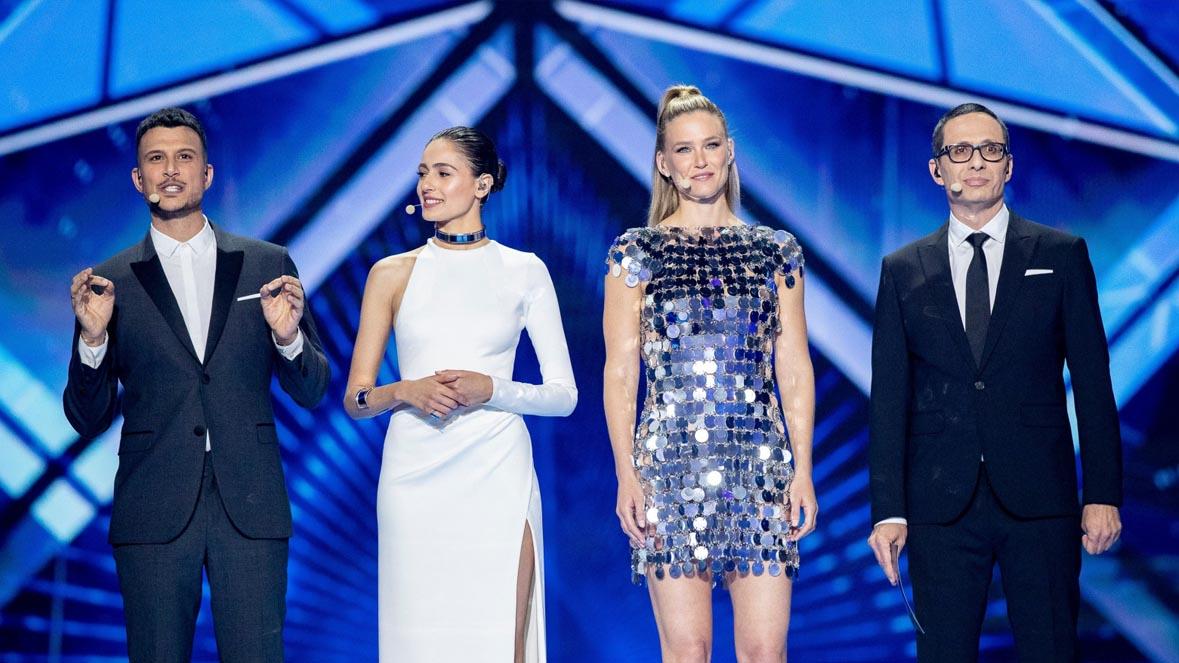 duo S!sters sat in the Green Room full of hope, only to hear Bar Refaeli cruelly announce in Tel Aviv: “Sorry, zero points.” But it did not end there. The same thing happened again to Jendrik in 2021, who responded with rolling, helpless laughter as he realized that Europe had simply ignored them for two consecutive years.
The Humiliation of the United Kingdom: If there is a country that turned “zero points” into an art form, it is undoubtedly the United Kingdom. However, the special case from Eurovision Song Contest 2021 in Rotterdam provided the most iconic “zero points” moment of the new system. British singer James Newman finished the jury vote with a humiliating round zero. When it was time to receive the public vote, the hosts announced that viewers at home had not given him a single point either. Instead of breaking down or lowering his head, Newman proved what real British composure looks like: he stood up, raised his beer glass in the air with a grin, and lifted the entire arena into roaring cheers. A perfect lesson in how to lose with style.
But this was far from the only time the United Kingdom heard that painful zero. In 2024, the country’s representative Olly Alexander managed to receive around 46 points from the juries, but the public at home was unconvinced and awarded him a round zero. A year later, the audience once again did not particularly connect with the British song. While the juries awarded the band Remember Monday 88 points, the public once again gave them not a single point. This coming May, we will find out whether Look Mum No Computer will maintain the tradition, or succeed in removing the British public voting curse with his song “Eins, Zwei, Drei.” (In English: One, Two, Three)
The voting sequence will always remain Eurovision’s emotional roller coaster. No matter how tightly the EBU writes scripts or tries to separate politics from music, when you have live television, peak emotions, and spokespersons chasing their moment of fame, something will always go wrong and these are exactly the moments we stay awake for.
What voting moment do you remember most? Did we miss any live blunder? Tell us in the comments below!
For previous articles in the “Eurodrama – 70 Years of Eurovision” series:
Episode 1: Not Just Politics: The Dirty Secrets from Eurovision’s Early Years
Episode 2: Between Toilet Paper and the Malmö Curse: The Dirty Secrets of Eurovision Trophies Revealed
Episode 3: The Security Nightmare: When the Eurovision Stage Was Breached Live
Eurovision 2026: the 70th edition of the contest will take place in Vienna, Austria, on May 12th, 14th, and 16th, 2026. The Wiener Stadthalle arena, which will host the event, is expected to accommodate around 16,000 spectators per show. The contest returns to Austria following the nation’s third historic win with the song “Wasted Love”, performed by JJ. It will be Austria’s third time hosting Eurovision, after previous editions held in the country in 1967 and 2015.