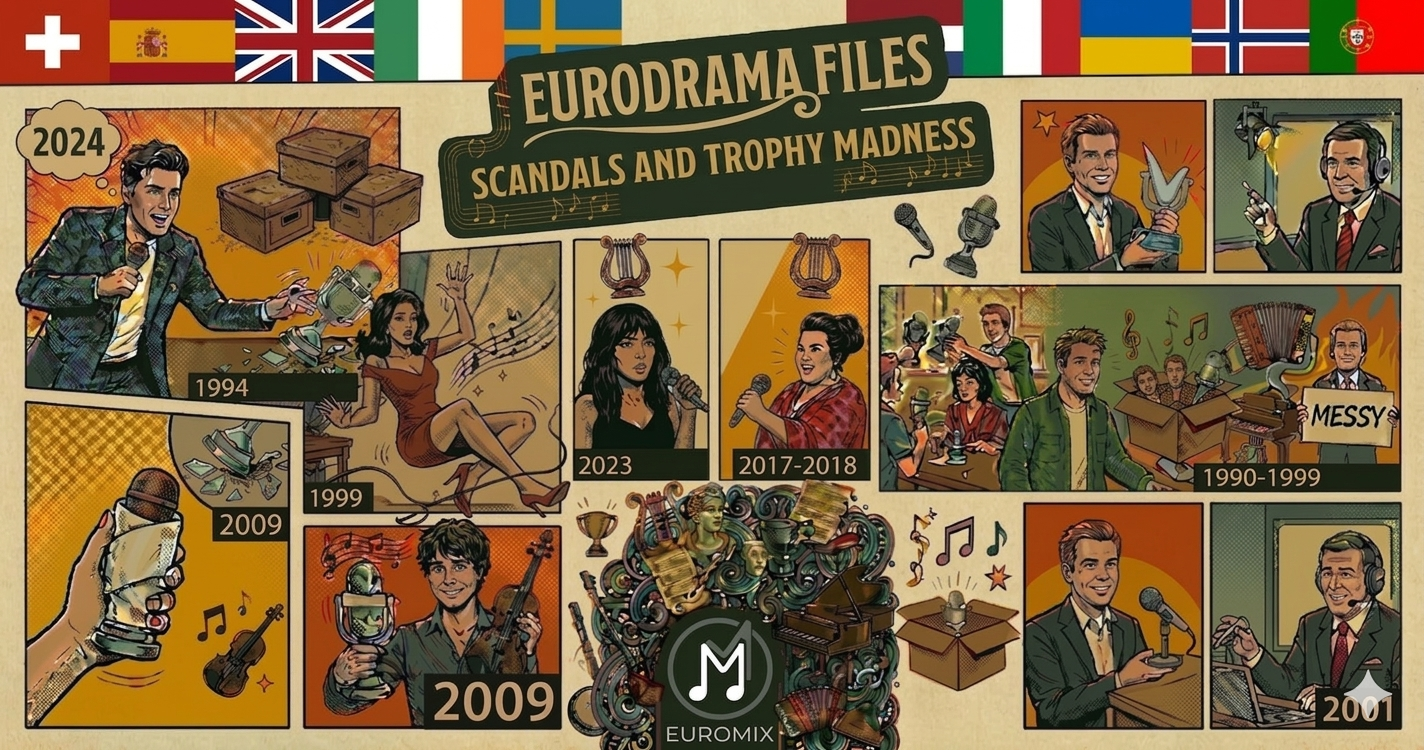
Political statements in parcels, smashed glass trophies on live and prizes forgotten in cardboard boxes: this chapter of “Eurodrama Files” reveals how Eurovision cups became symbols of ego, mishaps and protest.
Seventy years ago, in a small casino hall in Lugano, Switzerland, only seven countries gathered for a modest song contest. There were no Finnish monsters, no wind machines, and no glass trophies shattering live on air. Seven decades later, the Eurovision Song Contest is no longer just a song competition – it is one of the biggest pop‑culture phenomena in the world. To mark the contest’s 70th anniversary, the “Eurodrama Files” series by EuroMix editors Roie Ben Hoor, Talya Raviv and Oscar Diefenthal continues its journey deep into the archives.
In each chapter of the series, we open a different “file” and revisit the biggest, strangest and most unforgettable moments that shaped the history of the world’s biggest music competition. After the previous episode, where we opened the “corruption and back‑room deals of the 1950s and 1960s” file, this time we turn the spotlight to the shiniest prize every artist dreams of the Eurovision trophy. We opened the “trophies file” to find out what really happens when Europe’s most prestigious prize meets the floor, toilet paper, backstage drama and petty politics.


Broken Code, Broken Trophy: Nemo’s Karma and the Infamous Package to Geneva
Before we dive into the deeper history, let’s start with a very recent case. You probably all remember the Eurovision 2024 victory of Swiss performer Nemo, but let us remind you what happened to the trophy five minutes after the winner was announced: right after completing the reprise performance of “The Code”, emotional Nemo sat down on the stage and put the trophy down, but no one anticipated what came next. The trophy simply could not bear the pressure, snapped in two – and in the process also fractured Nemo’s thumb.
The emotional moment shattered together with the trophy. At the winner’s press conference, Nemo appeared with a bandaged hand and a freshly improvised replacement trophy provided by the production team, declaring in “I broke the code, and I broke the trophy. Maybe Eurovision also needs a bit of fixing.” No one really knows what Nemo meant, but some fans speculated that perhaps this was karma “punishing” him for his comments about another contestant, Israeli representative Eden Golan.
In fact, that amusing incident was only a prelude to the real drama around this trophy, which exploded a year and a half later. Ahead of Eurovision 2026, Nemo decided to return the trophy to the European Broadcasting Union (EBU) in protest at Israel’s participation in the contest. According to reports in Swiss media, when staff opened the package Nemo had sent to the EBU offices in Geneva, they found the trophy completely smashed – and wrapped in toilet paper. The gesture caused genuine shock, and many wondered whether it was a blunt political statement or simply terrible packaging. One thing was clear: this trophy had long since stopped being just a musical prize and had turned into a political statement, raising wider questions over how winners choose to treat it.
The First Crack: Did the Trophy “Curse” Actually Start in Moscow?
If you thought the phenomenon of “smashing the trophy live on air” was invented by Nemo, let us take you 15 years back – to Eurovision 2009 in Moscow. That year, Norway’s representative Alexander Rybak conquered Europe with his violin and folk‑pop hit “Fairytale”,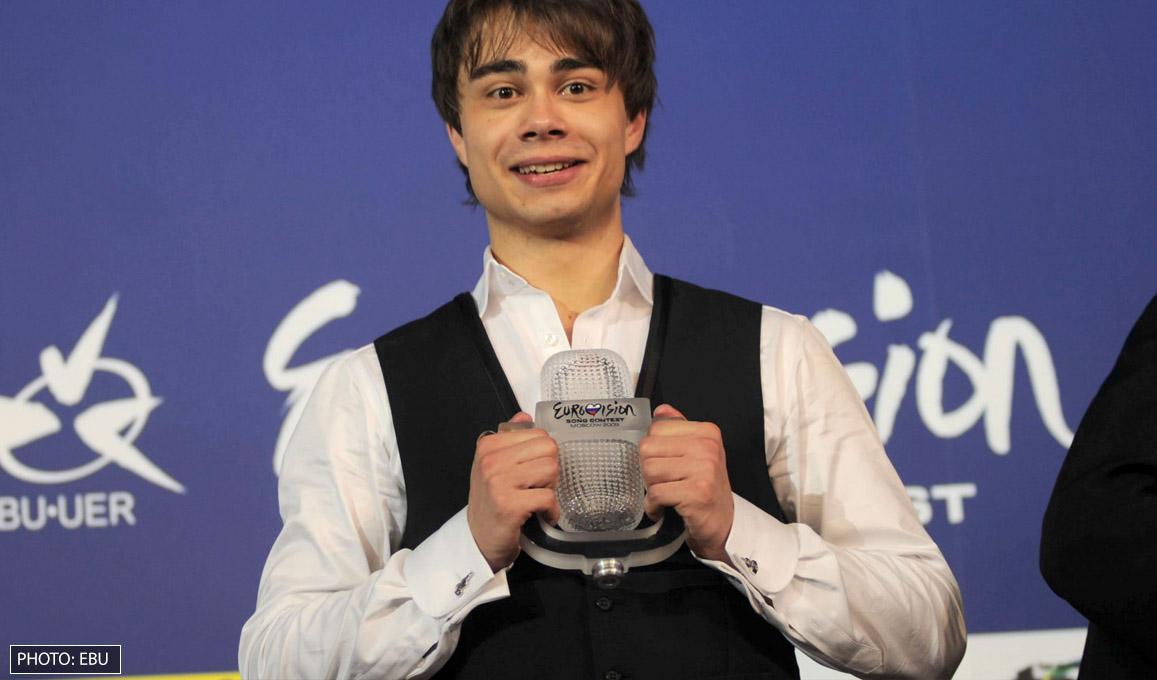 breaking all the voting records of the contest at the time. But it turns out that records were not the only thing he broke.
Moments after receiving the glass microphone – then still a relatively new design that had been introduced only a year earlier – an overexcited Rybak sat down on the floor at the end of his winner’s reprise. When he enthusiastically set the trophy down on Moscow’s glass stage, its base cracked and separated from the upper part. If you look very closely at the official victory photos from that night, you can see Rybak grinning from ear to ear while pressing the two broken glass pieces together with both hands, desperately trying to hide the mishap from the cameras. So much for the “Malmö curse” – it seems it actually began in Russia back in 2009.
Smiles for the Press, Storm Online: The Swedish Legend Who Refused to Pass the Trophy
It turns out that even after two historic victories for Sweden, Loreen never truly left the Eurovision stage – nor the drama surrounding it. In the year after her Eurovision 2023 win in Liverpool, the Swedish singer was due to return to the contest, this time in Malmö, in her traditional role as the reigning champion handing the trophy to the new winner. About a week before the grand final, she posted a friendly message claiming that “there is no place for politics in Eurovision”, trying to project a spirit of peace and calm. Yet only a few days later she dropped a bombshell that clashed with the contest rules: on May 11th 2024 she declared that if Israel won, she would refuse to hand the trophy to its representative, Eden Golan.
On paper this may have sounded like just another fleeting political statement, but in practice it turned into a full‑blown social‑media storm. Fans and delegations across Europe reacted angrily, and many users reminded her of her own “no politics” message from the previous week, turning her declaration into a very public display of contradictions and perceived hypocrisy. Against a backdrop of pro‑Palestinian protests in the streets of Malmö, Loreen suddenly found herself at the heart of the most charged controversy of that Eurovision season.
How did it end? Luck worked in her favor. Eden Golan finished in a respectable fifth place, meaning Loreen did not have to “play with fire” and face an awkward live‑broadcast confrontation. Instead, she handed the trophy, all smiles, to Swiss winner Nemo – neatly closing one of the most dramatic behind‑the‑scenes sagas in recent Eurovision memory.
“Yellow Smile” on Live: The Awkward Hug Between Salvador Sobral and Netta Barzilai
If we go five years further back, it becomes clear that the Loreen–Golan story was not the first time a reigning champion had tense feelings about handing over the trophy. In 2018, Portuguese winner Salvador Sobral, who had triumphed the year before with his minimalist ballad “Amar Pelos Dois”, was known as a singer who prefers “pure art” and dislikes bombastic pop performances like those of Israeli artist Netta Barzilai. He even famously described songs of that style – and Netta’s entry in particular – as “fast‑food music”.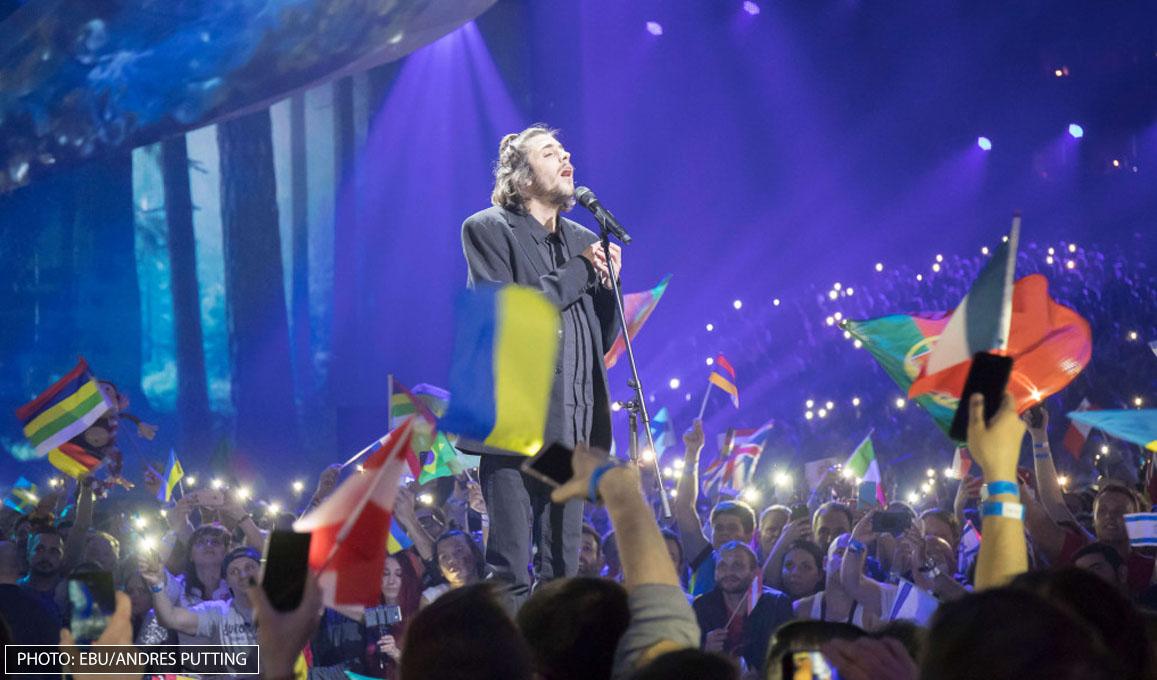
When asked in an interview whether he would feel embarrassed to give the trophy to such a song if it won, he replied in:
“It will be awkward if it is the girl from Israel (Netta Barzilai), because I said that and now it would be strange. But it is okay, and I am going to do it because I must, and I will do it with a smile on my face, but I guess it is going to be yellow,” explaining that in Portuguese, the expression “Sorriso Amarelo” (“yellow smile”) refers to a fake, forced smile.
In the end, the world remembers the historic moment of Netta’s victory, when Sobral handed her the trophy with hugs and kisses, seemingly full of warmth and support. Perhaps he simply played his part very convincingly. Since then, Sobral has continued to criticize Israel and to disparage artists like Netta, suggesting that the “yellow smile” may indeed have been more than just a colorful metaphor.
Drama Queen on Stage: When Dana International Almost Took Eurovision Down
No look at trophy‑related drama would be complete without mentioning Eurovision diva Dana International. After her landmark victory in 1998, she returned to the Eurovision stage the following year, when the contest was held in Jerusalem, this time as a guest performer with her winning song “Diva” and as the artist entrusted with presenting the trophy. As befits a true diva, the drama began long before the contest itself – but the real climax came in the final celebratory moments.
According to tradition, the previous year’s winner presents the trophy to the new champion. In this case, Dana was supposed to pass it to Swedish winner Charlotte Nilsson and her song “Take Me To Your Heaven”. When Dana stepped onto the stage, she unveiled an unforgettable look: a striking gown with large feathers in both hands and very high heels. The mix of nerves, the trophy’s weight and the slippery stage created a legendary moment: Dana lost her balance, slipped and fell together with one of the winning song’s writers, Gert Lengstrand, in front of millions of viewers across Europe.
Like any true diva, Dana recovered in seconds, got back on her feet and completed the moment with full professionalism. Fortunately no one was hurt, and the trophy itself was spared; the ceremony continued as planned. Charlotte received her trophy, the crowd roared and Eurovision gained another iconic memory for its already rich history. Dana may not have been competing that night, but when it comes to unforgettable drama, she once again proved that she has no real rivals.
A Trophy of Illusions: When a Danish Prank Met British Cynicism
In 2001, before the now‑famous glass‑microphone design existed, the Danish production of the Eurovision final in Copenhagen presented a new, shiny trophy shaped like a “V”. In the middle of the live broadcast, Danish host Søren Pilmark stood on stage holding the trophy with great reverence as he addressed the audience. Then, “by accident”, the top part of the trophy slipped from his hands, fell and smashed on the floor in front of tens of thousands in the arena and millions watching across Europe. Co‑host Natasja Crone Back, standing beside him, looked “horrified”, and Pilmark even blurted “Oh, shit” into the microphone.
The arena and TV audiences were stunned – it looked like a true live‑broadcast disaster. Moments later, though, it turned out to be an elaborate, pre‑planned comedy sketch. Immediately after the “trophy smash”, Pilmark simply walked behind a black screen and re‑appeared with the real, intact trophy.
Legendary British commentator Terry Wogan, covering that year’s contest for the BBC, did not particularly appreciate the forced presenting style and Danish humor of that show. He sarcastically nicknamed the hosting duo “Doctor Death and the Tooth Fairy” because of their constant rhyming throughout the night. Aware of the planned sketch in advance, he was unimpressed and decided to hint to millions of British viewers that something amusing was about to happen. As Pilmark lifted the “fake” glass trophy, Wogan told his BBC audience in “Watch this, it’s going to be funny,” and after the staged breakage he continued with quips like “Oh! See?” and “Good acting.”
Danish viewers and broadcasters were furious and did not forgive him easily. The EBU and Danish broadcaster DR issued an official condemnation, claiming that he had insulted the spirit of the contest and undermined the production’s efforts. Wogan, for his part, stood his ground and argued that their humor was simply “awful”. In the end, the real trophy was safely awarded to Estonian duo Tanel Padar & Dave Benton, reaching its destination without a scratch. Yet the incident illustrates how much Eurovision has changed; in today’s social‑media era, the chances of this kind of surprise sketch slipping by un‑spoiled are close to zero.
Tired of Winning: When the Eurovision Trophy Becomes “Just Another Object” in a Box
During the 1990s, Ireland became a Eurovision winning machine, leaving many across Europe wondering whether other countries even stood a chance. Four victories in a single decade – including three in a row from 1992 to 1994 – created an absurd situation in which the prestigious trophy shifted from distant dream to almost ordinary household item, treated with a kind of amused indifference. 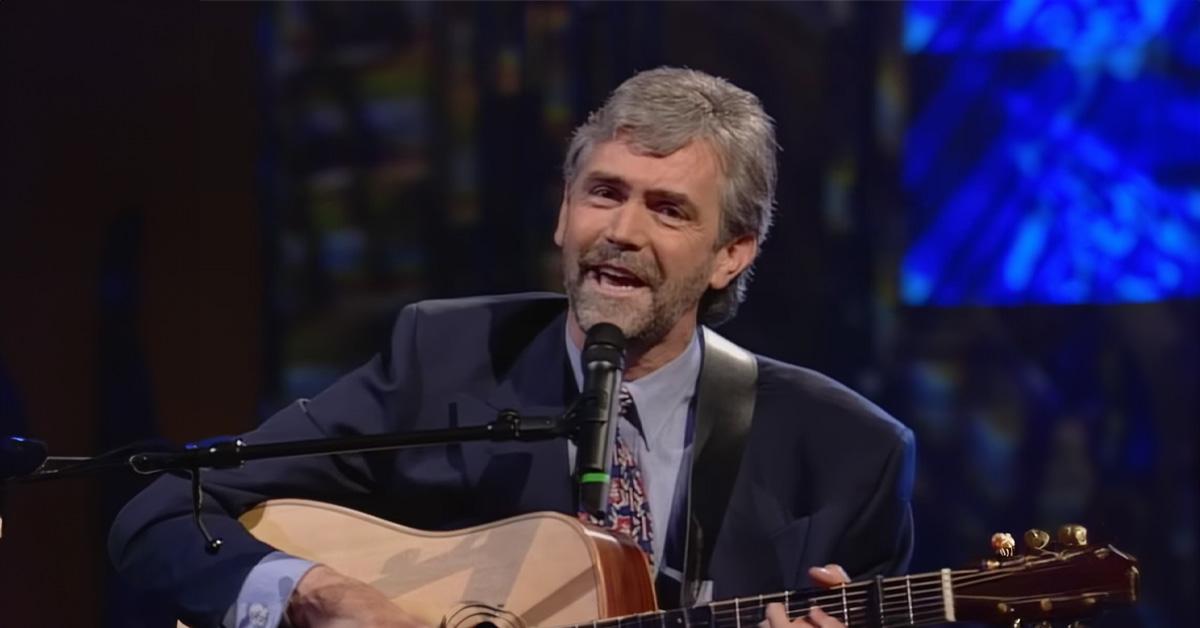
The best‑known story belongs to Charlie McGettigan, who won Eurovision 1994 alongside Paul Harrington with the song “Rock ’n’ Roll Kids”. After the win, McGettigan brought the trophy back to his hometown of Drumshanbo in Ireland. Instead of placing the crystal prize in a lit glass cabinet, as most winners would, he admitted in interviews that he simply left it in its original cardboard box because he had nowhere suitable to put it. The trophy, he said, sat under the piano for a long time, as if it were just another random object.
Irish nonchalance did not end there. While elsewhere in Europe the trophy was treated as almost sacred, in Ireland it became a local attraction. Trophies would tour between pubs in the winners’ home towns, placed casually on bar counters next to pints of beer, as locals passed them around, posed for photos and celebrated as though they had just won a football cup. This atmosphere fed a running joke that Irish broadcaster RTÉ had reached its financial limit after so many costly hostings, and that the channel was secretly praying to lose. The sense of exhaustion and “victory fatigue” dominated that decade, inspiring numerous jokes and even a famous sketch in the TV comedy “Father Ted”, in which characters try to lose Eurovision on purpose to save public funds.
If you think the story of McGettigan and the trophy ends there, think again. Remember Nemo’s protest from the start of this article? It turns out McGettigan ended up connected to that gesture too. When Nemo announced in December that he would return his trophy in protest, McGettigan was so inspired by this “brave act” that he decided to do the same with his own trophy – only to discover a problem: so many years had passed since his victory that he could no longer find it. He stated in “If I can get my hands on the trophy we got back then, I will send it back.” The moral, he hinted, is simple: never underestimate trophies and objects, because one day you may actually need them.
In the end, even Europe’s most prestigious glass cannot withstand the combined weight of politics, ego or a slippery stage. The Eurovision trophy has been dropped, shattered, hidden away, mocked and used as a tool in public disputes – yet it still stands as the ultimate symbol of the world’s biggest music competition.
This coming May, we will find out whether the next trophy awarded at Eurovision 2026 in Vienna survives the night unscathed, or whether another spectacular drama is about to be written into the archives.
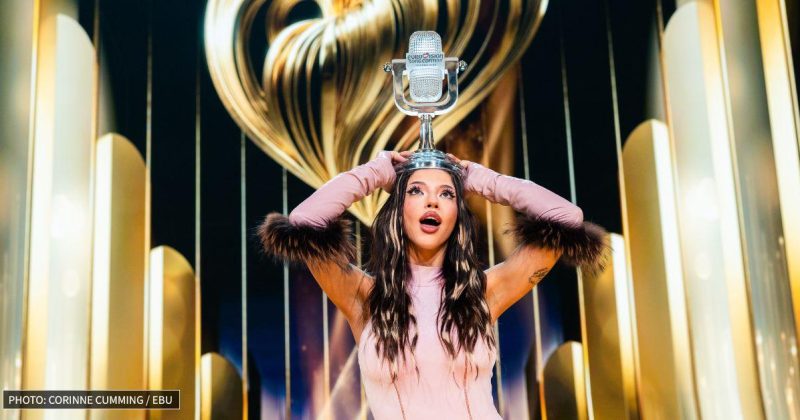
Eurovision 2026: the 70th edition of the contest will take place in Vienna, Austria, on May 12th, 14th, and 16th, 2026. The Wiener Stadthalle arena, which will host the event, is expected to accommodate around 16,000 spectators per show. The contest returns to Austria following the nation’s third historic win with the song “Wasted Love”, performed by JJ. It will be Austria’s third time hosting Eurovision, after previous editions held in the country in 1967 and 2015.