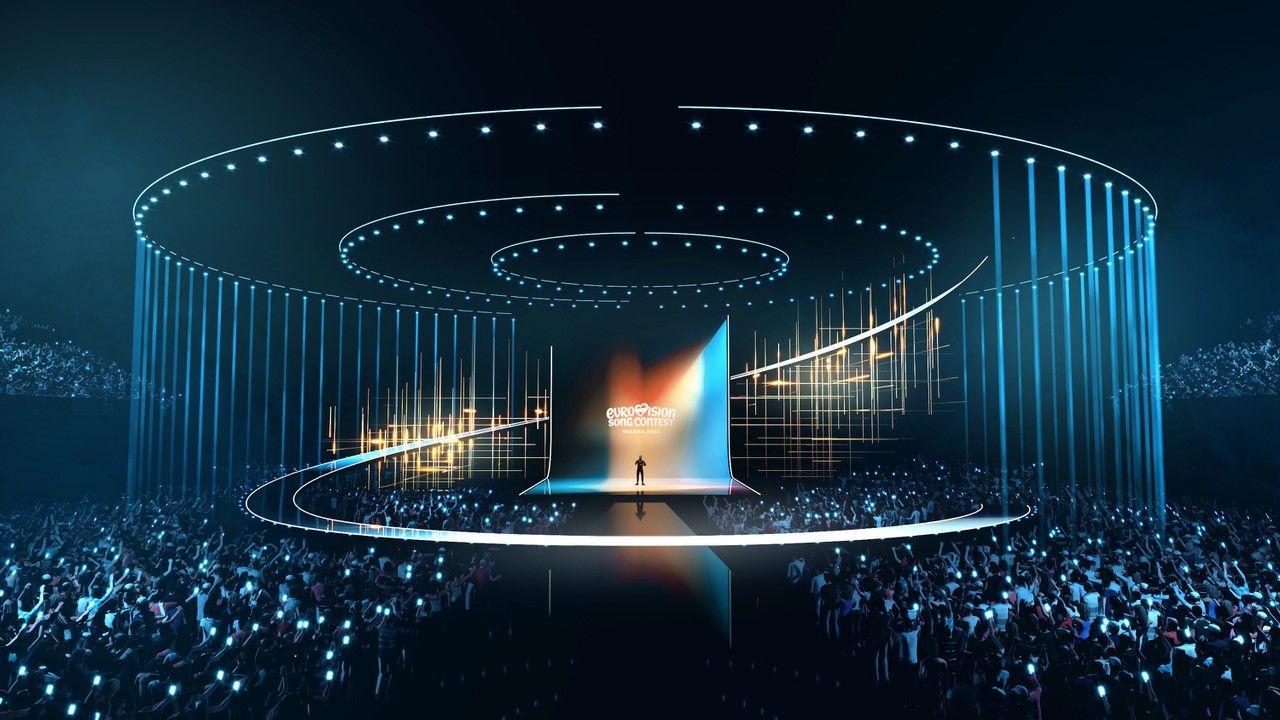
The Austrian Eurovision production unveils a historic and unique design for the delegations’ area, which will become, for the first time, a traditional Viennese café directly connected to the main stage.
As part of the preparations for Eurovision 2026, set to take place next month, the Austrian national broadcaster ORF, revealed that the area designated for the delegations during the live shows – traditionally known as the Green Room – will be designed in the style of a classic Viennese café. This is an unusual and unprecedented design decision in the contest, serving as a tribute to Vienna’s café culture, which has been recognized by UNESCO as an intangible cultural heritage. The broadcaster’s head of programming, Stefanie Groiss-Horowitz, stated that the production chose not to settle for standard furniture, but rather to create a complete cultural experience that connects the artists and viewers to the local atmosphere of the host city.




The Green Room is the space where artists and delegations stay from the moment they finish their performance until the winner is announced. It is the area where the most significant drama of the broadcast unfolds, as cameras capture the emotional reactions of participants while points are being awarded. This year, the space will be located into the arena and will be directly connected to the main stage through a walkway that passes through the audience, enabling a seamless flow between the performance moment and the relaxation moment in the “café”.
Last week, precisely at 07:00 CET, a festive ceremony took place during which the ribbon was cut at the entrance to the famous Wiener Stadthalle, which will host Eurovision 2026 in just a month and a half. The ribbon-cutting event marked the official launch and opening signal of the 70th Eurovision Song Contest.
הצגת פוסט זה באינסטגרם
At the event, held inside the Wiener Stadthalle, executive producer Michael Krön and the venue’s CEO Thomas Waldner cut the traditional Eurovision ribbon – symbolizing the official handover of operational control to the production team ahead of the May festivities. Krön received the ceremonial key to the hall, and immediately afterward, the large-scale logistical operation began as the first of hundreds of trucks unloaded the initial technical equipment inside Hall D – the largest indoor arena in Austria.
Built in 1958, this iconic venue has already hosted the contest once before, in 2015, and was selected again for its ability to accommodate complex television productions under one roof.
Tight Schedule Ahead of Austria
This year’s stage and infrastructure setup is considered one of the most ambitious in the contest’s history. According to reports, about 35 international companies are involved, with teams working in continuous shifts around the clock. Approximately 3,500 tons of raw materials and technical gear will be delivered over the coming weeks, including a network of 27 broadcast cameras and 8,500 LED lights designed to illuminate the stage. Alongside production, organizers are placing special emphasis on one of the world’s most advanced security systems, which will transform the arena into a fully sterile zone ahead of the delegations’ arrival.
The official schedule reveals an intense pace of work: initially, the production will focus on constructing the main stage inside the iconic “Hall D”, after which efforts will gradually expand throughout the complex. Interestingly, despite the massive preparations, regular activity at the venue will not stop immediately – performances in the neighboring “Hall F” will continue alongside the construction work. Toward the end of April, however, the entire venue will undergo strict “security lockdown” procedures, requiring all personnel entering the Stadthalle grounds to pass rigorous airport-style checks.
The excitement is expected to reach its peak in late April with a special stage reveal event, signaling the start of technical rehearsals on the new platform. In early May, delegations and artists from across Europe will arrive in Vienna to begin intense preparations leading to nine public rehearsals and three main broadcasts. This demanding and emotional journey will culminate in three spectacular live shows: the two Semi-Finals on May 12th and 14th, and the Grand Final of Eurovision 2026 on Saturday, May 16th.
Eurovision 2026: the 70th edition of the contest will take place in Vienna, Austria, on May 12th, 14th, and 16th, 2026. The Wiener Stadthalle arena, which will host the event, is expected to accommodate around 16,000 spectators per show. The contest returns to Austria following the nation’s third historic win with the song “Wasted Love”, performed by JJ. It will be Austria’s third time hosting Eurovision, after previous editions held in the country in 1967 and 2015.

Email: [email protected]
Phone: +972-50-9441919
Ilay Gaist is a leading Israeli content creator and writer specializing in the Eurovision Song Contest. He is a well-known commentator with extensive expertise in the contest’s history, rules, and dynamics. His passion for Eurovision drives him to deliver rich, professional, and innovative content to his audience.
Ilay holds a bachelor’s degree in Arabic and has a multilingual background. He also engages in cultural research, with a particular focus on global culinary traditions and the evolution of local cuisines around the world.