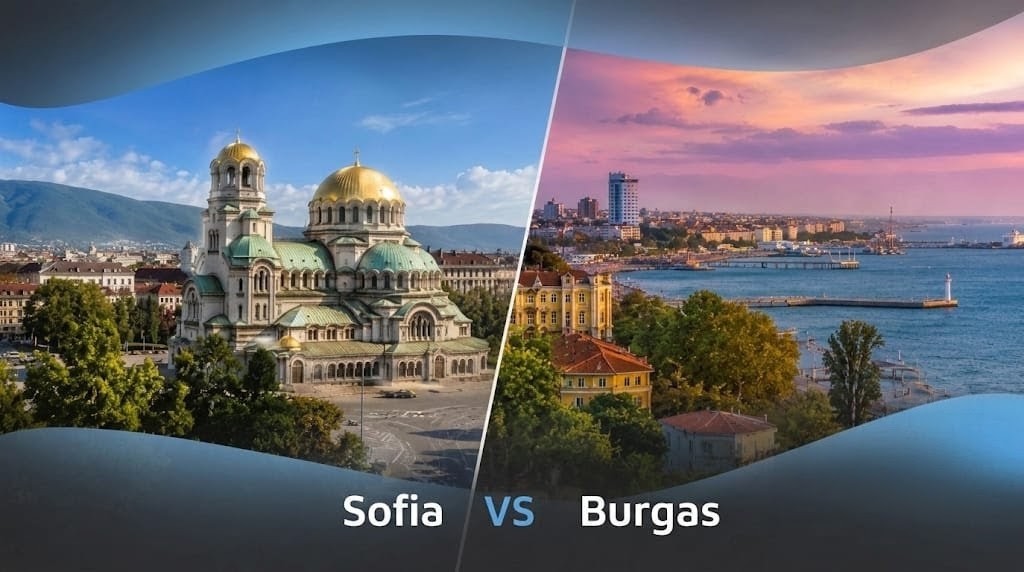
Burgas Airport reveals its logistical plans for Eurovision 2027, as the Bulgarian host city race against Sofia reaches its dramatic final days.
The past week has been riddled with dramatic developments surrounding the selection of the host city for Eurovision 2027. By Saturday, Burgas had overtaken Sofia in the leading betting odds, and it currently sits at the top of the table with approximately an 80% chance of being the host city. Last night, it was reported that the host city will be revealed this coming Wednesday. Now, as reported by the Greek website Eurovisionfun, Burgas Airport has revealed its preparations for the possibility that the city will be selected, alongside plans to add flights and capacity during the Eurovision period.








Preparing to Welcome Tens of Thousands of Fans
The airport, managed by Fraport Twin Star Airport Management AD, confirms that talks are underway with airlines to explore the possibility of adding flights and increasing capacity during the contest, although no new routes have been officially confirmed at this stage.
Currently, the airport boasts over 70 direct routes, and in May it is connected to about 40 destinations in nearly 20 countries via more than 25 airlines. Operationally, the airport can handle up to 21 aircraft movements per hour and up to 50,000 passengers a day, including approximately 1,800 arriving and 1,800 departing passengers every hour. Should Burgas be selected, the airport is equipped to accommodate additional scheduled and charter flights, and is ready to cooperate with airlines, tour operators, and other entities in the event of a surge in demand. The airport emphasizes that they have the infrastructure, professional staff, and experience in handling seasonal passenger loads, and they can rely on the international experience and connections of the Fraport network.
The company is collaborating with the Burgas municipality and the parties involved in the city’s bid. If Burgas is chosen, the airport will be actively involved in the event’s preparations and will play a central role in welcoming tourists, delegations, journalists, and international guests. As part of the preparations, more than 60 meetings are expected to take place between October 2026 and April 2027 at international aviation forums. Their goal is to showcase Burgas and explore options to increase aerial connectivity to the city ahead of Eurovision.
The airport expresses clear support for the Burgas bid and believes that the city has the necessary infrastructure, tourism capacity, and organizational ability to host an event of Eurovision’s magnitude. They view the competition as a significant opportunity to increase the international exposure of Burgas and the southern Black Sea coastal region. The airport even released a video supporting the Burgas bid for Eurovision 2027, as part of an effort to demonstrate the backing of the city and local entities for hosting the contest in Burgas.
Sofia vs Burgas: The Hosting Contenders

Sofia
Sofia, the capital of Bulgaria, is currently the primary candidate to host Eurovision, with strong rumors suggesting it has already secured the bid. During a broadcast on the Bulgarian national broadcaster, a caption unexpectedly appeared reading: “Canada will make its debut in the upcoming contest in Sofia.” The incident immediately sparked curiosity among Eurovision fans, raising questions as to whether it was an early leak of the host city or merely a production error.
Beyond these rumors, the candidacy of Sofia faces a tangible bureaucratic hurdle. Reports in Bulgaria raise concerns that the city might fail to meet contest requirements due to the name of its proposed venue, “Arena 8888” (which previously hosted Junior Eurovision in 2015). In September 2024, the arena’s management signed a sponsorship agreement with the online gambling platform 8888.bg, a partnership that could conflict with EBU regulations. However, previous contests have been held in venues named after sponsors, such as “Pala Alpitour” (Inalpi Arena) in Turin 2022 and “M&S Bank Arena” in Liverpool 2023. Even if issues arise regarding the gambling company, the venue’s name would likely be changed temporarily for the Eurovision period, as occurred in 2011, 2016, and 2018.
In addition to these challenges, Sofia faces a notable shortage of accommodations compared to previous host cities and its fellow contender. This scarcity could drive up prices for traveling fans seeking to attend the contest.
Burgas
Burgas, the bustling summer capital on the shores of the Black Sea, presents a hosting package that is very hard to ignore. First, the city boasts an advanced arena similar in size to the one in Sofia, though slightly smaller. Beyond that, the huge advantage of Burgas lies in its tourism infrastructure. It has an immense abundance of accommodations and hotels, and such a large supply guarantees much more affordable and accessible prices for the thousands of fans and delegations who will flock to the contest.
But the true advantage of Burgas, and what is likely shuffling the cards for the decision-makers, is the atmosphere. Eurovision is ultimately a massive festival of music, culture, and joy. Burgas comes alive at night, offering a rich nightlife scene and the energies of a young and vibrant city. In contrast, the capital Sofia is perceived as a much older, heavier, and even boring city compared to the dizzying pace offered by the coastal city.
Although it initially seemed that Sofia’s inherent advantage as a capital city, with its developed governmental infrastructure, would close the story in advance, the proposal from Burgas is simply better in the parameters that truly matter. The combination of a proper arena, cheap accommodation solutions, and a young party atmosphere that perfectly matches the DNA of Eurovision, is the winning formula. This is exactly why, according to our estimates at EuroMix, Burgas will do the unbelievable and snatch the hosting rights from Sofia at the very last minute.
A Crucial Decision Ahead
The host city selection process officially opened last June after the Bulgarian national broadcaster held a briefing with representatives from the four local municipalities that expressed interest in hosting the contest: Burgas, Plovdiv, Sofia, and Varna. Just over two weeks ago, it was officially confirmed that Sofia and Burgas are the final two cities competing for the hosting rights.
As a public broadcaster and full member of the European Broadcasting Union, BNT plays a leading role in organizing Eurovision 2027 in close partnership with the EBU. The Bulgarian national broadcaster actively secured Bulgaria’s participation in Eurovision 2026 following a three-year absence, leading to a historic victory in Vienna that earned the country the honor of hosting the upcoming edition.
Eurovision 2027 is expected to draw thousands of visitors, international media crews, and millions of television viewers across Europe and beyond, offering a significant opportunity for international visibility and tourism growth for Bulgaria.