Key Line: “What is the secret behind Meghan Markle’s healthy hair? I think it’s deep hydration.”
The “WTF” Moment: The Serbian performance, which opened with meticulous handwashing on stage, became an overnight viral sensation. Singer-songwriter Konstrakta opens the song with a puzzling query about the Duchess of Sussex’s hair, followed by a verse noting that “an enlarged spleen is not healthy, and I don’t have health insurance either.”
The Hidden Meaning: Behind the strange lyrics lies a sharp, brilliant satire addressing modern society’s obsession with health and beauty standards, alongside the lack of healthcare accessibility for artists and ordinary citizens. Whether audiences caught the underlying message or not, Serbia secured a 5th-place finish in the Grand Final.
Key Line: “Instead of meat, I eat veggies and pussy… sorry, veggies.” (and naturally: “Being green is sexy.”) 
The “WTF” Moment: The Latvian group set out to raise environmental awareness and promote a vegan lifestyle, but opted for an overtly provocative, energetic, and humorous approach. The opening line ultimately forced the EBU to censor part of the text during the live broadcast.
The Hidden Meaning: While the lyrics sound like a chaotic barrage about eating salad, recycling, and sex, the goal was to deliver a serious ecological message (“saving the planet”) to younger audiences via humor and a disco-funk beat. The strategy fell short, with the entry finishing 14th in its Semi-Final.
Key Line: “And before that wolf eats my grandma, give that wolf a banana.”
The “WTF” Moment: The mysterious yellow wolf duo from Norway captivated Turin with an entry resembling a fever dream pulled straight from a fairy tale.
The Hidden Meaning: Beyond the viral internet joke and the infectious TikTok choreography, the song was inspired by Little Red Riding Hood. It serves as an analogy for real-life situations where it is better to appease the “monsters” or dangers around us with something sweet before they cause harm. Thanks to its eccentricity and a sharp performance, the track finished 10th in the Grand Final.
Key Line: “I hold a drink in both hands, and I have no time to be afraid.”
The “WTF” Moment: The fan favorite of Eurovision 2023 brought an explosive fusion of metal, electro, and Finnish pop to the stage. The lyrics detail a person exhausted from the workweek who heads to a bar, drinks to shed inhibitions, and ends up in a wild cha-cha-cha dance.
The Hidden Meaning: Though the lyrics appear silly and alcohol-centric, Käärijä described a relatable human condition – the difficulty introverted individuals face in opening up without external help, and the complete liberation that occurs when one stops caring about judgment. The entry went on to finish in 2nd place, turning into a massive party hit across Europe.
Key Line: “I have everything: a bike, suits, apartments… but I just want a mustache!”
The “WTF” Moment: The French act delivered a colorful, comedic hip-hop/electro-pop track about a man who possesses every luxury imaginable yet remains miserable simply because he lacks a mustache like famous leaders or stars.
The Hidden Meaning: Beneath the quirky storyline, the band aimed to critique capitalist consumer culture – the endless pursuit of what one lacks, even when one already has everything. Audiences failed to embrace the joke, leaving France in last place in the Grand Final.
Key Line: “Einstein, Newton, cholesterol… Euro neuro, stop the climate change!”
The “WTF” Moment: Rambo Amadeus, an eccentric Montenegrin artist and philosopher, took the stage alongside a donkey figure, delivering staccato vocals in broken English that mixed scientific, economic, and political terms without any apparent logical connection.
The Hidden Meaning: The performance was a sharp, chaotic protest against European Union bureaucracy, the Eurozone financial crisis, and Western attitudes toward the Balkans. Visually and musically complex, the entry served as the show opener and failed to qualify from the Semi-Final. In subsequent years, running orders were determined by producers rather than random draws, a change many attributed to avoiding similar unconventional openers that might alienate early viewers.
Key Line: “Crazy world… there are some evil leaders who want to push the button.”
The “WTF” Moment: The band Teapacks arrived in Helsinki with a genre-bending track blending Hebrew, English, and French that centered on nuclear threats, conflict, and terrorism. The EBU even evaluated whether to disqualify the entry over prohibited political content.
The Hidden Meaning: While the lyrics sounded like rhythmic satire, they presented a sharp reflection of daily existential anxieties regarding global security and political extremism. International audiences were less receptive, and singer Kobi Oz along with his bandmates finished 24th out of 28 participants in the Semi-Final.
Key Line: “What do you have there? What is that in your hand?”
The “WTF” Moment: German comedian and television host Stefan Raab took a gibberish phrase he overheard an elderly woman say to her dog and built a full funk-disco track around it.
The Hidden Meaning: There isn’t one. Raab simply set out to prove that an absurd phrase in spoken German, paired with rich musical production and an energetic stage show, could reach the top tier of Eurovision – ultimately securing 5th place.
Key Line: “Diggi-loo diggi-ley, my golden shoes make me dance and feel free.”
The “WTF” Moment: The three Herrey brothers made history by winning the contest in Luxembourg with an iconic 1980s pop track defined by its nonsensical, repeating refrain.
The Hidden Meaning: The lyrics tell a quirky tale of a man who finds enchanted golden shoes in the street that compel him to dance uncontrollably. The chorus nonsensical phrasing was deliberately crafted to be catchy and internationally accessible, which succeeded entirely—earning Sweden its second victory, exactly one decade after ABBA.
Key Line: “Our connection is like a hot dog with mustard… you are the bun and I am the filling.”
The “WTF” Moment: Austrian singer Marty Brem opened Eurovision in Ireland with a fast-paced pop-disco track accompanied by dancers wearing erratic athletic and fast-food themed costumes.
The Hidden Meaning: The entire song relies on bizarre food metaphors (hot dogs, mustard, and buns) to describe love and relationships. Despite the humor, the entry struggled on the scoreboard, finishing 17th out of 20 countries.
Which lyrics did you find the most amusing or confusing? What other songs with unusual lyrics would you add to the list?
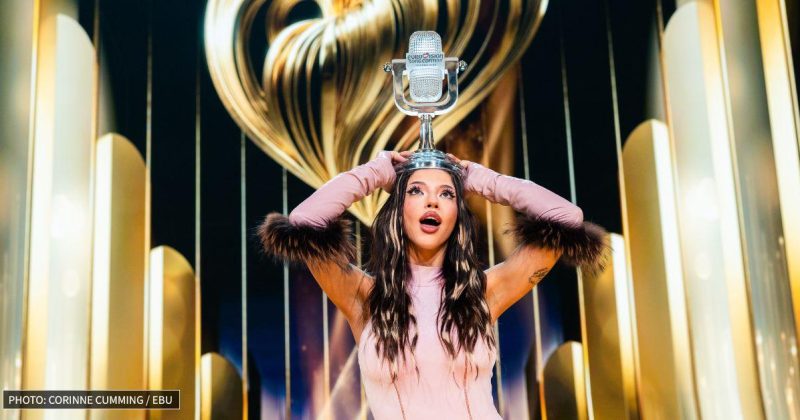
Eurovision 2027: The 71st Eurovision Song Contest will take place in Bulgaria, following the country’s victory with the song “Bangaranga” performed by the singer DARA. This will be the first time the contest is hosted in Bulgaria.