Eurovision 2026 controversy intensifies after Bambie Thug states in a live broadcast she would perform in Russia, while continuing to publicly boycott Israel’s participation in the contest.
Recently, Irish singer Bambie Thug sparked widespread backlash and reignited debate across Europe after remarks that many perceived as highlighting contradictions within parts of the progressive cultural sphere. Ireland’s Eurovision 2024 representative stated during a live broadcast on the social media platform “TikTok” that she would be willing to perform in Russia while continuing to boycott Israel. The statement, delivered live and recorded by viewers, draws a sharp contrast: a sustained public boycott of Israel, a democratic country and full member of the EBU, alongside cultural openness toward a country excluded from the Eurovision Song Contest following its military invasion of Ukraine.
This was a direct, unequivocal public declaration without clarification or subsequent correction that intensifies the ongoing controversy surrounding Israel’s participation in Eurovision and the singer’s stance toward it.




bambie thug (linnea lagerqvist) says she wants to perform in russia pic.twitter.com/CHkGwHSnwt
— Waxxy Bumhole (@WaxxyBumhole) January 5, 2026
A Live TikTok Statement and the Backlash Erupts
During a live session on TikTok, Bambie Thug was asked whether she would be willing to perform in Russia. Her answer was unequivocal: yes. At the same time, she reiterated that she continues to boycott the Eurovision Song Contest as long as Israel remains a participating country.
The remarks spread rapidly across social media platforms, generating thousands of reactions within hours and prompting sharp criticism from Eurovision fans, journalists, and commentators across Europe.
This statement reignited accusations of double standards, political hypocrisy, and even antisemitism claims that have accompanied Bambie Thug since Eurovision 2024.
Selective Morality – Why It Is Seen as Antisemitic
Since Russia’s invasion of Ukraine in 2022, Russia has been excluded from Eurovision frameworks and much of Europe’s cultural sphere. The overwhelming majority of Western artists have avoided performing there as part of a broad international consensus. Against this backdrop, Bambie Thug’s assertion that she would have performed in Russia “long ago” were it not for sanctions is widely interpreted not as a marginal remark, but as a deliberate value-based choice.
Conversely, the same artist chose to stop performing the song that represented Ireland at Eurovision 2024 where she placed sixth citing protest against Israel’s participation in Eurovision 2026. This was not a response to rule violations or extraordinary EBU decisions, but solely to Israel’s presence in the competition.
For those who closely followed Eurovision 2024, this trajectory came as little surprise. Throughout the contest, hostility toward Israel’s representative, Eden Golan, was widely documented, alongside the marginalization of Israeli fans and repeated online attacks. To many observers, a consistent pattern emerged: Israel was subjected to harsher, exceptional, and at times humiliating treatment irrespective of musical considerations.
In discussions with long-time Eurovision followers across Europe, the same sentiment repeatedly surfaced: criticism of Israel frequently extends far beyond legitimate political discourse and enters territory where national identity itself becomes the issue. This is precisely where accusations of antisemitism take hold.
Based on years of covering the contest, Eurovision has always carried a certain political dimension. However, it is rare to see an artist willing to extend cultural legitimacy to a country excluded due to military aggression and human rights violations, while simultaneously boycotting another country solely for participating in the competition. Historically, even the sharpest protests targeted governments or institutions not the act of participation itself, nor an entire audience. This is a red line that much of the European public finds difficult to ignore.
Bambie Thug at Eurovision 2024: Beyond the Performance
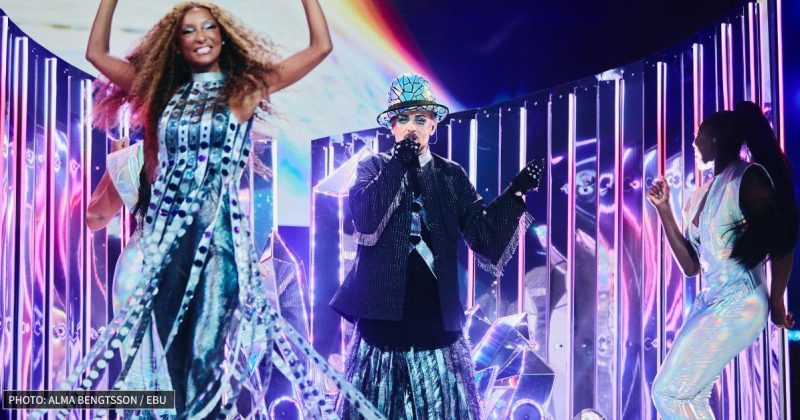
Bambie Thug, a non-binary Irish singer, drew attention not only for her performance of “Doomsday Blue” at Eurovision securing Ireland’s best result since 2000 but also for outspoken political positions that became integral to her presence at the contest. During rehearsals and interviews, she displayed explicit support for Palestinians, including writing in ancient Irish on her face calling for “a ceasefire”, wearing a Palestinian keffiyeh, and placing watermelon-shaped cushions in the green room during voting. These actions intensified tensions surrounding the Israeli–Palestinian conflict within the Eurovision 2024 framework.
Even after the competition concluded, Bambie Thug maintained this trajectory. She continues to articulate a clear anti-Israeli stance and recently released a new song titled “REDRUM“, again foregrounding her political views. The song explicitly references the LGBTQ+ community and the war in Gaza, functioning as another one-sided protest vehicle that portrays Israel negatively and deepens her alignment with an ongoing political campaign.
Ireland at Eurovision 2024
“Doomsday Blue” is the song performed by Bambie Thug, representing Ireland after winning “The Late Late Show 2024”. Ireland qualified to the final after finishing third in the first semi-final with 124 points, in the grand final it finished sixth, with 278 points – 142 from the juries and 136 from the public. Israel didn’t give Ireland any points.
It’s the first time Ireland qualified to the grand final since 2018, and this is Ireland’s best result since Eurovision 2000, which Ireland got the sixth place as well.
Eurovision 2025: This was Ireland’s 58th participation in the contest. The country joined Eurovision in 1965 and is tied with Sweden for the most wins, with seven victories. Ireland’s most recent win came in 1996 with the song “The Voice”, performed by singer Eimear Quinn.
Email: [email protected]
Phone: +972-53-9514754
A writer and content creator with a strong specialization in the Eurovision scene, particularly across Eastern Europe and post-Soviet countries. His work highlights the artistry, storytelling, and cultural variety that define the contest, offering readers a deeper look into both established performers and emerging voices.
As a skilled translator and polyglot, he brings a unique linguistic and cultural understanding to his analysis and coverage..