From one-point victories to last-second reversals, relive Eurovision’s most thrilling scoreboard moments and iconic wins.
Seventy years ago, in a small casino hall in Lugano, Switzerland, only seven countries gathered for a modest song contest. There were no Finnish monsters, no wind machines, and no glass trophies shattering live on air. Seven decades later, the Eurovision Song Contest is no longer just a song competition – it is one of the biggest pop‑culture phenomena in the world. To mark the contest’s 70th anniversary, the “Eurodrama Files” series by EuroMix editors Roie Ben Hoor, Talya Raviv and Oscar Diefental continues its journey deep into the archives.
In each episode, we reopen a Eurovision case file to revisit the moments that shaped its history. After exploring point allocation dramas, we now turn to the segment that keeps viewers awake past midnight: the results sequence. What should be the night’s emotional peak often becomes a psychological rollercoaster under the pressure of a live broadcast to 200 million viewers. The “Results File” recalls the moments that had us gripping seats and shouting at screens from razor-thin finishes to rare tiebreak procedures. Settle into the green room — we begin.




Silence in Skopje, Shockwaves in Birmingham: The Night Dana International Became Europe’s Diva
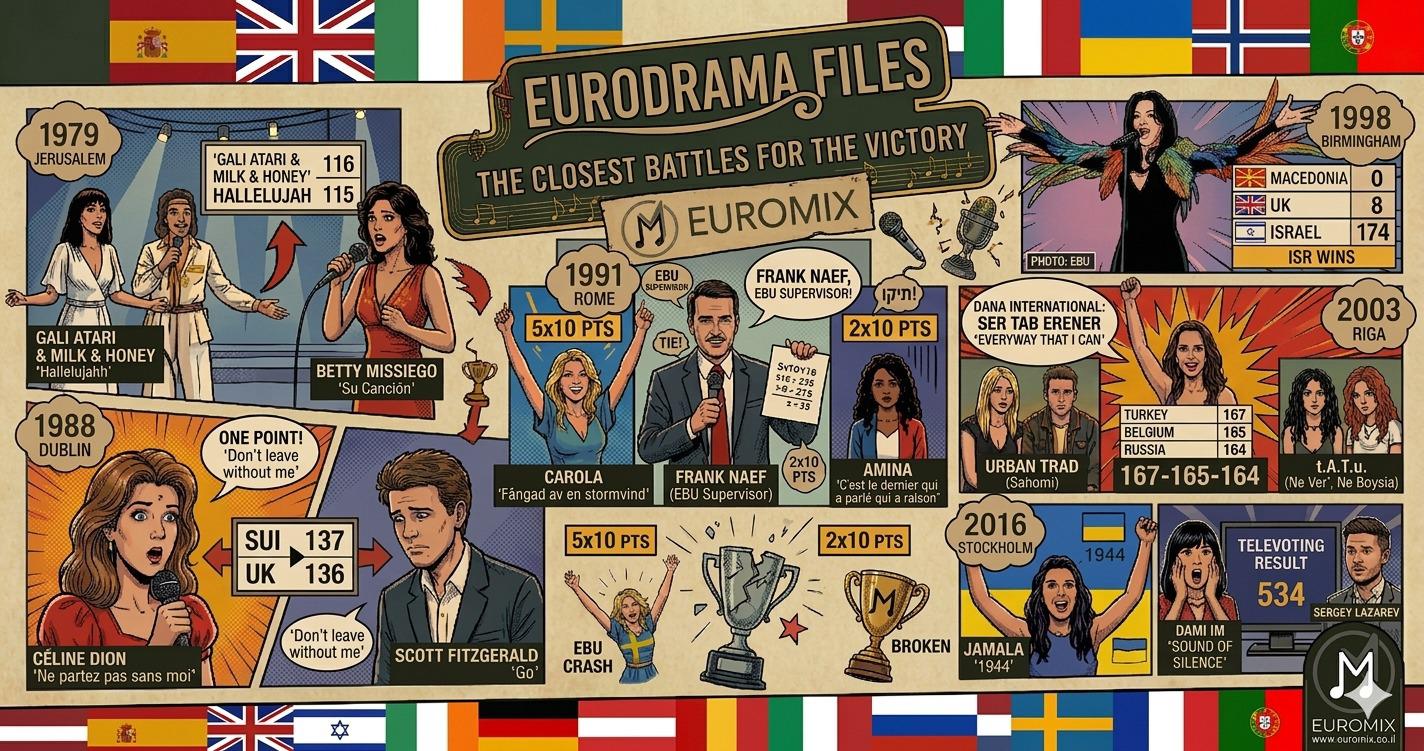
It is impossible to discuss voting drama without starting with the historic night at the Eurovision Song Contest 1998 in Birmingham. An entire nation and a vast global audience held its breath. The reveal of the results that year remains one of the most suspenseful in contest history and marked a structural turning point: after a small-scale trial the year before, 1998 became the first year in which Europe widely adopted public televoting. In most countries, points were determined entirely by viewers at home, with only three nations lacking telephone infrastructure permitted to use juries. The scoreboard, now effectively in the hands of the public, turned into a brutal three-way fight.
The battle unfolded between Dana International with “Diva,” Chiara from Malta, and Imaani representing the host country. The scoreboard flipped repeatedly until the final country to vote North Macedonia. Before its points were announced, Malta and Israel were tied at the top with 166 points each. All Chiara needed were a handful of points to secure Malta’s first victory. But the Macedonian spokesperson delivered the scores, leaving Malta with zero points. Seconds later, eight points were awarded to Israel, pushing Dana International to first place with 174 points and confirming the victory. The tension inside the arena was unbearable. And in true diva fashion, as soon as the win became clear, Dana International ran backstage to change into the iconic feather dress designed by Jean-Paul Gaultier for the reprise performance.
Three Nations, Three Points: The Cinematic Finale of Sertab Erener, Urban Trad, and t.A.T.u.
The year 1998 was far from the only time Eurovision delivered a breathtaking three-way tie. A similar scenario unfolded five years later at the Eurovision Song Contest 2003 in Riga. The Latvian capital hosted one of the wildest and closest finales the contest has ever seen a triple drama resolved in the final seconds.
The race for victory involved Sertab Erener from Turkey with “Everyway That I Can,” the Belgian group Urban Trad performing “Sanomi” in an entirely invented language, and the Russian pop duo t.A.T.u. with “Ne Ver’, Ne Boysia.” (In English: “Don’t Believe, Don’t Be Afraid”)
Throughout the evening, the lead shifted constantly. Just before Slovenia the last country to vote revealed its points, Belgium led with 162 points, Turkey followed with 157, and Russia closely trailed with 152. When the Slovenian spokesperson began announcing the results, Europe collectively stopped breathing: three crucial points went to Belgium, twelve points propelled Russia forward, but the ten points awarded to Turkey were exactly what Sertab Erener needed to overtake them all.
In a cinematic, pulse-raising finale, Turkey claimed its only Eurovision victory with 167 points. Belgium settled for a painful second place with 165, and Russia completed the trio with 164 a merciless gap of just three points between first and third. To this day, it is considered the tightest three-country finish in Eurovision history.
By a Single Point: How Céline Dion Edged Past Scott Fitzgerald in Dublin
The Eurovision Song Contest 1988 in Dublin delivered one of the greatest head-to-head dramas ever seen on the Eurovision stage. The experienced British singer Scott Fitzgerald appeared to be cruising toward victory against a then-unknown 20-year-old Canadian singer representing Switzerland: Céline Dion.
For nearly the entire voting sequence, the United Kingdom held the lead with “Go” standing at 136 points compared to Switzerland’s 131. Then came the final country to vote Yugoslavia. The arena tension reached boiling point as the Yugoslav spokesperson began reading the points. The decisive moment arrived when six points were awarded to Switzerland for “Ne partez pas sans moi,” (In English: “Dont Leave Without Me”) pushing Céline Dion into first place by the slimmest possible margin: one point.
The United Kingdom still had a theoretical chance if it received even a single point from the remaining high scores. Cameras captured Scott Fitzgerald’s tense expression opposite Céline Dion’s stunned disbelief. But the Yugoslav spokesperson calmly distributed the remaining points to the Netherlands, Germany, and Norway. Finally, the coveted twelve points went to France leaving the UK with nothing and sealing the most dramatic one-point victory in Eurovision history. It was the breakthrough moment that launched Céline Dion toward global superstardom, while British celebrations abruptly turned into heartbreak.
The Tie That Shook Europe – Rome’s Mathematical Drama
If a single-point difference is tense, what about a complete tie? Eurovision 1991 in Rome is remembered as one of the most chaotic events in history, partly due to the messy, unforgettable hosting by Toto Cutugno, but its voting system alone reads like a thriller.
The central battle was between Carola from Sweden with her energetic pop storm “Fångad av en stormvind“(In English: “Caught by a Storm Wind’), and Amina from France with the hypnotic ethnic song “C’est le dernier qui a parlé qui a raison” (In English: “The Last to Speak is Right’), while other participants, like Orna and Moshe Datz, finished respectfully in third place.
After all the points were read, Europe was in total shock: Sweden and France were tied at 146 points each! As the Italian hosts struggled with protocol, legendary European Broadcasting Union (EBU) supervisor Frank Naef took control. Following the lessons from the four-way tie in 1969, the tie-break rule was applied immediately. Naef announced live what his computers had already calculated: even with the 12 points counted, both were still tied each receiving the maximum points exactly four times. Moving directly to the “10-point count,” Sweden’s Carola edged out Amina with 0.5 versus 0.2, securing victory amid complete chaos and leaving France with a heartbreakingly narrow defeat in front of tens of millions of viewers.
he Drama of Jerusalem: Spain Decides the Battle
Eurovision 1979 in Jerusalem provided one of the most iconic scoring moments in history – the night the phrase “the last country to vote” gained historical weight. Israel hosted Eurovision after Izhar Cohen’s previous year win, with Gali Atari and the band Milk and Honey performing “Hallelujah.”
During the scoring phase, the scoreboard revealed a tense duel between countries, with leadership changing constantly and the margin remaining razor-thin until the final seconds.
At the peak of suspense, only one country remained: Spain, represented by Betty Missiego with “Su Canción” (In English: “Your Song”). Spain was the last to award points and led Israel by just one point, 116 to 115 before reading its scores.
The Jerusalem arena was unusually silent, tense, and nervous, as everyone understood the final decision rested with the last competitor. The Spanish spokesperson began reading points, and as other countries’ points were distributed, tension rose. Then it happened: Israel received 10 points, flipping the scoreboard. The audience erupted in excitement, Gali Atari and Milk and Honey rose in stunned disbelief, and the hosts paused for several minutes until calm was restored. Israel jumped to first place with 125 points, Spain remained behind with 116, producing one of Eurovision’s most dramatic and memorable finishes – a victory determined by the last country at the very last moment.
Sleeping Early or a Heart Attack in the Living Room? The Scoreboard Revolution
On the other hand, some years saw unanimous agreement among judges and viewers, making the scoreboard a coronation ceremony devoid of adrenaline. This began in 1997 when Katrina and the Waves from the UK set a record with 227 points for “Love Shine a Light“, leaving other countries fighting for scraps. This trend peaked in 2009 when Norwegian prodigy Alexander Rybak won with 387 points for “Fairytale“, being declared the winner even before 11 countries had voted.
Due to such cases, where winners were clear half an hour before the broadcast ended, the EBU decided to shake up the system. From 2016 onward, the voting method was completely revised: jury points were announced country by country first, followed by all audience televotes combined, from last place to first. This brilliant and ruthless change prevents “boring” victories, and it works perfectly: since 2016, suspense and heart attacks are guaranteed right up to the last country.
The Score Revolution: The Night Televoting Turned the Table
Thanks to the new system, the atmosphere during result announcements became far more dramatic. Eurovision 2016 in Stockholm introduced the split voting method: jury scores were read normally, while audience televotes were reserved for the end, creating unprecedented tension.
On stage, a triple battle emerged between Jamala from Ukraine with “1944”, Dami Im from Australia with “Sound of Silence” and Sergey Lazarev from Russia with “You Are The Only One“. After the jury votes, Australia led, Ukraine was second, and Russia third, but the real picture was only revealed once audience votes were added.
Then came the televoting phase. The Stockholm arena held its breath as each country’s audience points were revealed in one go. Russia received 361 points, jumping to the top, seemingly securing victory. However, Ukraine followed with about 323 points, completing a dramatic turnaround: Ukraine overtook both Russia and Australia to win Eurovision with a total of 534 points. The audience gasped, many struggled to comprehend the scoreboard flip, and hosts had to explain the calculation to clarify the chaos. Within minutes, Eurovision 2016 was etched as one of the most confusing, tense, and unforgettable finales, with the victory determined only in the final seconds by audience votes.
Voting methods evolved over 70 years, electronic boards replaced wooden ones, and mathematics grew more complex, but one thing remains: the suspense of the “douze points” has always been and will remain Eurovision’s beating heart. The drama of point collection transforms the contest into not just a musical show, but a true sporting event.
Which voting turnaround left you speechless in front of the screen? Is there a close battle we forgot? Share your thoughts in the comments below!
What voting moment do you remember most? Did we miss any live blunder? Tell us in the comments below!
For previous articles in the “Eurodrama – 70 Years of Eurovision” series:
Episode 1: Not Just Politics: The Dirty Secrets from Eurovision’s Early Years
Episode 2: Between Toilet Paper and the Malmö Curse: The Dirty Secrets of Eurovision Trophies Revealed
Episode 3: The Security Nightmare: When the Eurovision Stage Was Breached Live Episode 4: Eurovision Voting Chaos: Zero Points, Political Protests and Live TV Disasters
Eurovision 2026: the 70th edition of the contest will take place in Vienna, Austria, on May 12th, 14th, and 16th, 2026. The Wiener Stadthalle arena, which will host the event, is expected to accommodate around 16,000 spectators per show. The contest returns to Austria following the nation’s third historic win with the song “Wasted Love”, performed by JJ. It will be Austria’s third time hosting Eurovision, after previous editions held in the country in 1967 and 2015.