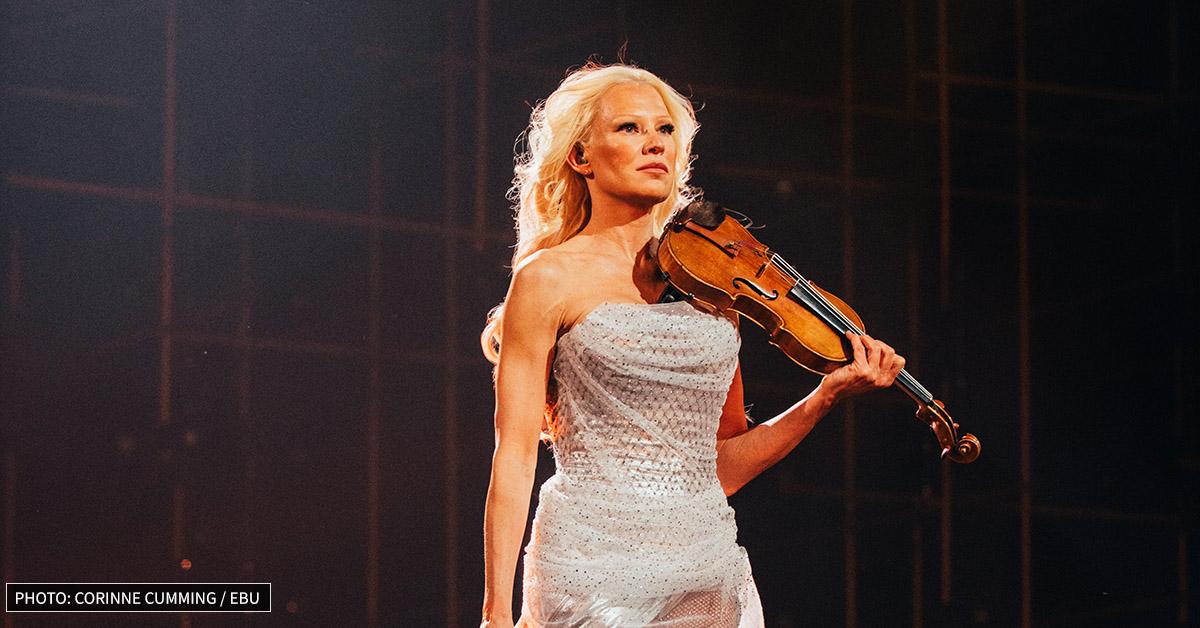
Backstage Drama: While Switzerland and Luxembourg settle for playback, Finland play a live violin on stage. We reached out to the EBU for explenation, and the answer we received changes everything we knew about the contest rules.
A storm is brewing in the Eurovision world. Since 1999, we have grown accustomed to the fact that every instrument seen on stage is a mere “prop.” Guitars are unplugged, drums are silenced, and everything is pre-recorded. However, this year, something on the Eurovision stage looked and sounded different – and it all started with the Finnish delegation.
After wondering why countries like Switzerland (with the electric guitar) or Luxembourg (with the violin) are using playback while Finland was permitted a live violin capture, we contacted the European Broadcasting Union (EBU) for answers. The official response we received reveals a surprising new reality.
The Exceptional Approval: Finland Allowed, Switzerland and Luxembourg Denied
 Back in March, the Finnish delegation submitted a request that seemed quite unusual – to allow violinist Linda Lampenius, who performs the song “Liekinheitin” (in English: “Flamethrower”) alongside Pete Parkkonen, to play the violin live on the Eurovision stage. This sensational request was officially approved last Wednesday.
In an emotional post on Linda and Pete’s official Instagram account, they wrote:
“We are very honoured and grateful to be a part of history. After countless rehearsals, trials and discussions we are proud to announce that Linda Lampenius is allowed to and will play violin-led parts live on the Eurovision stage. It brings us immerse joy that her voice will be heard through her violin on the biggest night in music.”
However, despite the excitement over the Finnish live-play performance, not all delegations were granted similar requests. Switzerland submitted a similar plea – to allow singer Veronica Fusaro to play the electric guitar live – but was refused. Similarly, Luxembourg’s representative, Eva Marija, revealed in an interview that she “wasn’t given that permission” to play the violin live on the Eurovision stage.
Can the rules change?

Since 1999, one of Eurovision’s rules has been the ban on live instrument playing on the Eurovision stage. The reason for this rule is the speed required to prepare the stage between each country’s performance – an instrument usually needs its own microphone and tuning, which can extend the setup time. In addition, the EBU also has technical concerns about sound issues arising from the use of live instruments.
Over the years, a considerable number of artists have sought permission from the EBU to perform live on stage. Among the memorable cases are Netta’s looper in 2018 and Tinkara Kovač, the flutist who represented Slovenia at Eurovision 2014 and also tried to make the same request to the European Broadcasting Union while in Copenhagen.
All contestants who were asked to play live on stage in the past were refused, with one exception last year. Lucio Corsi, the Italian representative, performed a harmonica solo on stage and took advantage of the fact that this instrument did not require a prior sound check or an additional microphone. The question this year is therefore whether the European Broadcasting Union will be more flexible in light of that case and the fact that the Finnish song is currently ranked first in the betting odds.
The EBU’s Official Response to EuroMix:
“In close conversation with ORF we granted the request made by Yle some months ago to play parts of the violin solos in the Finnish entry as a live audio capture into a microphone. This decision is in accordance with the Rules of the Eurovision Song Contest 2026 which say that live audio capture of instruments may exceptionally be permitted where artistically justified.
We’re always happy to consider requests from delegations. A final decision on this request was made following the second artist rehearsal as the production has to be satisfied that the performance works for audiences and artists alike.”
The Takeaway: Artistically Justified?
From this, we can conclude that the total ban on live instruments is a thing of the past. The rule is now only applicable to countries where there is no “artistic justification” for the live performance. This, of course, raises a major question: if art is subjective, why is the same instrument considered “artistically justified” for one country, yet denied to another?
Eurovision 2026: the 70th edition of the contest will take place in Vienna, Austria, on May 12th, 14th, and 16th, 2026. The Wiener Stadthalle arena, which will host the event, is expected to accommodate around 16,000 spectators per show. The contest returns to Austria following the nation’s third historic win with the song “Wasted Love”, performed by JJ. It will be Austria’s third time hosting Eurovision, after previous editions held in the country in 1967 and 2015.