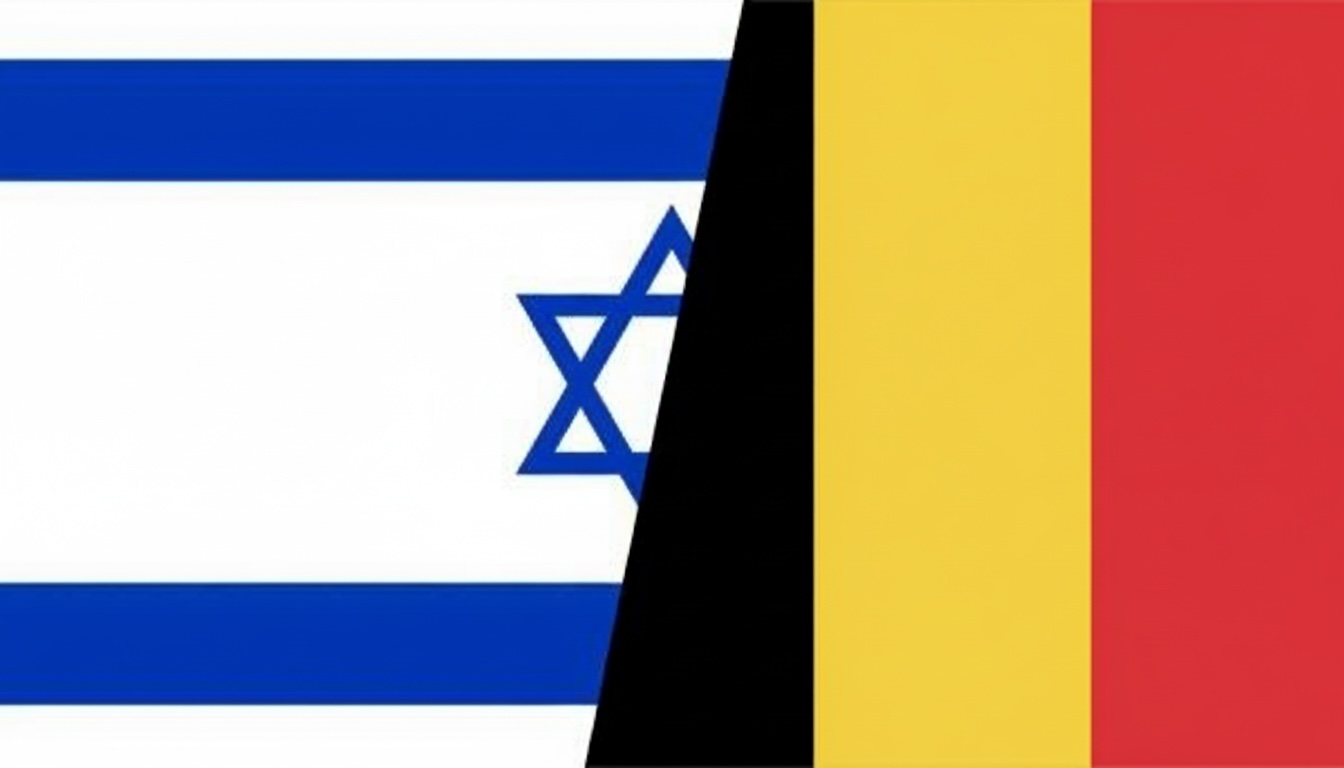
Escalation in protest: Workers’ unions at Belgium’s national broadcasters VRT and RTBF launch coordinated action, demanding Belgium’s immediate withdrawal from Eurovision 2026 due to Israel’s partcipation.
The pressure on European national broadcasters is escalating — and this time, it comes from within. On Tuesday morning, in a joint and dramatic announcement, the workers’ unions of Belgium’s two public national broadcasters, VRT (Flemish) and RTBF (Walloon), officially called for a boycott of Eurovision 2026 in protest of Israel’s participation. This follows our December report on a group of 170 Belgian artists and cultural figures who had issued a strongly worded public letter urging the broadcasters to withdraw from Eurovision 2026 as long as Israel remains a participant.




“Mannequins Instead of Workers”: Protest Installation at Headquarters
In an unusual act of inter‑union solidarity, members of the ACOD (by VRT) and CGSP (by RTBF) unions took over the shared lobby of the broadcasting headquarters in Brussels earlier today. Workers placed dozens of mannequins holding placards that together spelled out: “BOYCOTT EUROVISION.”
In a sharply worded letter sent to both broadcaster managements, the unions demanded two primary actions:
-
Immediate withdrawal: No Belgian contestant should be sent to Vienna.
-
Complete blackout: The contest should not be broadcast at all, particularly not the Israeli entry.
“Third Year of Protest — Now United”
Ilse Orbaen, Vice President of the ACOD union at VRT, explained the move in an interview with local media:
“This is the third consecutive year we’ve fought over Eurovision. In the first year, we interrupted the broadcast with a protest slide. Last year we partnered with Oxfam, and this year we’re standing united with our colleagues at RTBF, backed by a broad civic movement”.
Eric Tamundele, a director at RTBF and representative of CGSP, added that the protest is part of a global wave:
“Countries like Spain, the Netherlands, and Ireland have already chosen to boycott or are considering it. In Malta and Greece, similar unions are mobilizing to block the broadcast. We’re not alone”.
Fear of Live Broadcast Disruptions
The greatest concern now facing Belgian broadcasters is a repeat of the 2024 incident. During the Eurovision 2024 semi‑final, VRT unions followed through on threats and cut the live broadcast during Israel’s performance, showing instead a protest slide condemning Israel’s actions in Gaza and alleged violations of press freedom. That year, the event ended with a quiet reprimand, but the EBU had made clear that repeated disruptions of the mandatory uninterrupted broadcast would not be tolerated. Now that unions from both broadcasters are united, there is growing fear of a complete shutdown or a “slow strike” that could prevent viewers in Belgium from watching the show. If harsher actions occur this year, such as total broadcast obstruction, Belgium could face severe sanctions — from hefty fines to future disqualification.
Clear Breach of Contest Regulations
The Belgian unions’ threats directly contradict the EBU’s official rules. Those regulations require all participating broadcasters to air the contest live and unedited, without selectively censoring individual songs. Any attempt to “black out” the screen during Israel’s song would constitute a fundamental breach of contract with the EBU.
Despite domestic pressure, management at both broadcasters appear determined to proceed as planned. RTBF intends to present the Belgian entrant this Thursday, while VRT has pledged to provide “additional contextual framing” — a coded term for critical commentary or explanatory slides during the show. Yet, with workers threatening to “break the system”, the fate of Belgium’s broadcast has never seemed more uncertain.
Belgium at Eurovision 2025
“Strobe Lights” is the title of the song performed by Red Sebastian, who represented Belgium in the first semi-final of Eurovision 2025 in Basel, Switzerland. Belgium did not qualify for the grand final, marking the second consecutive year of non-qualification. Belgium finished 14th out of 15, earning only 23 points.
Eurovision 2026: This will be Belgium’s 67th participation in the contest. Belgium joined Eurovision in 1956 as one of its seven founding nations. The country’s best result came in 1986, when Sandra Kim won first place with “J’aime la vie”.

Email: [email protected]
Roie is a journalist, content creator, and commentator specializing in the Eurovision Song Contest. His extensive knowledge and in-depth familiarity with the Eurovision world are reflected in every article, ensuring reliable, professional, and up-to-date content.