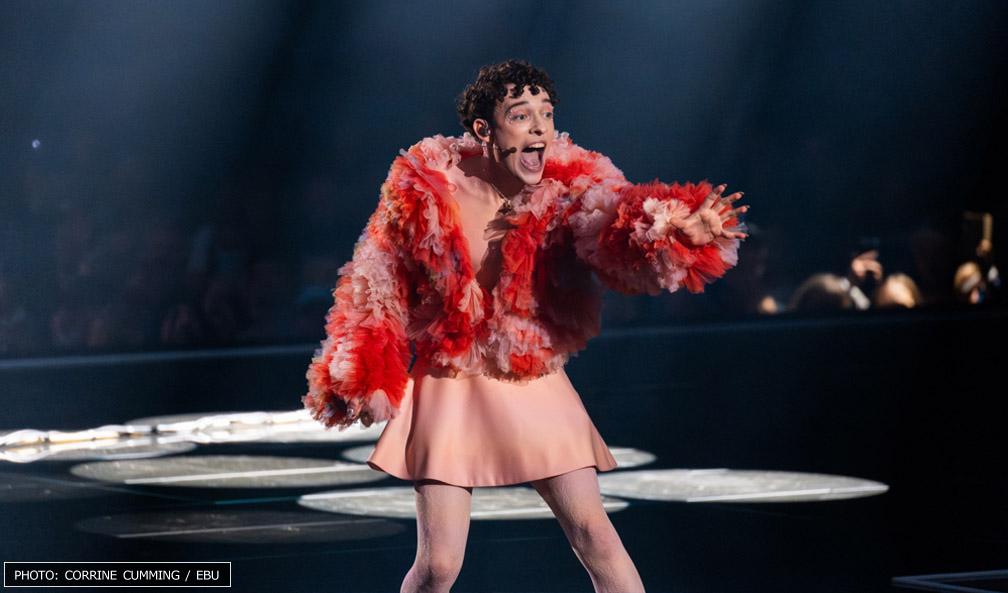
The controversy deepens as Nemo, winner of Eurovision 2024, sparks new uproar after returning the trophy in protest against Israel’s participation and following revelations about troubling chapters in his family’s history.
Nemo Mettler, the Eurovision 2024 winner, has been at the center of recurring controversies over recent months due to his protest actions and revelations about his family’s troubled past. The drama began about two months ago, when he took a dramatic stand and returned his Eurovision trophy to the contest organizers. The reason? A protest against Israel’s participation, which he accused of “genocide”. Nemo, who often speaks about “values”, “inclusivity”, and “respect for all people”, chose to exclude Israeli performers from his message of unity. About a month after returning the trophy, an investigative report revealed that while Nemo preaches morality to the Jewish state, his own family history hides dark skeletons – ones dressed in SS uniforms and Nazi insignia. Now, another controversy unfolds – this time surrounding the trophy he returned as an act of protest.








I Broke the… Trophy!
According to a report published Saturday on the Swiss news outlet Blick, when Nemo returned his trophy to the EBU, it arrived shattered and wrapped in toilet paper. After rumors of this incident reached the Swiss media, the outlet contacted the EBU seeking clarification: they asked about the trophy’s current location, whether there was a recent photo, and whether the story was accurate.
In response, the EBU issued a brief and noncommittal statement:
“We regret that Nemo returned the trophy that Nemo deservedly won in 2024. We respect the deeply felt views that Nemo expressed at the time, and Nemo will always remain a valued part of the Eurovision Song Contest family”.
The EBU refused to provide further details, concluding with the statement “We have nothing further to add”. The Swiss news outlet also attempted to contact Nemo directly, but he was unavailable for comment.
The Family Past of Nemo – “Hitler-Mettler” Great-Grandfather
Born as Nemo Mettler, the artist comes from a well-known, wealthy family from St. Gallen, Switzerland. A report by Christoph Mörgeli in the Swiss magazine Weltwoche has uncovered that his great-grandfather, Arnold Mettler-Specker, a prosperous textile industrialist, was a fervent admirer of Nazism – so much so that locals nicknamed him “Hitler-Mettler”. During World War II, Arnold and his wife Elsa lived in a lavish villa surrounded by fine art, while funding fascist and antisemitic movements in Switzerland, including the National Front.
Their antisemitism went far beyond ideology – it was tangible and cruel. When asked to donate to a campaign aiding Jewish refugees, Elsa refused, chillingly stating:
“Swiss Jews have so much money that they can help their suffering brethren themselves”.
According to local historical records, the couple dreamed of building “an authoritarian Europe under fascist leadership”.
Hypocrisy Without Limits
Today, Nemo, who constantly champions equality and tolerance, seems to ignore this blood-stained family background while pointing condemning fingers at Israel. While his ancestor took his own life in 1945 fearing punishment for treason, Nemo now chooses to boycott artists from the Jewish state. In his article, Christoph Mörgeli highlights the glaring irony: Nemo presents himself as a moral crusader outraged by “genocide”, yet he blacklists the very nation born from the ashes of the Holocaust – an atrocity enabled by the ideology his own family once supported. Nemo speaks in terms of O’s and 1’s, and ironically violates his own song’s main message. The article states:
“If Nemo moralizes about the Middle East conflict, he must understand that the very existence of Israel is tied to the genocide of the Jewish people. He should have acknowledged that his family once supported Nazism intellectually, practically, and financially – an ideology responsible for that genocide in the first place”.
It’s worth recalling that the Swiss singer snubbed Israeli representative Eden Golan backstage in Malmö, persisting with a rigid “black-and-white” narrative. Although Nemo recently claimed he had “studied the Israeli-Palestinian issue in depth”, it appears he skipped a crucial history lesson—the one his own family wrote in blood.
Switzerland at Eurovision 2025
“Voyage” is the title of the song performed by Zoë Më, who represented Switzerland in the grand final of Eurovision 2025, held in Basel, Switzerland. Switzerland finished tenth in the final with 214 points – all awarded by the jury. Switzerland ranked second among the juries, but received last place from the public, with zero points.
Since the change in the selection process in 2019, Switzerland has consistently achieved relative success and has regularly qualified for the grand final of the contest.
Eurovision 2026: This will be Switzerland’s 66th participation in Eurovision. Switzerland joined the contest in 1956, was one of the seven founding countries, and has won three times over the years. Switzerland’s most recent victory was at the last Eurovision, 2025, with Nemo and the song “The Code”. This win follows Switzerland’s previous victory in 1988 with the song “Ne partez pas sans moi”, performed by the international singer Céline Dion.