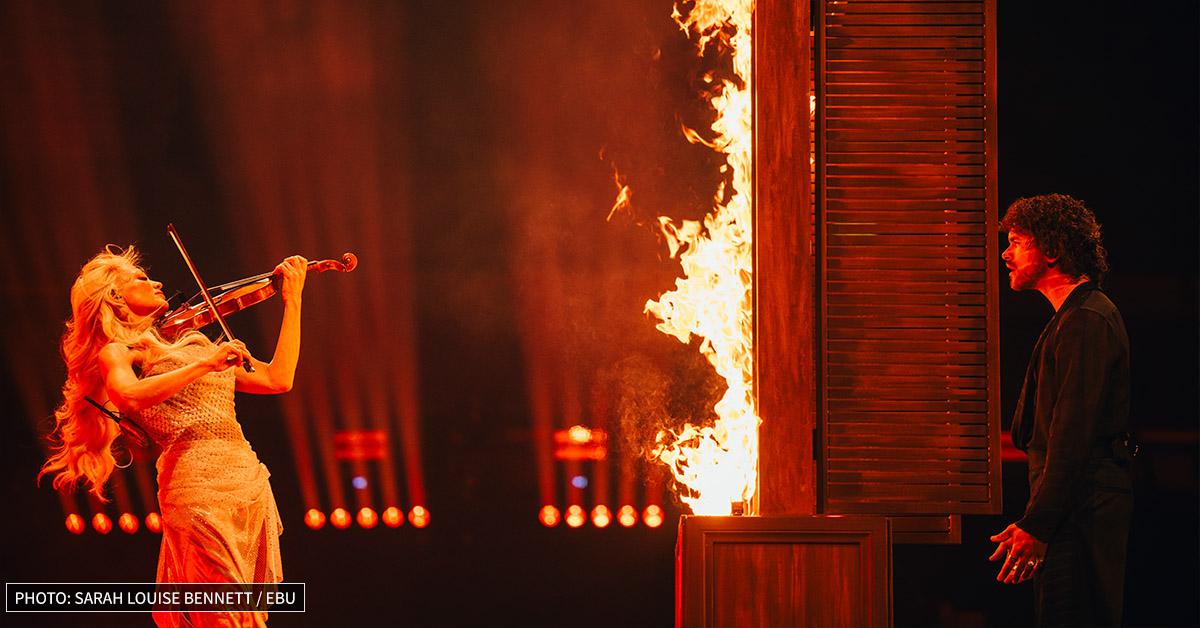
Finland’s Eurovision delegation reportedly blocked Kan and ORF interviews with Linda Lampenius and Pete Parkkonen in Vienna.
With just 48 hours remaining until Eurovision 2026 officially opens with the First Semi-Final – another major storyline has emerged around Finland, one of the competition’s leading favorites this year.
Finland’s representatives, Linda Lampenius x Pete Parkkonen, currently dominate the betting odds ahead of the contest and are widely considered the frontrunners to win Eurovision 2026. Following the recent controversy surrounding the exceptional approval granted to Linda to perform live violin on stage in Vienna, another dramatic development has now surfaced.
Israel’s Kan culture correspondent Amit Harari revealed in an exclusive report on her Instagram page that the Finnish Eurovision delegation spokesperson instructed the artists not to give interviews to the Israeli national broadcaster Kan or to Austria’s national broadcaster ORF during the Turquoise Carpet event held earlier today.








Amit Harari Reveals Details From the Turquoise Carpet
In an Instagram story uploaded to her personal account, Harari wrote:
“These are Pete and Linda from Finland, two talented people who are probably unaware of the choices made by their delegation. They will probably win this Eurovision. The Finnish delegation spokesperson decided, without apologizing, not to allow us – and not even the Austrians – to interview them. There was no issue with any other delegation. Saying it’s a shame for them is an understatement”.
Playing With Fire?
Finland’s decision, particularly as the current favorite to win the competition with an estimated 37% winning chance according to betting tables, could potentially alienate parts of the Eurovision audience at the decisive moment and raise questions around the country’s apparent path to victory.
Beyond that, Eurovision favorites are generally expected to expand their fanbase and strengthen audience engagement during the promotional period leading up to the contest. Instead, the Finnish delegation appears to have chosen a distancing approach that, in practice, somewhat isolates its representatives from parts of the Eurovision media landscape and prevents them from appearing on major platforms capable of increasing their exposure ahead of the competition.
The Finnish team may also need to remember that Eurovision victory is not determined solely by juries. The televoting audience at home has repeatedly proven capable of deciding the outcome of the Grand Final.
Whether this unusual move by Finland will ultimately affect the country’s result when the votes are revealed remains to be seen.