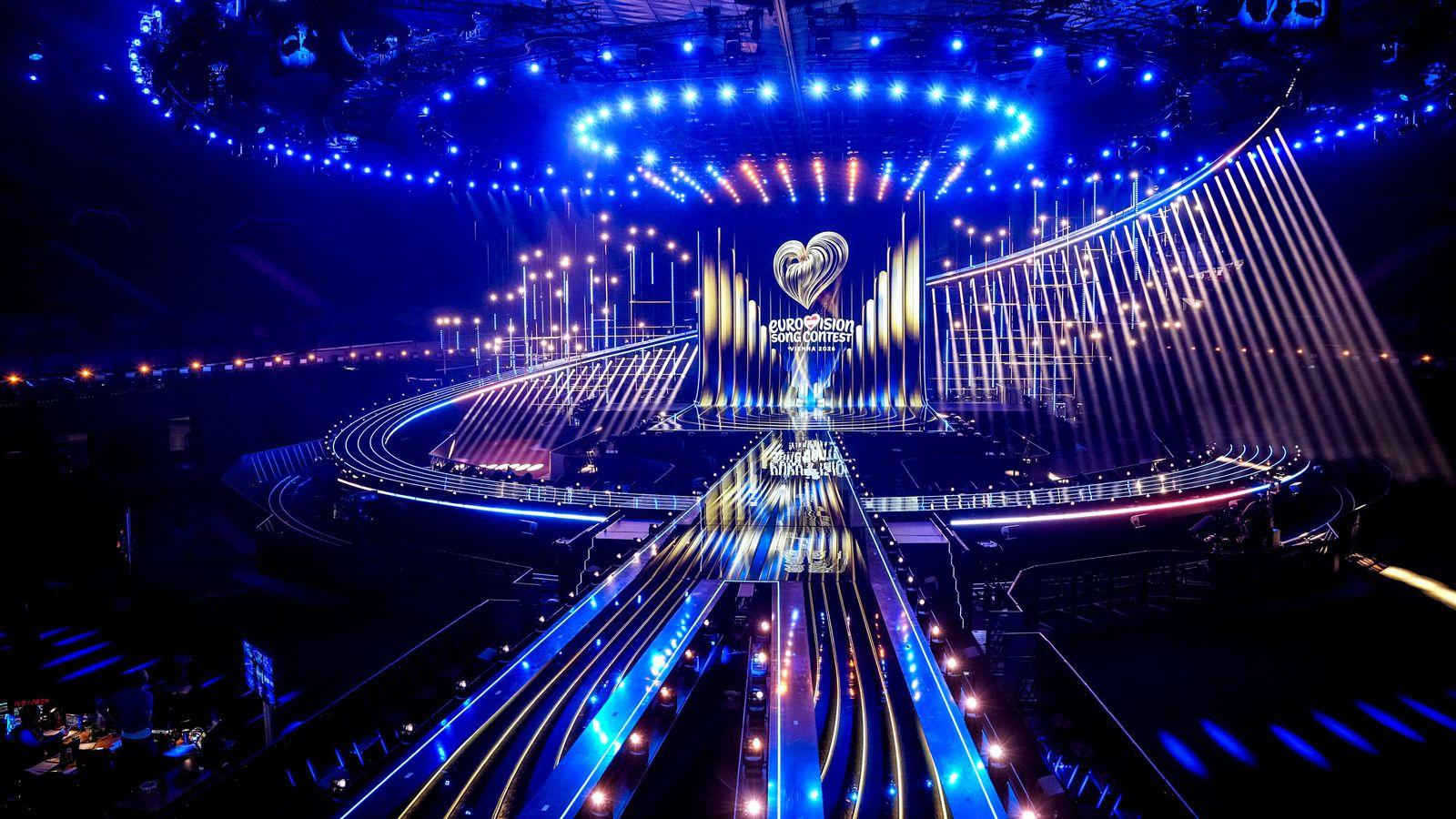
Get the full coverage from the third dress rehearsal of the second semi-final, currently taking place on the Eurovision 2026 stage in Vienna. One by one, Bulgaria, Azerbaijan, Romania, Luxembourg, Czechia, France, Armenia, Switzerland, Cyprus, Austria, Latvia, Denmark, Australia, Ukraine, UK, Albania, Malta and Norway will take the stage. We will be providing updates throughout the rehearsal with all the details received by our editorial team.
Photo: EBU
Today at 15:00 CET, the third dress rehearsal began ahead of the second semi-final broadcast, which will take place today at 21:00 CET (Thursday, May 14). We’re here to report everything happening on stage in real time from Vienna.
As a reminder, this year the countries that automatically qualify for the Grand Final will also perform during the semi-finals, but their songs will not be eligible for voting at this stage. In the second semi-final, France, the host Austria and United Kingdom will take the stage.
Make sure to click the refresh button so you can continue following along during the rehearsals!




Second Semi-Final – Initial Overview:
At the start of the show, a video appears on the screen featuring hosts Victoria Swarovski and Michael Ostrowski. In the clip, they perform a rendition of last year’s winning song, “Wasted Love”, packed with vocal mistakes and technical chaos.
The staging closely mirrors the original performance by JJ, but with a comedic twist: one of the hosts falls off the stage, water is splashed across the set, and the stage ultimately bursts into flames. Once the video ends, the hosts emerge from the real stage set to officially kick off the contest.
1. Bulgaria – Dara, “Bangaranga”:
The Bulgarian staging is not ready on time, so several audience shots are shown on screen.
DARA takes the Eurovision stage wearing a pink tank top and burgundy fur-trimmed shorts, accompanied by four dancers. The performance begins with a set designed as a waiting room. The dancers are upside down on red chairs, and the performance opens with DARA’s face appearing upside down on screen while the dancers’ legs are visible. This time, the dancers wear masks with clown-style makeup. The camera angles are highly intriguing, and the entire televised performance looks stunning. The room begins to rotate around DARA, while the singer and dancers go wild on the chairs, creating the illusion that they are spinning rather than the set itself. DARA then joins them in the choreography.
The set opens up, the dancers remove the chairs from the frame, and the entire stage goes dark with lighting and video art projected onto the floor. At this point, DARA begins to show some vocal fatigue, although her vocals had been excellent up until then. The ending of the performance is more dramatic than the original version, as they dance without the set while lighting descends from the stage ceiling. Loud applause is heard in the press room at the end of the performance.
2. Azerbaijan – JIVA, “Just Go”:
Jiva takes to the stage as the floor is covered in smoke, and the cameraman is accidentally seen running through the frame. This time, she is not wearing the red tear-like makeup dripping from her eyes. Black ropes are wrapped around her wrists like bracelets. White curtains are placed on stage, from behind which the singer emerges. She begins the song in English.
Behind the curtain stands a mysterious male figure. The LED screens display flowing white fabric along with additional video art showing both happy moments, as she sings about their love, and more difficult moments in the relationship during the “Just Go” lyric. The dancer approaches her, she pushes him away and manages to escape onto the catwalk while he pulls her back using the ropes.
The video art shows him walking out the door at the end of the song, while Jiva finishes the performance alone at the center of the catwalk after freeing herself from the ropes around her wrists. In the penultimate chorus, Jiva performs the song in Azerbaijani. The vocal performance is stable, aside from a few moments at the beginning, though the staging does not feel impactful enough to qualify for the grand final.
Alexandra Căpitănescu opens the performance at the center of the catwalk with her back to the audience, while two band members hold her using illuminated white ropes (connected to her on one end and to their guitars on the other). The camera angles appear intentionally blurred. The third “Choke Me” in the chorus is not performed by the singer, but by a pre-recorded backing vocal, while a mysterious figure wearing a white hooded cloak and face covering appears.
The rest of the band is positioned on stage, and Alexandra moves toward them while still facing away from the audience. The staging resembles an exorcism-like ritual between Alexandra and the white-clad figure. Numerous electrical cables are integrated into the performance.
Just before the high note, there is a brief pause of about one and a half seconds; she lands the note, though it sounds slightly strained. At the end of the performance, the stage is lit in red, with flames rising from the floor accompanying the finale. The performance is highly engaging, vocally solid (possibly with the singer conserving her voice for the live broadcast), and visually striking on television.
4. Luxembourg – Eva Marija, “Mother Nature”:
Eva Maria is positioned at the center of the catwalk, playing the violin like a small guitar in an extremely long close-up shot of her face, while the microphone stand resembles a tree. Interesting graphics are displayed on the screen throughout, featuring the moon and vegetation, with fireflies surrounding her in the video art.
The singer is not fully in time during parts of the performance. Eva moves toward the center of the stage, where a world of nature, stars, and butterflies is revealed on the LED screens. She touches the floor and holds a light source resting on it.
As she reaches the main stage, light is used as points of illumination toward the camera, resembling fireflies. Eva spins as crew members run around her and bring her the violin. She plays it (not live, of course), while flowers on the stand bloom as she becomes visibly emotional.
The backing vocals are performed live during the song. An excellent performance.
5. Czechia – Daniel Zizka, “Crossroads”:
Daniel Žižka begins the performance seated on the floor, surrounded by circular mirrors placed behind and in front of him, creating a repeated reflection effect. A spotlight from above illuminates him, giving the staging a music-video feel while the arena remains dark.
He stands and moves toward the front mirrors, where opposing reflections create a strong duplication effect. The mirrors then close around him in a circle, producing a striking visual moment before opening to release a wave of color across the stage. A cameraman is briefly visible in two short moments.
Daniel delivers an outstanding vocal performance throughout. The number is hypnotic on television, though less impactful for the live audience, and the overall atmosphere resembles JJ’s Austrian entry from last year, but with stronger vocals. He is considered the strongest singer of the year.
A short break follows, during which host Michael, dressed in fur and feathers, introduces the French entry, which qualifies automatically for the final and is not subject to voting in this semi-final.
Monroe begins the performance on a small circular white stage, with flashing lights surrounding her and smoke rising from the floor. The camera rotates around her, and as she stands with her back to the audience, five dancers join her.
There is extensive use of lighting from the stage ceiling. They move along the catwalk, accompanied by a turquoise light strip and heavy smoke effects. She is engulfed in smoke while the dancers perform around her, and she joins in parts of the choreography.
The camera angles change frequently, and at the climax, fireworks appear on the screen. Monroe steps onto an elevated platform on the catwalk as the entire arena fills with smoke, which is also clearly audible on the broadcast.
At the end of the song, a production crew member is seen moving part of the set (likely due to a technical issue). A stunning vocal and television performance.
Afterwards, “Professor Eurovision” strikes again, as a video is shown in which host Victoria Swarovski teaches a class about LGBTQ+ history at Eurovision.
Simon begins his performance inside a closed structure designed to resemble an elevator, wearing a suit covered with attached notes. The elevator doors open and close repeatedly throughout the performance, with each opening revealing Simon and the dancers performing different actions.
At one point, the elevator splits open to reveal multiple office boxes on the LED screens, followed by close-ups of Simon’s face. Yellow “Paloma Rumba” captions also scroll across the screen.
Simon and the dancers stand in a line, each positioned over a glowing white square. He removes his jacket as the group breaks into more energetic choreography on stage. The dancers support him as he performs a backflip.
They knock over a stack of office boxes onto the floor, run toward the center of the catwalk, and the performance ends with Simon kneeling on the shoulders of two dancers. A strong vocal performance and a highly televisual staging, with clear improvement in the overall presentation.
7. Switzerland – Veronica Fusaro, “Alice”:
Veronica Fusaro begins the performance with a very long white rope attached to her microphone, along with a white line running across the stage. She moves across an almost completely dark stage, while one of the dancers pulls her using the cable.
Intense white, electric lighting accompanies the chorus, which resembles a musical frequency. Four dancers perform with their backs to the audience as a large prop with red threads is brought onto the stage. All of them enter it, while Veronica attempts to break free.
She mimics playing the instrument (not live), as threads bind around her. She runs toward the catwalk and ends the performance kneeling on the floor in a pleading gesture. There is a live backing vocalist, a rare occurrence in recent years.
The vocal performance is outstanding, and earlier camera issues have been corrected, although the cameraman is still briefly visible in one shot. At the end, she writes the name “Alice” using the red thread on the microphone. A striking performance that will strongly appeal to the juries, and hopefully also to the public. Some EuroMix members reportedly got chills during the performance.
Antigoni begins the performance on an elevated stage designed to resemble a table, with tableware placed on it. Behind her, the LED screens display Roman-era columns. She removes her white head covering, which becomes caught in her shoes.
Four dancers join her, holding white fabrics and performing choreography with them. The vocal performance is weak, and Antigoni struggles significantly to keep up with the tempo, to the point where she does not sing all of the lyrics.
She drags a white throne-like chair across the stage and dances on the table, while the dancers alternate between performing on the table and on the stage floor. The lighting is orange throughout. Antigoni then lies on the table in a dramatic pose before moving theatrically, strongly evoking Eleni Foureira.
Heavy use of fire appears on stage as she and the dancers move toward the catwalk, with two lines of flames concluding the performance. The song is visually striking, but the vocal performance is notably weak and may jeopardize her chances of qualifying for the final.
A short break follows the Cypriot entry, during which host Michael explains the Austrian entry in the contest, which is not competing in the semi-final but will perform directly in the final.
*Austria – Cosmó, “Tanzschein”:
Cosmo begins the performance lying on the stage with a star drawn over his eye, surrounded by dancers also lying on the floor, wearing silver animal masks and moving across the ground. On the stage floor, the words “Dance your inner animal away” are displayed.
Cosmo and the dancers stand up, form a line, and perform the signature choreography. The dancers execute acrobatic movements as two wide barred structures are brought onto the stage, which they climb while continuing to dance, even while on the framework.
Animal imagery appears on the LED screens as Cosmo runs toward his guitarist in the center of the catwalk. A firework bursts from the stage floor, and the entire group joins in.
The vocal performance is generally solid, but the staging is not particularly engaging.
Atvara is alone on stage, with an inclined platform behind her. The singer’s shadow is projected onto the stage as a spotlight is directed at her. At times, Atvara’s movements are not fully synchronized with the shadow.
The staging closely resembles the national selection performance. On the LED screens, a close-up of a glass of whiskey evaporating is shown. A child-like silhouette now appears on the inclined stage.
Video art of shattered glass surrounds the singer like a vortex. Atvara ends the performance as the lighting fades out around her. The vocal performance is excellent, although visible strain is evident throughout, particularly in her facial expressions. She also successfully reaches the high notes.
Søren Torpegaard Lund begins the performance with a transparent room prop behind him, inside which the dancers are positioned. He touches the wall and moves his hips from side to side. He holds onto a ladder on the side of the structure while the dancers perform inside it.
He climbs to the ceiling of the structure, maintaining constant interaction with the dancers. Smoke continuously fills the space. Søren then enters the room and dances closely with the performers.
The dancers remove his light blue shirt, revealing a sparkling mesh tank top. They all exit the structure, and the dancers push him toward the center of the stage.
The vocal performance is solid with minor inaccuracies, and he splits the high note by taking a breath midway. The LED screens display fire, and orange lighting accompanies the end of the performance. A single firework erupts from the floor, with no additional pyrotechnics. In my view, this is a top 3 performance.
Following the Danish entry, a break occurs as the hosts take the stage. A video is screened showing the Eurovision contestants’ first reactions to the stage, which also includes shots of Noam Bettan appearing on the screen.
11. Australia – Delta Goodrem, “Eclipse”:
Delta Goodrem takes the stage, which features a harp, a shimmering piano at the center of the catwalk, and a full lunar eclipse prop on the main stage. A harpist begins the performance. Goodrem sings from the center of the moon prop, with the floor shrouded in smoke and numerous stars on the LED screens. She looks very much like a combination of Celine Dion and Shiri Maimon.
She gazes toward the horizon as the camera rotates in a back – and – forth half – circle around her. The singer advances toward the catwalk, nearly slipping, with her dress sparkling intensely. She moves toward the grand piano, and there was a specific shot heavily filled with smoke while she plays. The LED visuals feature solar and lunar eclipses.
Goodrem climbs onto the piano and is gradually elevated by an additional platform she is attached to, while a waterfall of fireworks begins behind her – reminiscent of the performance by Yuval Raphael last year. The vocal delivery was perfect, and loud applause was heard in the press room at the end of the song.
12. Ukraine – LELÉKA, “Ridnym”:
LELÉKA stands at the side of the stage as she walks toward the other side, where a traditional string instrument player is located. She wears a type of half-glove covering only her fingers, and only one of her eyes is styled with eyeliner (intentionally).
A wide white stripe is positioned on the stage floor. Two long, thin white fabrics descend from the ceiling, and the vocal performance so far is perfect. Smoke is created from the sides of the stage as the stage colors shift to red and blue. The colors transition again to white and light blue as four long white fabrics descend from the ceiling.
LELÉKA performs the high note perfectly, and unlike in previous rehearsals, she does not take a breath in the middle. Very impressive! An excellent vocal and stage performance!
There is a break following the Ukrainian performance as the hosts introduce the additional entry that is not competing in this semi-final as it is an automatic finalist, the United Kingdom.
* UK – Look Mum No Computer, “Eins Zwei Drei”:
Look Mum No Computer takes the stage, which features 12 tables and dancers wearing vintage computer monitors over their faces. The singer begins at the back corner table. The dancers approach him, each bringing office equipment that is swept off the table – eventually including one of the dancers herself.
The dancers create a cage effect around him using white foam boards. He flips one of the tables, which turns into his electronic musical instrument, and uses a cable to “operate” the dancers. Now, the dancers wear fuzzy, light-green vintage monitors on their heads. They carry him while he lies on the table, flipping other tables that also reveal electronic control panels underneath.
The dancers nod in different directions, and the singer leads the call: “When I say Eins, you say Zwei.” The dancers engage the crowd to clap, with many shots of the audience shown. The singer and dancers head toward the catwalk, where one dancer performs a flip and a firework erupts from the stage floor.
Overall, the vocal performance was good (though not always on beat), with chaotic and messy staging that was highly appreciated creatively.
13. Albania – Alis, “Nân”:
Alis begins the performance on his knees with the stage floor covered in smoke. A mother figure gazes at him from the LED screens, with English subtitles accompanying the performance. Alis wears a massive shimmering cloak and sunglasses; the vocal performance has been inaccurate so far. A beam of light passes over him as he stands. White lighting from the stage floor pulses to the rhythm of the song.
Before the chorus, many mothers are seen on the LED screens, appearing as if they are right next to him in reality. Afterward, male figures sing toward him. The backing vocals are also performed live. There is an overhead camera shot showing an analog clock on the LED floor. The cameraman circles him as his mother walks toward him holding a watch.
The vocal performance is not accurate at all, but it is impossible to deny that this is a performance moving enough to bring one to tears. There are visuals of wings in the background when he is not perfectly centered; his mother removes his glasses, strokes his face, gives him the watch, and leaves. The press room ended the performance with loud applause.
14. Malta – Aidan, “Bella”:
Aidan begins the performance with an overhead camera shot. He is surrounded by illuminated arches (resembling a garden gazebo), which is undoubtedly the largest prop this year. The camera moves outside the arch as it shimmers around him. A female figure in a dress is projected onto the arches, appearing multiplied and spinning around him.
He exits the prop, moves playfully around it, and then steps back inside. The stage itself rotates while Aidan stands on it, with wind blowing through his hair. The stage colors shift to red as Aidan mimes crying during the song. The vocal performance is excellent, though most of us preferred the staging from the national selection.
15. Norway – Jonas Lovv, “Ya Ya Ya”:
Jonas Lovv begins the performance with his back to the audience, while his musicians are positioned on a red raised platform. He joins them as the camera rotates around him. The word “AY” appears on the LED screens, multiplied many times and rotating. During the chorus, the words “Ya Ya Ya” move across the LED screens in rhythm with the song, and Jonas does not perform the chorus himself – instead, he lets the audience and backing vocals sing it. He is saving his voice for the live performance.
So far, the vocal performance is less polished than in the national selection. The stage colors are red and white, as Jonas performs several provocative moves (following the censorship of even more provocative choreography). Jonas approaches his musicians and strokes them, exits the raised platform onto the main stage, and then runs toward the catwalk. A firework erupts from the stage floor, and he does perform the chorus at the end of the song, though it lacks vocal precision.
Jonas runs in an arc surrounding the stage, fireworks erupt from the stage floor at the conclusion of the song, and he finishes the performance with a middle semi-split. While the song is uplifting, it may not appeal to all personal tastes.
After all performances conclude, the hosts take the stage, open the voting, and present a recap of all the songs.
The hosts then perform “I’m So Excited” by The Pointer Sisters alongside dancers, dressed in period – accurate clothing as disco balls emerge from the stage floor. A second recap of all the entries competing in the second semi – final was shown afterward.
The two hosts share a slow dance together to the sounds of “Merci, Chérie” (in English: “Thank you, darling”) by Udo Jürgens, the 1966 Austrian winner, while the delegations in the Green Room also join the dance. Following this, the voting is closed.
Did you miss the commentators’ Eurovision quiz? It returns for the second semi – final! This time, it features commentators from Norway and Denmark competing against the United Kingdom team.
The hosts take the stage after the quiz to present the Eurovision CD, DVD, and vinyl. Afterward, last year’s winner, JJ, performs his new song, “Unknown”. He is accompanied by numerous dancers standing on white cubes on the stage, while he stands on a larger black cube in the center. Aerial acrobats suspended from the ceiling also accompany him. The vocal performance was excellent. JJ will also perform during the Grand Final on Saturday.
A recap of the ten countries that have already qualified from the first semi – final is screened. Following this, an additional host – who had not been introduced before – speaks with delegations in the Green Room before passing the broadcast back to the main hosts to reveal the results.
The fake qualifiers from the second semi-final (in alphabetical order):
-
Armenia
-
Australia
-
Azerbaijan
-
Bulgaria
-
Cyprus
-
Czechia
-
Denmark
-
Latvia
-
Romania
-
Switzerland
EuroMix team members’ bets for the finalists after watching the rehearsal (in alphabetical order):
Avi: Albania, Australia, Bulgaria, Czechia, Denmark, Latvia, Luxembourg, Malta, Romania, Ukraine.
Tal: Albania, Australia, Bulgaria, Czechia, Denmark, Malta, Norway, Romania, Switzerland, Ukraine.
Noy: Albania, Armenia, Australia, Bulgaria, Czechia, Denmark, Malta, Romania, Switzerland, Ukraine.
Shahar: Albania, Australia, Bulgaria, Cyprus, Czechia, Denmark, Malta, Romania, Switzerland, Ukraine.
Thank you for staying with us!
Join us at 21:00 CET for the live first semi-final!
Eurovision 2026: the 70th edition of the contest will take place in Vienna, Austria, on May 12th, 14th, and 16th, 2026. The Wiener Stadthalle arena, which will host the event, is expected to accommodate around 16,000 spectators per show. The contest returns to Austria following the nation’s third historic win with the song “Wasted Love”, performed by JJ. It will be Austria’s third time hosting Eurovision, after previous editions held in the country in 1967 and 2015.