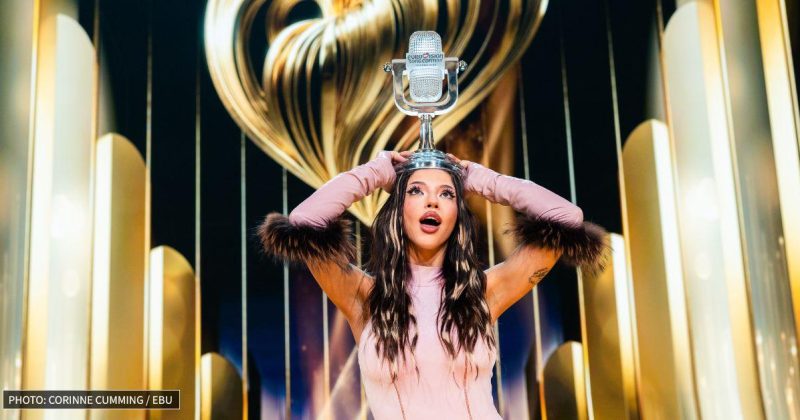
ORF and the EBU have released the Eurovision 2026 running order, placing Linda Lampenius and Pete Parkkonen in a prime late-show spot.
Photo: EBU
The stage is set for the Eurovision 2026 Grand Final, which will take place this Saturday featuring 25 participating nations. Following the conclusion of the semi-finals, 20 qualifiers have joined the host nation, Austria, and the “Big 4” countries – the primary financial contributors who qualify automatically for the final.
Before the official announcement, each delegation drew their position for either the first half (songs 1-13), the second half (songs 14-25), or the “Producer’s Choice.” This latter option grants the production the flexibility to determine the specific placement to ensure a high-quality television show. Since 2013, the exact running order has been proposed by the Eurovision production team and approved by the European Broadcasting Union (EBU). The Austrian national broadcaster (ORF) aims to create a diverse and engaging flow, alternating between different musical genres and tempos while managing the technical requirements for stage props.




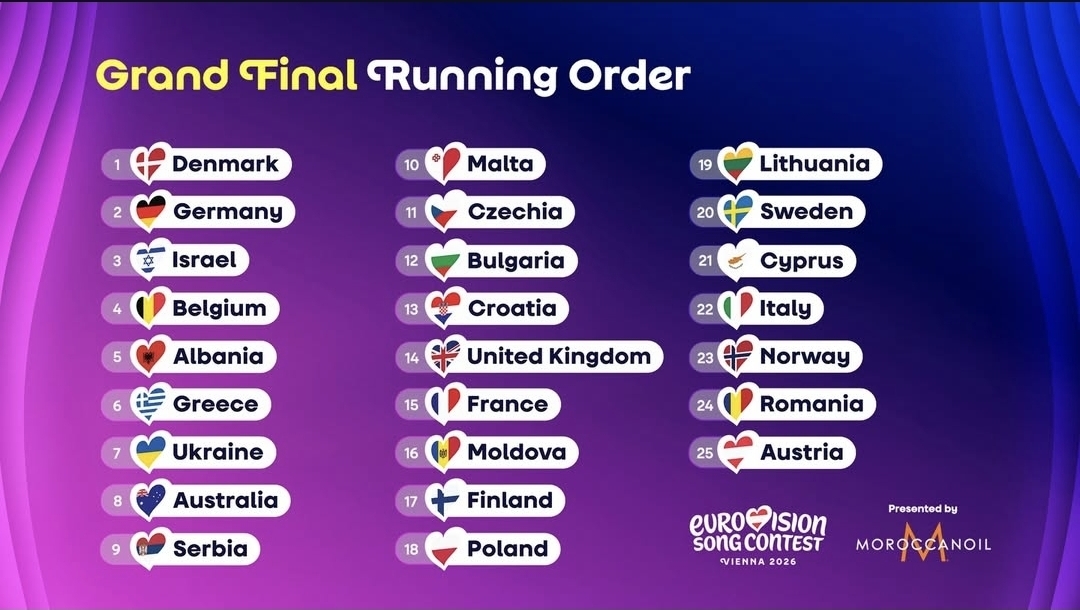
The Official Running Order for the Grand Final:
-
Denmark: Søren Torpegaard Lund – “Før vi går hjem” (in English: “Before we go home”)
-
United Kingdom: Look Mum No Computer – “Eins Zwei Drei” (in English: “One Two Three”)
-
Finland: Linda Lampenius x Pete Parkkonen – “Liekinheitin” (in English: “Flamethrower”)
-
Lithuania: Lion Ceccah – “Sólo quiero más” (in English: “I only want more”)
-
Italy: Sal Da Vinci – “Per Sempre Si” (in English: “Forever Yes”)
Does the Running Order Predict the Winner?
Historically, winners have typically emerged from late-show slots. In the first half (1-13), winners include Conchita Wurst (2014, #11), Måns Zelmerlöw (2015, #10), Salvador Sobral (2017, #11), Duncan Laurence (2019, #12), Kalush Orchestra (2022, #12), and Loreen (2023, #9). From the second half (14-25), winners include Emmelie de Forest (2013, #18), Jamala (2016, #21), Netta Barzilai (2018, #22), Måneskin (2021, #24), and Nemo (2024, #21).
For 2026, the strategic placement of Finland at number 17 suggests the production views Linda Lampenius and Pete Parkkonen as the primary contenders. Not only is the song positioned late in the show, but it is sandwiched between two non-favorites (Moldova and Poland). Furthermore, slot #17 is statistically the most successful position in Eurovision history.
Conversely, Denmark, a major favorite, faces an uphill battle from the opening slot. Australia was placed at #8 – a reasonable position for a first-half win – while Greece faces a difficult path from #6.
The placement of the Israeli entry at #3 follows a recent pattern. In previous years, Yuval Raphael was placed at #4 (2025) and Eden Golan at #6 (2024), suggesting the production may be intentionally positioning the nation in early, less memorable slots amid ongoing procedural and political complexities. However, the #3 slot carries a unique historical parallel: it is the same position assigned to Nadav Guedj when he represented Israel in Vienna in 2015 with “Golden Boy”, eventually finishing in 9th place.
Where and How to Watch the Eurovision Grand Final
The live broadcast can be watched from almost every EBU member, and from the official Eurovision Song Contest channel:
Eurovision 2026: the 70th edition of the contest will take place in Vienna, Austria, on May 12th, 14th, and 16th, 2026. The Wiener Stadthalle arena, which will host the event, is expected to accommodate around 16,000 spectators per show. The contest returns to Austria following the nation’s third historic win with the song “Wasted Love”, performed by JJ. It will be Austria’s third time hosting Eurovision, after previous editions held in the country in 1967 and 2015.