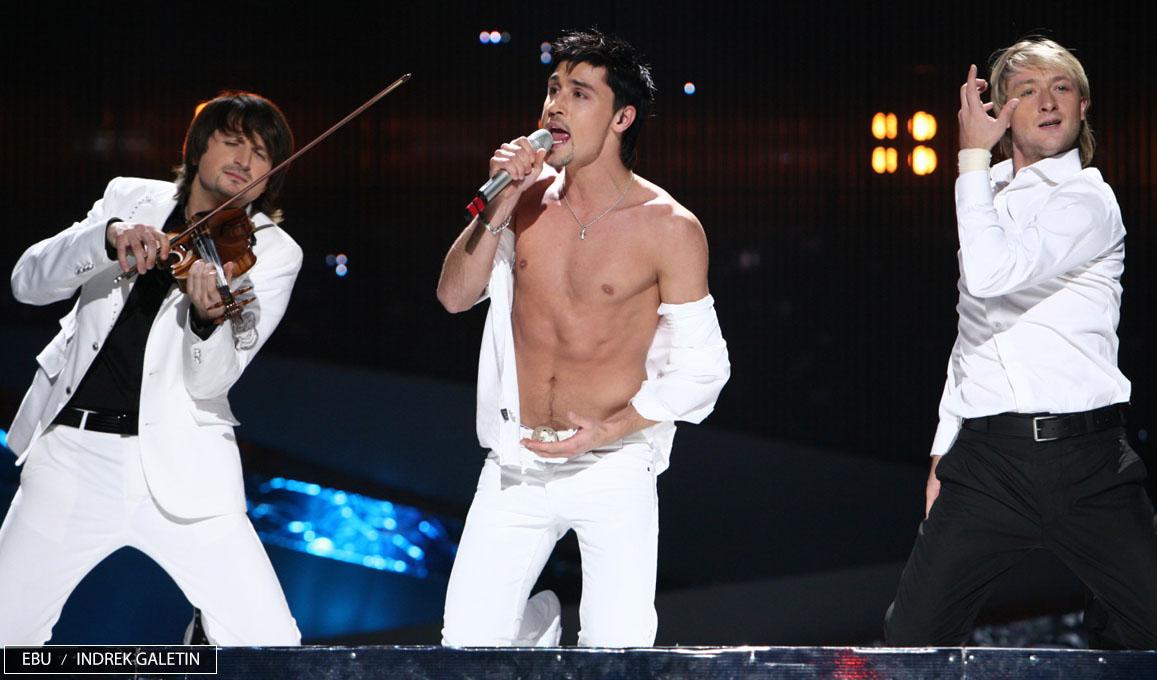
The Eurovision official YouTube channel upgraded thumbnails for all winners with shiny new branding – but skipped Russia’s 2008 victory. Political revenge or a human error?
Sometimes a single small image on YouTube can ignite a full political storm. Over the past day, social media networks and fan groups have been buzzing over what appears to be a quiet yet defiant political move by the EBU against Russia. The arena: the official YouTube channel of the Eurovision Song Contest.
New Branding for All Winners – Except One
This year, to mark 70 years of Eurovision, a decision was made to refresh the contest’s branding. Managers of the official Eurovision YouTube channel embarked on a comprehensive project to update the aesthetics in the video archive. All performance videos of contest winners over the years received a new, designed, and uniform Thumbnail. The festive and shiny branding features a golden background, a large heart containing the flag of the winning country, and the prominent caption “[Country Name] Winner [Year of Victory]”.
Indeed, all major winners received this digital honor: the new branding is visible for our representatives Dana International from 1998 and Netta Barzilai from 2018, for the Norwegian Alexander Rybak, and also for the Serbian Marija Šerifović. It seems everyone underwent a perfect upgrade. Everyone – except one country.
A “Slap in the Face” to Dima Bilan?
The Russian Telegram channel “Евровидение Live” (Eurovision Live) was the first to notice the detail now boiling over networks in Russia: the 2008 Eurovision winner, Dima Bilan, remains the only champion in history whose performance did not receive the new branding. Instead, Bilan’s video, which brought Russia its sole victory in its history, retains the old, simple, and generic design bearing the standard caption “LIVE AT THE 2008 GRAND FINAL”.
Russian fans are not buying the “human error” excuse and are convinced it is a planned and provocative boycott. While Russia is suspended from the contest due to the invasion and war in Ukraine, it seems the EBU is using its digital archive to convey a quiet yet unequivocal message: there is no intention to celebrate the Russian victory in a shiny new wrapper. Adding to this the fact that Bilan is considered an artist close to and supportive of the Putin regime, and you get the perfect recipe for sweet virtual revenge from Europe. Will the EBU cave and fix the image amid network pressure? We will continue to follow.
United By Music? Not for Russia
But beyond the specific drama, this move casts an ironic and deeply problematic light on the conduct of the EBU. After all, just recently the EBU announced that the slogan “United By Music” would become the permanent motto of the contest forever, constantly waving the flag that Eurovision is a “non-political cultural event designed to bring hearts together”.
Here precisely the great hypocrisy is exposed: if the contest is truly non-political, and if music is meant to unite us above all disputes or conflicts – why erase a historic musical victory from 18 years ago due to current politics? After all, in 2008 Russia won according to the contest rules, and the song itself contained no improper message. The fact that the EBU chooses to apply its “unity” values selectively, while editing history in the digital archive, proves once again that behind the scenes, politics always runs the show.
Russia at Eurovision
“Russian Woman” is the name of the song performed by Manizha in the second semi-final of Eurovision 2021. Russia reached ninth place in the Grand Final with 204 points. Russia has competed in the Eurovision Song Contest 24 times since joining the competition in 1994. To date, Russia has won only once, in 2008, with the song “Believe” performed by singer Dima Bilan. Russia has reached second place four times and third place four times. So far, Russia has failed only once to qualify for the competition’s final. In 2022, the European Broadcasting Union (EBU) decided to suspend Russia’s membership until further notice due to its invasion of Ukraine.
Eurovision 2021: This was Russia’s 24th participation in Eurovision. Russia joined the competition in 1994 and won it once, in Eurovision 2008 with the song “Believe” performed by singer Dima Bilan.