Portugal at Eurovision 2026: Bandidos do Cante won “Festival da Canção 2026” and will represent the country at Eurovision 2026 in Vienna, Austria with the song “Rosa”. Listen to the song.
Bandidos do Cante are the winners of “Festival da Canção 2026”. Unlike 13 other contestants in the competition, the band had declared that they would be willing to represent the country and would not boycott Eurovision 2026, which will take place in Vienna, Austria. Bandidos are expected to perform at Eurovision with the song that won them “Festival da Canção” – “Rosa”.
The song was written by the band members Miguel Costa, Luís Aleixo, Francisco Raposo, Francisco Pestana, and Duarte Farias, together with Bluay, Kasha, Gui Alface, and Gonçalo Narciso. The song is performed entirely in Portuguese. Portugal will compete in the first half of the first semi-final on May 12th.
Currently, Portugal is ranked 31st in the betting tables ahead of Eurovision 2026.



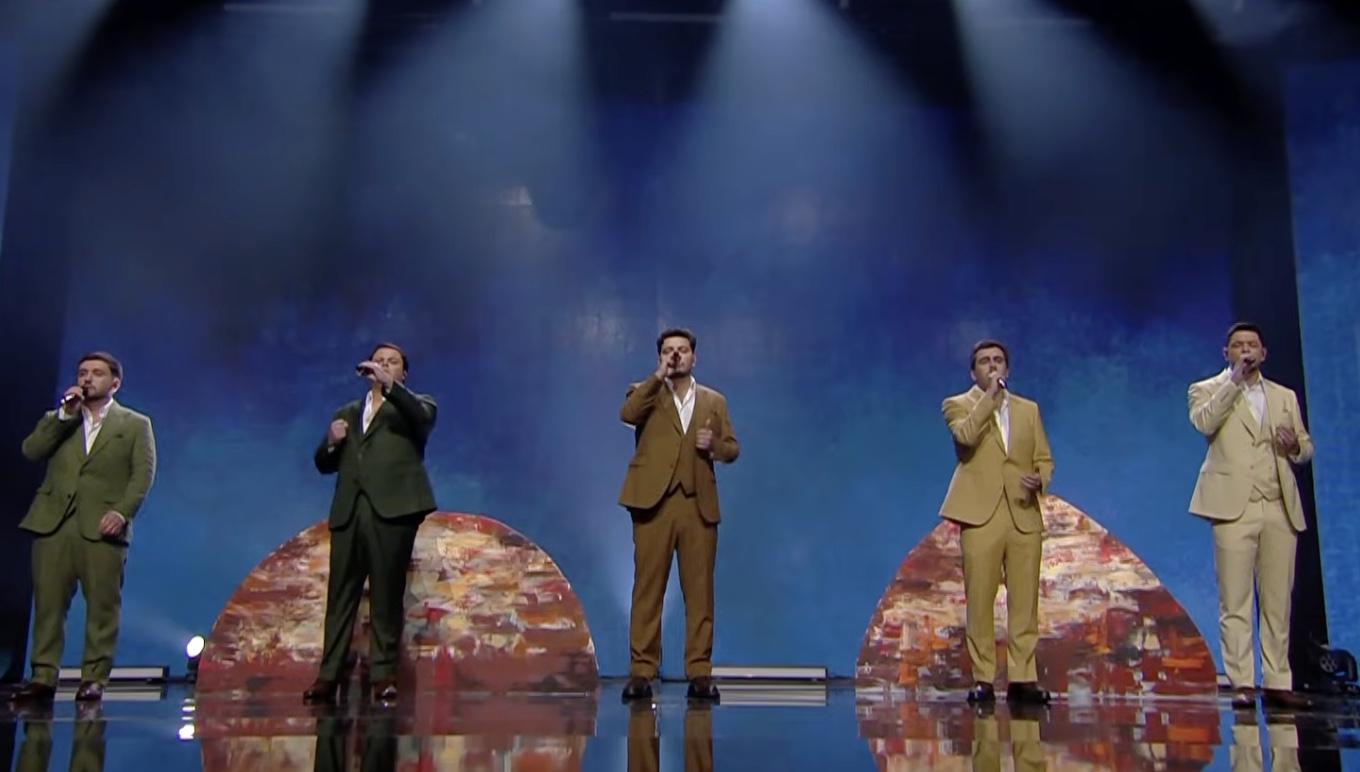
The band’s stage direction is as clean as their singing style. The five band members are dressed in suits in earthy and green tones that symbolize their connection to the land, while behind them on the large screen there appears what looks like oil paints changing their shades from the blue of the sky to the red of fire and to brown and green tones of earth. Towards the end of the song, the colors in the background evoke colorful sunset skies, as a female violinist in a white suit joins the band. At the end of the song, one of the band members extends a rose toward the camera, echoing the song’s title.
The song deals with the memory of a great love that remains engraved in the heart even after it has passed. The band members use delicate images of nature, night, and a rose garden to describe the longing for the beloved and the memories that remain from the relationship they once had. The roses that were planted when the love was genuine and whole become a central symbol of the relationship – beautiful and delicate, but also something that now belongs to the past. Throughout the song, a sense of missed opportunity is suggested, as the garden that was not watered turns into a garden of longing. In the chorus, the beloved is described as “the most beautiful rose” that grew in the south of Portugal – an image that emphasizes the beauty and uniqueness of the love that has remained in memory despite the passing of time.
Bandidos do Cante – Who Are You?
Lyrics – “Rosa”
No silêncio do luar
Sopra o vento devagar
Traz o cheiro das roseiras
E o teu nome a sussurrar
Meu Amor se hoje for
À noitinha ao meu jardim
Por lá encontrarei rosas
Fazem-me lembrar de ti
Não há pressa de onde eu sou
Não há preço p’ra esta calma
Se falhei paguei em dobro
Sobrou pouco ou quase nada
Só as rosas que plantei
Quando a gente era verdade
Sobrou pouco eu não reguei
E o jardim virou saudade
Meu Amor se hoje for
À noitinha ao meu jardim
Por lá encontrarei rosas
Fazem-me lembrar de ti
Fazem-me lembrar de ti
Com saudade do teu beijo
És a rosa mais bonita
Que brotou ao sul do Tejo
Fazem-me lembrar de ti
Com saudade do teu beijo
És a rosa mais bonita
Que brotou ao sul do Tejo
És a rosa maiѕ bonitа
Que brotou no Alentejo
The Boycott in Portugal
As mentioned, Bandidos do Cante along with André Amaro are the only contestants in “Festival da Canção” to take a different stance from the other participants, would boycott the competition if they were to win, as a protest against Israel’s participation. This move is made possible by a new clause added to the festival’s regulations, according to which the winner of “Festival da Canção 2026” is not obligated to represent Portugal at Eurovision – unlike in previous years.
Portugal’s national broadcaster RTP has stated that it voted in favor of the new regulations and supported Israel’s participation during the General Assembly of the EBU, a decision that has led to internal opposition among employees over the decision and “enormous pressure”, as described by the network’s chairman, from various organizations, labor unions, and political actors who demanded that Portugal withdraw from the competition as long as Israel remains a participant.
Artists’ Revolt – Protest Step or Part of a Trend?
 A storm erupted across Europe, triggering a wave of criticism calling for the conference’s resolutions to be reversed. Iceland, Ireland, The Netherlands, Slovenia and Spain chose to withdraw from Eurovision 2026 due to Israel’s participation, and quite a few former Eurovision participants joined the wave as well – Eurovision 2024 winner Nemo announced that he is returning his winner’s trophy to the EBU as a protest against Israel’s participation, and numerous former representatives in the contest were quick to praise him for “the brave decision”. Following Nemo, Eurovision 1994 winner Charlie McGettigan decided to return his winner’s trophy as well and to join the protest In addition, three other past winners sharply criticized the conference’s decisions – and with them many others – and it seems this has almost turned into a kind of “trend”.
The participants in Portugal’s “Festival da Canção” have also joined the protest, and the artists’ declaration raises many questions: Does this step come from a genuine place – or are they also simply part of the trend? Why did the artists choose to revolt precisely now? After all, it has been known that since the beginning of the war between Israel and Gaza two years ago there has been criticism by fans and artists over Israel’s participation in Eurovision.
It appears that the artists’ move does not truly stem from a purely genuine protest. Under the current circumstances, the artists have significant backing, and the revolt no longer appears to be breaking boundaries. The trend has already become part of the routine, and as a result, artists who previously would not have dared now suddenly find the courage to protest.
Eurovision 2026: This will be Portugal’s 57th participation in the Eurovision Song Contest. Portugal joined the competition in 1964 and achieved its best result in Eurovision 2017 when singer Salvador Sobral won first place with the song “Amar pelos dois”.

Email: [email protected]
Phone: +972-50-9441919
Writer and content creator specializing in the Eurovision field. Her writing emphasizes professional analysis and a wide range of opinions.