Eurovision 2026: All contest songs have been revealed, and one country still holds the lead in the betting odds! Which countries are leading? This is the current state of the betting tables.
The list of competing songs in Eurovision 2026 has been completed, and all 35 songs were unveiled yesterday (Wed) for listening! With the release of the songs, the betting table is stabilizing and providing a clearer picture of who has a chance to win the contest and who is expected to miss out on the final. The betting tables now carry significant weight as a tool for predicting the results of the contest, which will be held in May in Vienna, Austria. The betting will close in parallel with the broadcast of the Eurovision Grand Final, which will be held on May 16th. The full betting table is at the bottom of the article!





Who Are the Top 10 Countries Competing for the Win?
Tenth Place: Ukraine – Leléka – “Ridnym”
At the moment, in tenth place with a 2% winning chance is the song “Ridnym” (in English: “Relatives”), which will be performed by the Ukrainian singer Leléka. The song won “Vidbir 2026” held on February 7th and will be performed in English and Ukrainian. Ukraine is known as a highly creative country that delivers distinctive and innovative stagings, which naturally raises curiosity about Leléka and her song ahead of Vienna. Leléka is clearly relying on drama, and our curiosity grows as we wonder how the dramatic music and the many shifts that occur in the video clip will be translated to the live stage.
The Ukrainian entry deals with human resilience, hope, and renewal in the face of a reality marked by destruction and painful change. The lyrics describe a situation in which things fade and disappear, yet emphasize that even when it seems that everything is lost, “the roots still carry water” – an image that reflects a deep connection to the past, to tradition, and to an inner strength that continues to sustain life even in difficult times. The central message is that precisely through confronting fear and transforming pain into joy, it is possible to grow to new heights and to lead the way back home, much like trees that grow taller after a storm. Ukraine finished last year’s contest in ninth place, a result considered relatively low for the country.
Ninth Place: Cyprus – Antigoni – “JALLA”
In ninth place, with a 2% winning chance, is the song “JALLA” (in English: “More”), which will be performed by the British-Cypriot singer Antigoni. The song will be performed in English and Greek. The singer was selected internally on November 6th, 2025 and her song was unveiled on February 8th. It appears that Antigoni is planning a performance in the style of Eleni Foureira in Vienna. Antigoni has stated that she wishes to bring the Cypriot culture she loves to Vienna. The video clip for her song was filmed in various cities and villages across Cyprus, and it features traditional dances and local residents.
Eighth Place: Czechia – Daniel Žižka – “Crossroads”
In eighth place, with a 3% winning chance, is the song “Crossroads”, which will be performed by the Czech singer Daniel Žižka. The song will be performed in English. The singer was internally selected on March 8th and his song was revealed three days later. Daniel Žižka has a strong connection to the world of acting, he has appeared in numerous Czech series and films and draws inspiration for his music from the worlds of musical theatre and the stage. Žižka studied musical theatre at a conservatory, and he is currently studying singing and composition. Czechia has been climbing in popularity on the betting table and rose to eighth place just a few hours before it was revealed that Žižka had been chosen to represent the country, despite two difficult years in which Czechia failed to qualify for the final – so close, but yet so far.
The Czech entry explores an inner journey of searching for identity and direction in a complex and confusing world. The singer describes a sense of being lost and wandering between many different paths, as if caught in “cruel spider webs” where it is hard to find the right way. The appeal to “Mother” may represent a protective figure or a primal source – perhaps a mother, nature, or even home – before whom the narrator expresses feelings of confusion and not belonging. The imagery of a deep sea, fields, and roads hints at a desire to explore, to understand, and to find meaning beyond what appears on the surface. The song weaves together a personal quest with a philosophical reflection on human nature and its constant struggle to find freedom and purpose.
Seventh Place: Israel – Noam Bettan – “Michelle”
Seventh place, with a 5% winning chance, is taken by Israel, “Michelle”, which will be performed by the singer Noam Bettan. The song will be performed in English, Hebrew, and French. The singer won the grand final of the 12th season of “HaKokhav Haba”, on January 20th, and his song was internally selected and released on his birthday, March 5th. Unlike Sweden, Israel keeps all its cards close to its chest and releases them gradually. Every detail is published in turn, with great precision. Very little is known about the performance expected in Vienna, which places – in a slightly different and positive way – all eyes on us. The song was written by the singer together with Tslil Klifi, Nadav Aharoni, and last year’s Israeli representative, Yuval Raphael.
In recent years’ songs (“New Day Will Rise”, “Hurricane”, “Unicorn”), every small detail related to staging, choreography, and dancers’ identities has been kept in a hermetic safe, but the small detail caught by EuroMix is the figure of “Michelle” on stage – which will be portrayed by the dancer Lihi Freud, expected to dance with Bettan on the Vienna stage.
The Israeli entry deals with the choice to break free from a toxic emotional cycle. It tells a story of emotional growth and maturation, a moment when the character realises she must let go and choose her new path on her own. Michelle, who is not aimed at a specific real-life figure, is a character representing impossible love. The conflict between the attraction to the figure and the release from her creates human drama.
Sixth Place: Sweden – Felicia – “My System”
In sixth place, with a 5% winning chance, is the song “My System”, which will be performed by the Swedish singer Felicia. The song won “Melodifestivalen 2026”, held on March 7th and will be performed in English. Sweden is known as a polished and consistent country on stage, which in my view leaves no room for curiosity ahead of Vienna – what we saw on the Melodifestivalen stage in Stockholm is likely what we will see on the Eurovision stage in Vienna, all of Sweden’s cards are already on the table. Sweden continues to play it too safe, and that is probably what allows it to keep taking the top prizes. Will the Swedish machine boast yet another achievement? It seems that Sweden is less in the spotlight this year than in the past.
This year, Sweden appears to be taking risks in a different way, as the singer has repeatedly tried to push the boundaries of the ethical code of conduct established by the EBU. The singer has attacked Israel’s participation twice, and the Israeli national broadcaster KAN has not remained silent in response. However, it appears that the contest’s supervisor, Martin Green, has so far refrained from taking action against Sweden and has issued only a warning regarding her comments.
The Swedish entry portrays an emotional struggle to break free from a relationship in the past. During the week, the singer manages to suppress the memories, but every weekend the emotions and attraction return and overwhelm her. Using metaphors from the world of technology, she describes attempts to “erase” or “encrypt” her feelings. In the end, she realises that this person is still part of her system – and that is why she finds it so hard to truly let go.
Fifth Place: Australia – Delta Goodrem – “Eclipse”
In fifth place, with a 5% winning chance, is the song “Eclipse”, which will be performed by the Australian singer Delta Goodrem. The singer and the song were selected together through an internal decision on March 1st, and the song will be performed in English. Australia is one of the newer entrants to the contest, having joined in 2015 to mark the 60th anniversary celebrations. Precisely in the same venue from which the 70th edition will be broadcast in Vienna, Austria.
The Australian entry presents a powerful, almost cosmic love story, one that feels as if the universe itself is rallying to unite two people. Imagery of shadows in the moonlight, stars in the sky, and planets aligning emphasises a sense of destiny and perfect timing – a love that did not happen by chance but was written in the stars. The connection between the two is described as a rare moment when time stands still, the world disappears, and only the love remains. The repetition in the song underscores the intensity and totality of the eclipse sensation and synergy, a feeling of a new beginning that promises a shared future filled with light and stars.
Fourth Place: Greece – Akylas – “Ferto”
Currently, in fourth place with a 7% winning chance, is the song “Ferto” (in English: “Bring It”), which will be performed by the Greek singer Akylas. The song won “Sing gor Greece 2026”, held on February 15th and will be performed in English and Greek. Since the release of the song “Ferto”, social networks have been flooded with reactions of admiration for the song, and many fans have even compared the artist and the song to Käärijä, Finland’s representative who finished second at Eurovision 2023 with the song “Cha Cha Cha”. This is an obligatory status for Greece, as the “audience favorite” slot with this comparison becomes no small target on his back. Especially when it comes to a singer who has only recently begun to break through and rise.
The Greek entry presents a manifesto of boundless ambition and unrelenting passion to reach the top. The lyrics describe a character driven by an inner fire and hunger for achievement, one who is not willing to settle for a small step forward but demands it all: fame, money, power, and influence. The intense repetition of the call “bring it” sharpens the sense that this is a constant demand for more, as if the world itself is required to submit to the speaker’s aspirations. Akylas enlisted Teo Pouzbouris, known as Freaky Fortune, one of Greece’s representatives at Eurovision 2014, to co-write the song.
Third Place: Denmark – Søren Torpegaard Lund – “Før Vi Går Hjem”
Third place, with a 10% winning chance, is taken by the song “Før Vi Går Hjem” (in English: “Before We Go Home”), which will be performed by the Danish singer Søren Torpegaard Lund. The song won “Dansk Melodi Grand Prix 2026” held on February 14th and will be performed in Danish. Søren is a Danish singer, songwriter, and theatre actor, known for his exceptional vocal abilities and his capacity to deliver lyrics in an emotional and theatrical manner. This combination, along with the Danish language, could create something very special on stage. This is the first time Denmark has sent a song in Danish since Eurovision 2021, when they sent the duo Fyr og Flamme with the song “Øve os på hinanden” (in English: “We’ll Practice on Each Other”).
The Danish entry describes a total and dangerous surrender to a destructive relationship, one that unfolds within the fog and euphoria of nightlife. The narrator portrays an internal struggle between logic urging him to walk away and a body craving touch, using imagery of burning and kidneys. The sense of losing control intensifies through descriptions of sharp and sweet tastes melting on the tongue, turning the attraction into an uncontrollable physical instinct. Similar to the experience of delaying gratification, the narrator is aware that morning will bring regret, yet he consciously chooses to sink into the neon lights and smoke, begging the night never to end – even at the cost of a broken heart once again.
Second Place: France – Monroe – “Regarde!”
In second place, with a 12% winning chance, is the song “Regarde!” (in English: “Look!”), which will be performed by the French singer Monroe. The singer was internally selected on March 6th, and her song was revealed just a few hours later and will be performed in French. It seems that in recent years, France has been one of the most mysterious countries in its selection process, not even revealing how or when its representatives will be chosen, as it can surprise in November, split the announcement between January and March, or simply announce at the last moment.
Monroe is the youngest contestant this year, just 17 years old. She took her first steps in the music world as a child in the local church choir. Her major breakthrough into French consciousness came very recently, when in January 2025 she took first place in season 11 of “Prodiges” – the talent show for classical music on the French television network. The well-known French newspaper “Le Parisien” predicted that the young and promising singer would be selected as the country’s representative for Eurovision 2026, and this is the third time we know the newspaper predicted correctly, after Louane last year and Tom Leeb ahead of Eurovision 2020.
The French song is essentially a message to the listener – a call to pause for a moment and look – at yourself and others, “Regarde” means “Look” in French. Through this gaze, one can understand the power of love, which appears everywhere and provides a sense of connection and meaning. Thus, the song presents love as a force that unites people, beyond borders, cultures, or difficulties. And for us, it remains to be seen how much love the youngest contestant this year will receive, because according to the betting odds – she will be particularly well-liked.
First Place: Finland – Linda Lampenius & Pete Parkkonen – “Liekinheitin”
Currently leading the table with a commanding 28% winning chance is the song “Liekinheitin” (in English: “Flamethrower”), which will be performed by the Finnish duo Linda Lampenius and Pete Parkkonen. The song won “UMK 2026” held on February 28th and will be performed in Finnish.
Pete Parkkonen broke into public consciousness in 2008 when he participated in the fourth season of the Finnish version of the show “Idol”, where he finished third. After the show, he launched a successful solo career, with his debut album, “The First Album”, topping the Finnish albums chart. Linda Lampenius is a virtuoso violinist and cultural icon since the 1990s. She is one of the most versatile musicians in Finland. The duo joined forces for the local pre-selection and became even more viral than Käärijä and Erika Vikman, as they reached one million streams in record time for a Finnish “Uuden Musiikin Kilpailu” song.
The Finnish song describes a destructive and addictive relationship characterised by a constant struggle between logic and an uncontrollable instinct. In the song, the singer presents the dilemma that the right and wise choice would be to leave the place, yet he finds himself captivated by the other side’s charm, which he likens to a flamethrower – a powerful figure that burns him emotionally and physically at the same time. The song emphasises the painful contrast between intimate nights and public alienation, where his love acts as if she doesn’t know him at all, creating a sense of humiliation mixed with intense attraction.
Current Betting Table as of Today:
Despite Finland’s commanding lead, we must temper expectations somewhat, as not every first place in betting sites ultimately claims the trophy. Last year, Sweden led the betting tables with 49% win probability and lost to its runner-up, Austria. Similarly, in Eurovision 2024, Croatia topped the betting tables, reaching a peak of 52% win probability during the Grand Final broadcast, only to lose to Switzerland, which had been in third place.
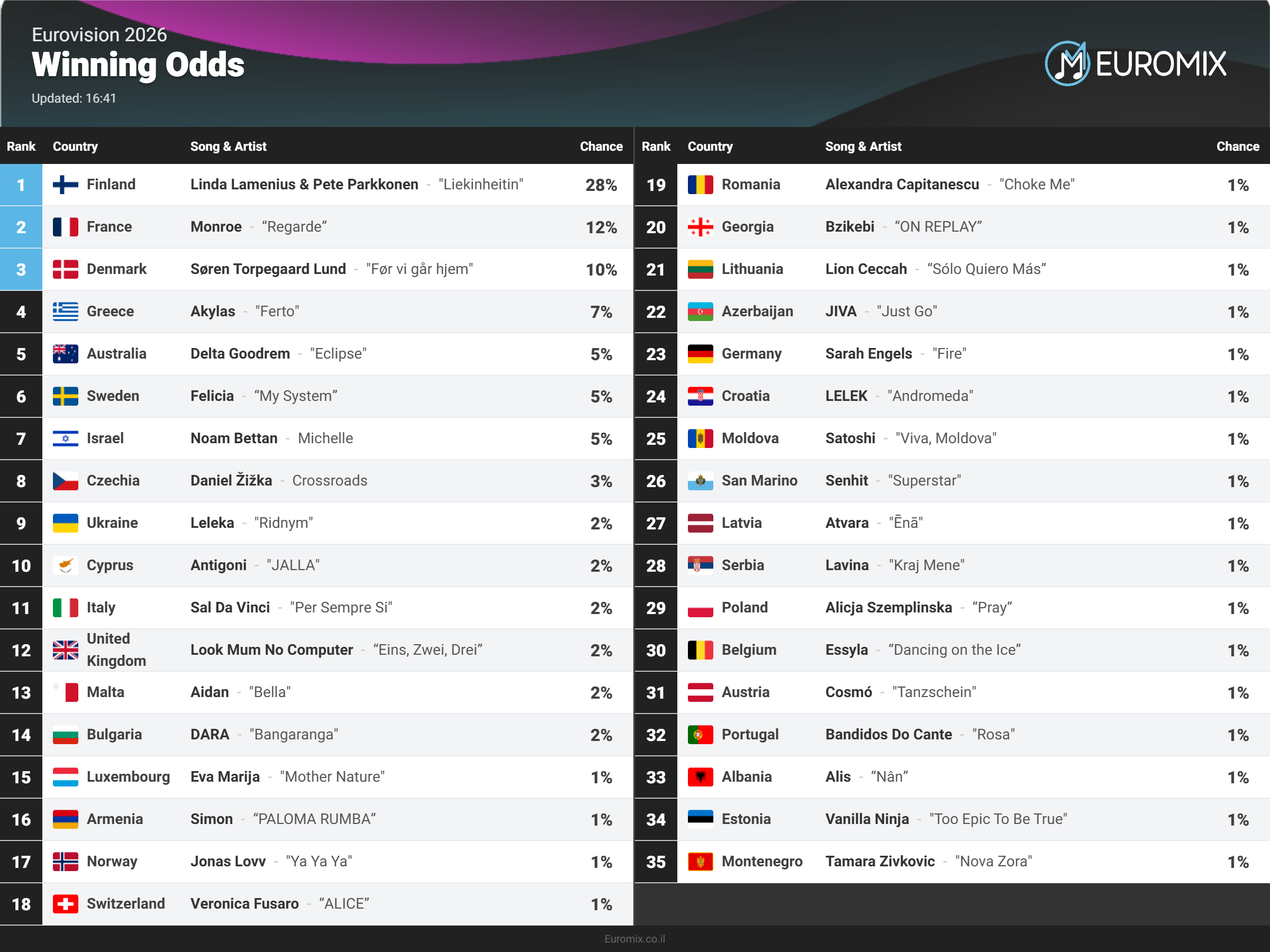
You can find the updated table on the betting page of our website!
The Significance of Early Betting Trends
It is important to emphasize that betting tables are based on public speculation and financial stakes placed by individuals who believe a specific country will win. At this point, the table serves as a map of expectations, much of which is based on historical performance rather than the current year’s musical content. These odds are expected to fluctuate thousands of times before May.
Historically, these trends offer a mixed bag of accuracy.
Last year, Sweden held first place in the betting odds throughout the entire Eurovision season, yet Austria was ultimately declared the winner while Sweden ranked only fourth in the Grand Final. In 2024, Switzerland took the top spot in betting tables at the beginning of April, and ahead of the final Croatia overtook it by a large margin, followed by Israel, but Switzerland claimed the trophy. Ahead of Eurovision 2022, after the war broke out between Ukraine and Russia, Ukraine topped the betting tables and ultimately won the contest.
Last year, the opening odds placed Israel in fourth. Despite various shifts that saw it drop to seventh in the betting closing prices, the entry actually achieved a remarkable second place finish. Because we are in such an early stage, these tables should be viewed with perspective, though they remain an essential tool for tracking momentum heading into the spring.
Eurovision 2026: The 70th Eurovision Song Contest will be held in Austria, following the country’s third historic win with the song “Wasted Love” performed by JJ. This will be the third time the contest is hosted in Austria, after 1967 and 2015.

Email: [email protected]
Phone: +972-50-9441919
Ilay Gaist is a leading Israeli content creator and writer specializing in the Eurovision Song Contest. He is a well-known commentator with extensive expertise in the contest’s history, rules, and dynamics. His passion for Eurovision drives him to deliver rich, professional, and innovative content to his audience.
Ilay holds a bachelor’s degree in Arabic and has a multilingual background. He also engages in cultural research, with a particular focus on global culinary traditions and the evolution of local cuisines around the world.