
After a long season of national selections, internal choices and pre-contests across the continent, the 35 artists and songs competing at Eurovision 2026 in Vienna have been revealed. Listen to all the entries.
All 35 participating entries for Eurovision 2026 set to take place in Vienna, Austria have now been published!
Thirty‑five countries and their acts from across Europe and Australia have been selected over the last five months, officially kicking off the contest season. A long run of internal selections, national finals and intense debates over Israel’s participation – which even led to the withdrawal of Iceland, Ireland, the Netherlands, Slovenia and Spain – has now come to an end. Over the past half‑year, all participating countries gradually unveiled or chose their representatives for the upcoming May contest.
Thirty countries will compete in two semi‑finals, held on May 12th and May 14th, aiming to qualify for the grand final on May 16th. They will join the four biggest financial contributors – Italy, the United Kingdom, Germany and France – who are automatically pre‑qualified for the final, along with the host country, Austria.



Six duos and bands, 13 male soloists and 16 female soloists will take part in this year’s contest, with Finland and the duo Linda Lampenius x Pete Parkkonen currently seen as frontrunners to win according to the betting tables.
Unlike Eurovision 2025, which was packed with classic “fan favourites”, this year’s line‑up is dominated by ballads designed to appeal to the juries, who have returned to voting in the semi‑finals after having been involved only in the grand final.
Three countries are returning to the competition this year: Moldova, back after a one‑year break, Bulgaria, returning after three years away, and Romania, back after two years absence.
On 6 November 2025, Cyprus became the first country to reveal its representative for Eurovision 2026. Armenia was the last to announce its act, on 11 March, completing the 2026 line‑up for Vienna. After 24 national‑final shows, every song is now known; all that remains is to follow the entries, play them on repeat and wait for Eurovision to begin in Austria.
Until then, the next two months are set to be busy, with pre‑party events across Europe, shifts in the betting odds, and further details being revealed about each delegation’s live performance.
The 35 competing songs at Eurovision 2026
Albania – Alis – “Nân”
Australia – Delta Goodrem – “Eclipse”
Austria – Cosmo – “Tanzschein”
Azerbaijan – JIVA – “Just Go”
Belgium – Essyla – “Dancing on the Ice”
Bulgaria – DARA – “Bangaranga”
Croatia – Lelek – “Andromeda”
Cyprus – Antigoni – “JALLA”
Czechia – Daniel Žižka – “CROSSROADS”
Denmark – Søren Torpegaard Lund – “Før vi går hjem”
Finland – Linda Lampenius x Pete Parkkonen – “Liekinheitin”
France – Monroe – “!Regarde”
Georgia – Bzikebi – “On Replay”
Germany – Sarah Engels – “Fire”
Greece – Akylas – “Ferto”
Israel – Noam Bettan – “Michelle”
Italy – Sal Da Vinci – “Per Sempre Si”
Latvia – Atvara – “Ēnā”
Lithuania – Lion Ceccah – “Sólo quiero más”
Luxembourg – Eva Marija – “Mother Nature”
Malta – Aidan – “Bella”
Moldova – Satoshi – “Viva, Moldova”
Montenegro – Tamara Živković – “Nova Zora”
Norway – Jonas Lovv – “Ya Ya Ya”
Poland – Alicja – “Pray”
Portugal – Bandidos do Cante – “Rosa”
Romania – Alexandra Căpitănescu – “Choke Me”
San Marino – Senhit – “Superstar”
Serbia – Lavina – “Kraj Mene”
Sweden – Felicia – “My System”
Switzerland – Veronica Fusaru – “Alice”
Ukraine – Leleka – “Ridnym”
United Kingdom – Look Mum No Computer – “Eins Zwei Drei”
Eurovision 2026 – Dates and times
Eurovision 2026 will take place in May, continuing the long‑standing tradition.
Here are the exact dates:
First semi‑final: Tuesday, 12 May 2026
Second semi‑final: Thursday, 14 May 2026
Grand final: Saturday, 16 May 2026
For those asking “What time does Eurovision 2026 start?”, each live show is scheduled to begin at 21:00 CET, making it accessible to viewers right across the continent.
Eurovision 2026 host city and venue
Eurovision 2026 will be held in Vienna, Austria. This will be the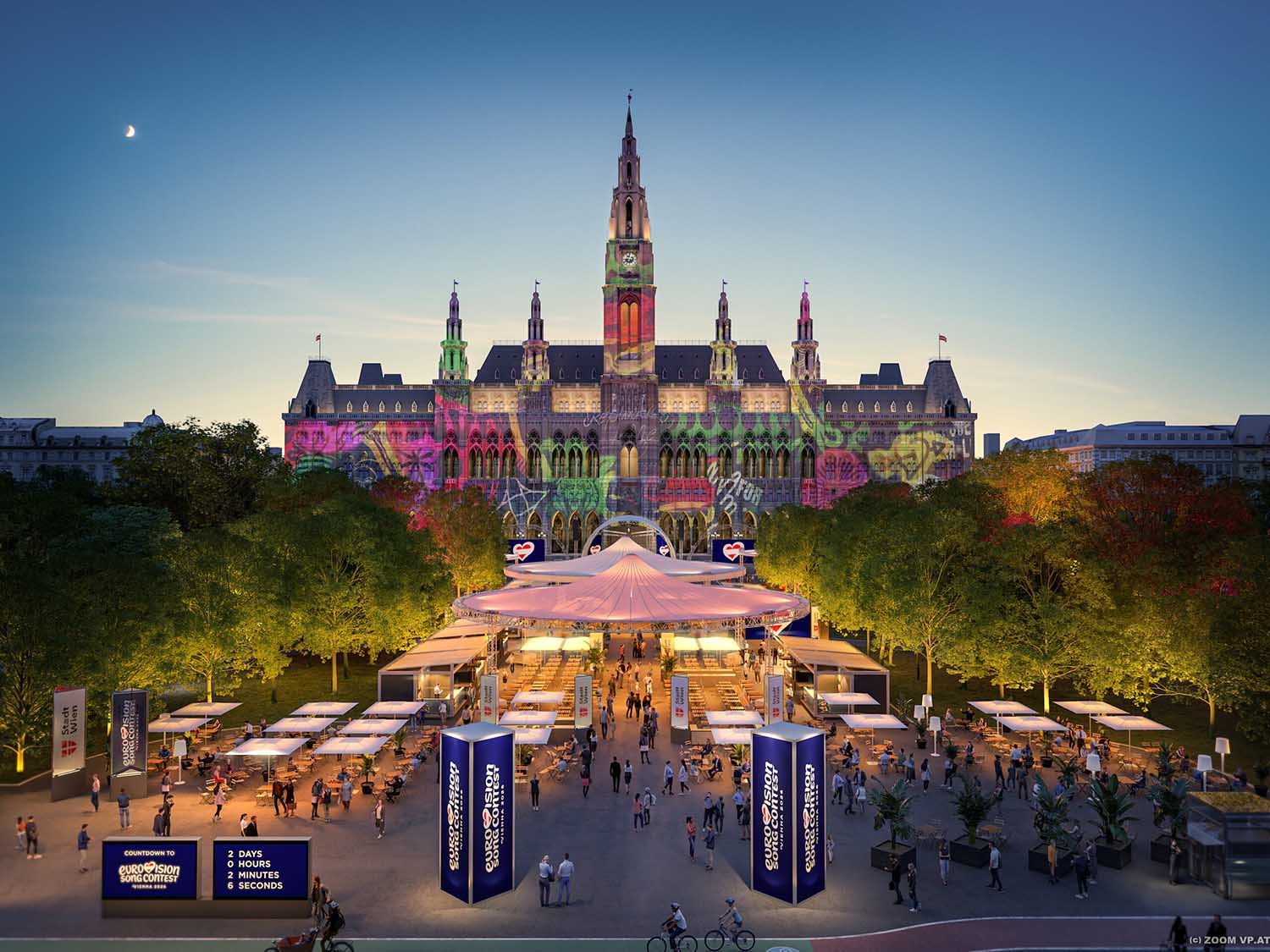 country’s third time hosting the contest, after previous editions in 1967 and 2015, all of them in the capital city.
The event will take place at Wiener Stadthalle, the same arena that hosted Eurovision 2015, with space for around 16,000 spectators at each show. Choosing this arena ensures an impressive experience for fans in the venue and viewers at home, with excellent acoustics and advanced technical facilities.
Preparations for Eurovision 2026
Preparations for Eurovision 2026 are already in full swing. On 12 January 2026, the allocation draw for the semi‑finals took place, determining which semi‑final each country will perform in. The very next day, on 13 January, ticket sales for Eurovision began, giving fans the chance to secure their seats in the arena, with another sales wave expected on 26 March.
Right now, each act is rehearsing in its home country ahead of the big performances on the Eurovision stage in May. At the beginning of May, all delegations will arrive in Vienna and start a structured rehearsal schedule on the contest stage.
Side events and Eurovision parties
In the run‑up to Eurovision 2026, several side events and Eurovision parties are planned across Europe. At these pre‑parties, competing artists perform their entries live, promoting their songs, meeting fans and giving interviews to media outlets from all over the continent. These events include:
Melfest WKND in Stockholm, 6–7 March
Eurovision Party SKG in Thessaloniki, 11 March
Nordic Music Celebration, 21 March
Eurovision in Concert 2026 in Amsterdam, 11 April
London Eurovision Party, 19 April
The history of Eurovision
The Eurovision Song Contest began in 1956 as an attempt to bring Europe closer together after the Second World War through music. Over the decades, it has grown into one of the biggest and most watched music events in the world.
Over the years, Eurovision has launched or boosted the international careers of several major artists, including ABBA, Céline Dion and Julio Iglesias. Initially, the results were determined solely by juries, but as technology evolved, so did the contest.
Today, viewers can vote via apps and text messages, and the contest is broadcast live worldwide and on multiple digital platforms. Advances in technology have also enabled more spectacular staging, with sophisticated visual effects enhancing the experience for audiences everywhere.
The impact of Eurovision
Eurovision has had a significant influence on popular culture in Europe and beyond. Many competing songs have gone on to become international hits, and the contest itself has become an integral part of the cultural calendar in many countries.
Eurovision has also played an important role in promoting LGBTQ+ visibility and celebrating cultural diversity. Hosting the contest can be a major economic opportunity for the host city and country: the event attracts thousands of visitors, creates temporary jobs and offers global exposure.
At the same time, staging Eurovision involves substantial costs, which can sometimes spark public debate about whether hosting the contest is financially worthwhile.
Conclusion
Whether you are asking when Eurovision is taking place, how the shows are scheduled or where the contest will be held, the answer is clear: Eurovision 2026 will take place on May 12, 14 and 16 in Vienna, Austria. The Eurovision Song Contest promises to be an exciting and unforgettable event, uniting millions of viewers from across Europe and beyond.
With its rich history, wide cultural impact and unique power to bring people together, Eurovision is far more than just a music competition. It reflects a European spirit of unity in diversity and offers a stage for musical talent from all over the continent to perform in front of an international audience.
As Eurovision 2026 approaches, anticipation continues to grow. With participating countries finalising their preparations, a packed calendar of side events and the big question of who will lift the trophy this year, Eurovision remains one of the most thrilling and entertaining music events in the world.
Frequently asked questions
Q: When does Eurovision 2026 start?
A: Eurovision 2026 starts on May 12th with the first semi‑final. The second semi‑final takes place on May 14th, and the grand final is held on May 16th.
Q: What time does Eurovision start?
A: Each of the Eurovision live shows, both semi‑finals and the final, is scheduled to begin at 21:00 CET.
Q: Where will Eurovision 2026 take place?
A: Eurovision 2026 will be held in Vienna, Austria, at Wiener Stadthalle (Wiener Stadthalle).
Q: How many spectators can attend each show?
A: The arena is expected to hold around 16,000 spectators for every live show.
Eurovision 2026: the 70th edition of the contest will take place in Vienna, Austria, on May 12th, 14th, and 16th, 2026. The Wiener Stadthalle arena, which will host the event, is expected to accommodate around 16,000 spectators per show. The contest returns to Austria following the nation’s third historic win with the song “Wasted Love”, performed by JJ. It will be Austria’s third time hosting Eurovision, after previous editions held in the country in 1967 and 2015.